A Friend in my Retreat
Family Life in Bromley St. Leonard Between the Wars
Originally published in the "East London Record", no.1 (1978)
I AM WRITING these notes sitting on a
log on the edge of the Forest and within view of a
corrugated-iron shed being demolished - probably the last
of the several Retreats which once existed within the
purviews of Epping Forest during the inter-war years.
Since I first rediscovered this 'tin-hut', known as
Rigg's Retreat, it has always acted as a catalyst for
memories of my schoolboy days way back in the Twenties.
We would arrive in the area of Epping Forest by a bus
hired for the day, although sometimes we travelled by
train, and then we would be let loose in the forest. Fun
and games would pass away the time until we were
assembled to enter one of these Retreats for
refreshments. Therein we would gorge ourselves with
lashings of bread and marge and jam, washed down with
mugs of tea, and, whether we felt blown out or not, we
grabbed our just share of buns and apples to scoff on our
joumey home.
Just prior to leaving the forest we would
all go absolutely mad in order to collect a bunch of wild
flowers as quickly as possible to take home to the mums
who would be waiting on our return back in
Bromley-by-Bow. The bunch of flowers for mum was the done
thing although by the time she had received them they had
undergone a great change from their pristine condition
when picked! During the whole of the return journey the
bunch of flowers would be gripped tightly in one hand -
the other being free for fighting or pinching someone's
apple or sweets. If we had a real rough house the flowers
would go scattering all around the upper deck of the bus
where they would remain until we had all exhausted our
energy and settled down to collect them and redistribute
them among the gang just in time to clamber down from the
upper deck of the bus to present them to mum accompanied
by kisses all round and choirboy innocence regained.
'Sorry they're in a bit of a state mum'...'That's alright
sonny-boy, it's the thought that counts'.
Mum was the patriarchal figure in those days. She was
responsible for the children in every respect. Father
would only emphasise and support her discipline when
necessary. His task was to work and support the family
and make decisions upon family matters whenever he felt
it necessary, otherwise he would like nothing better than
to be left in peace after a hard day at the workshop to
enjoy a glass of tipple and settle down in his easy
chair. The children were primarily mum's responsibility
from birth until they handed over their first wage
packet. It was not the custom for married women to work
in those days unless they were widows and obviously had
to take on a job to support their children; and for many
an unfortunate widow it was indeed a struggle to maintain
their families upon the somewhat meagre weekly pittance
received from the Relieving Officer.
Fifty years later with affluence visible everywhere,
despite inflation, it is difficult for people to
understand, or, might I add, want to understand, the
problems of family maintenance overcome by the mums of
the Twenties and Thirties. When you realise that in the
'well-off working-class families dad brought home a
weekly wage of but £2/10/- to £3/-/- and that
the labourer, many of whom were employed on a temporary
basis, would be lucky to receive £1/10/- for his
week's graft, most families were barely existing and for
many life was hard going. Of course you will comment that
everything was cheaper in those days - a suite of
furniture but a few pounds, rents varying from 7/6 to
12/- per week, etc. That may be so but don't run away
with the idea that life was a 'bed of roses'. Every
single family had to watch expenditure very carefully
whether the family earner was a labourer, artisan, ganger
or foreman. The ekeing out of the family income was mum's
responsibility and she struggled through her weekly task
often to her own detriment, in many cases by starving her
self to feed the youngsters.
How did she cope with her job of family provisioner?
How did she learn the 'know-how' remembering that the
majority had only acquired a sparse education as young
girls from a Board School for which they paid 1d
a week, often attending infrequently. As they grew older
and married they acquired knowledge of learning to live
simply by gossiping to others, especially their elders,
and learning from their experience and ideas, for example
upon such a practical matter as making money 'go as far
as possible' especially with regard to food which I shall
mention in more detail later on. But first let me
emphasise the real need for additional income to enlarge
the family budget. The day when young Alice, Edie, or
Bill would be leaving school at fourteen to start out at
work and contribute to the family unit was eagerly
awaited. This great financial need by all families I can
now more fully appreciate than when but 12 years old. I
can now understand why many of my young contemporaries
who were intellectually brilliant for their age were
deprived of attendance at grammar school or technical
school beyond the age of 14 years, because of the dire
need for family incomes to be supplemented.
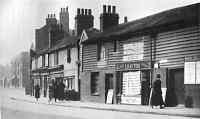 I was extremely fortunate with my family
circle. I was born 25 April 1915 into a family of an
elder brother and two sisters ... but fifteen years
later. We resided in Priory Street, situated within the
parish of Bromley St. Leonard. My mother used to quip
that I was an afterthought. Whatever she intended to mean
by such a remark I have never quite worked out. However,
when the opportunity arose for me to attend the School of
Engineering and Navigation, situated in Poplar High
Street, my mum was most enthusiastic but my father was
dubious as to whether he should agree to my being at
school for a few years longer than the norm.
I was extremely fortunate with my family
circle. I was born 25 April 1915 into a family of an
elder brother and two sisters ... but fifteen years
later. We resided in Priory Street, situated within the
parish of Bromley St. Leonard. My mother used to quip
that I was an afterthought. Whatever she intended to mean
by such a remark I have never quite worked out. However,
when the opportunity arose for me to attend the School of
Engineering and Navigation, situated in Poplar High
Street, my mum was most enthusiastic but my father was
dubious as to whether he should agree to my being at
school for a few years longer than the norm.
A chance remark by dad to his works manager about the
proposal tipped the scales in my favour and a new phase
in my life began. My sisters and brother, all being
married by now, our family became a one-child family and,
with three mouths to feed, mum's problem of maintenance
was made much easier, but the money still had to be
stretched even though supplemented by a small L.C.C. [i.e.
London County Council] education grant. My dad,
bless him, a dour Liverpudlian, was still concemed about
the expenditure on school uniform, drawing instruments
and books I needed. 'Is all this really necessary?' he
asked. Once again a word with his works manager changed
his attitude towards my obtaining the necessary equipment
I required.
I've digressed slightly to comment upon my family unit
in order to stress that while we were better off than
many, remembering that my dad was in permanent employment
whereas many wage eamers were constantly in and out of
work, there were still occasions when it became a
struggle to make ends meet; I became very conscious of
that fact that I should be contributing to the family
income and mentioned the fact to my mother. Her reply was
most emphatic - I was to keep going and not even consider
the idea of doing an odd job on Saturdays. She obviously
mentioned her feelings to dad and stressed them very
strongly as when he and I next went to watch West Ham
play at Upton Park he mentioned the need for me to stick
at school as he would manage somehow.
Now to mum's ability as a
housekeeper. Her system was not unique. Her technique of
shopping and making the food go down the week was similar
in most families. I would accompany her shopping on
Saturday evenings along the Roman Road market - we
would walk the distance to the market and think nothing
of it. In those days the shops and the stalls were
operating until nigh on midnight. The brightly lit shops
and the well-lit stalls with their sizzling paraffin or
carbide lamps coupled with the back-chat salesmanship of
the stall-owners and the crowds of shoppers milling every
where - the whole scene was characteristic of a carnival
atmosphere.
To the young mind it was an adventure to worm one's
way in and out of the crowded scene. As soon as we
arrived at Roman Road I would go into the pudding and pie
shop and buy a slice of plum pudding to munch whilst mum
would say that she would not be a minute as she had to
see someone. This used to puzzle me at first until my
inquisitiveness got the better of me on one occasion and
I followed her to discover that she popped into a near by
pub for a glass and was sitting talking to other shoppers
likewise engaged. When after a few minutes she came out
and discovered that I was waiting outside instead of
outside the plum-duff shop she nearly had a fit. 'Don't
you dare mention this to dad, if you do I'll kill you'
she said, and thereupon bought me another slice of
plum-duff - no doubt to seal my lips. I kept my word but
often laughed to myself about the incident that evening.
We would then progress to her favourite butcher's
shop. She would buy a joint of meat of a size suitable to
last us down the week. Of course, we had the additions
according to season: cabbage, cauliflower, carrots, peas,
beans and potatoes. Nevertheless meat was the staple diet
and the joint was the item of greatest expenditure.
Mother would rise early on a Sunday morning to prepare
the food for dinner - which in East London was the main
meal of the day, served during the week at about 12.30 to
1 p.m. and on Sundays anytime between 2 p.m. and 3 p.m.
sometimes a little earlier depending on family
arrangements. Dad would rise a little later on Sunday,
wash, then attire himself in his Sunday- best (a navy
blue serge suit and bowler hat). Watch and chain
displayed across waistcoat, he would sally forth to meet
his workmates either at a pub in the Roman Road or in
Mile End near the fairground (behind the present Mile End
Station). They must have drunk little and talked a lot as
never once did he come home drunk. At Xmas he would bring
home small presents from the various licensees, such as a
tobacco tin or pouch or an ash tray, all suitably
engraved. This was a custom in those days. Such was dad's
weekly habit. He would never go out throughout the whole
week except for this jaunt on a Sunday morning. He would
always have an half-pint with his midday meal throughout
the working week - mum used to pop round the corner to
the Priory Tavern with the jug - during the winter months
she would warm it by placing a red-hot poker in it. Dad
would never drink in the evening but reserved that period
to enjoy smoking a cigar which he would buy every other
day and cut in half. He detested cigarettes - called them
paper-pipes. His liking for cigars seemingly stemmed from
the fact that my grandmother in Liverpool used to
hand-roll them for sale. When a member of the family
arrived back from America and brought him a present of a
box of cigars he was most moved and made them last for
ages.
With the preparation of Sunday dinner complete we
would be obliged to await the return of dad before it was
served - never a moment before. He was always on time ..
2 p.m. How regular were the habits of families in those
days! Dinner served - we would settle down to stuff
ourselves with meat, potatoes, carrots and greens; to be
followed by what was then called 'afters' which would be
either rhubarb/apple and custard or the occasional
treacle or syrup pudding. Absolutely blown out we would
rest awhile and then dad would retire to have a laydown,
not before checking that I would be going off to
Sunday-school. My absence during the afternoon would give
mum an opportunity for a quiet rest - leaving the washing
up until I returned to help, although if I was ever late
she would do it herself not forgetting to emphatically
remind me of the fact when I did arrive home.
Sunday afternoon was the customary time for the
'shrimp and winkle' man to call around the streets,
either with a pony and cart, or hand-barrow, or in some
cases carrying a large wicker basket, to display his
shell-fish. Our Sunday tea more often than not comprised
shrimps or winkles, sometimes cockles if mum felt like
spending time thoroughly washing the grit away. Such
shell fish was quite fresh and would have come from the
suppliers at Leigh-on-Sea. After tea and the washing up
complete I would go off to evening service at Kingsley
Hall, sometimes accompanied by mum; dad would settle down
in his favourite chair and oscillate between dozing and
looking at the News of the World. Sometimes he
would go out for a walk and a drink but never to church.
As a child he had attended church in Liverpool but
drifted away as he grew older. Like many of his own age
group he was confused by the church's blessing of guns in
the First World War and whilst not in any way holding
pacifist convictions he could not relate the church's
glorification of war to the gospel message he had been
taught. Within our little community in Bromley, church
attendance was greater within the non-conformist
churches; even so men were in a minority within such
congregations.
My mother used to attend the Bruce
Road Congregational Church and it was there that she met
Muriel and Doris Lester who occasionally visited the
mid-week Women's Meeting to present a musical
programme, Doris singing and Muriel accompanying on the
piano. Ultimately they arranged and led the weekly
meeting. This was one of the contacts with Bow and
Bromley made by the Lesters which eventually led to the
establishment of the Kingsley Hall Social Settlement, in
memory of their brother Kingsley who died at the early
age of 26 years during 1914. The sisters and their
brother moved to live in No.60 Bruce Road during 1912 and
subsequently, in 1914 the adjoining property No.58 was
acquired and adult social activities arranged. Later, in
1915, they acquired an old Baptists 'Zion' Chapel
situated in Botolph Road which was adapted as the first
Kingsley Hall and opened in February. Ultimately further
sites were acquired for the building of the Children's
House in Eagling Road (1923) and the new Kingsley Hall in
Powis Road (1928).
My mother was one of a small bunch of local people who
participated in the early days - in fact I was the first
baby born to the membership after the first Kingsley Hall
was opened and my christian name was taken from Kingsley
Lester whom my mother knew and admired very much and not
from the 'Hall' which many locals thought. Kingsley Hall
was to continue for fifty years clothed in 'bricks and
mortar', but continued thereafter, not only in the hearts
and minds of its members, but put into practice by their
actions and service to their fellows in many varying
ways. The story of Kingsley Hall would take a book or two
to record and is not for this account but it has to be
mentioned because it played such a large part in my
mother's life and in my own upbringing virtually from the
cradle and therefore continuously in one way or another.
The 'Lesters' breathed fresh air into the somewhat
drab surroundings of my neighbourhood and their advanced
social ideas at the time surprised the local churches and
occasionally the local authorities too. Kingsley Lester
was to become a Baptist minister had not the illness
which led to his early death, prevented such aspirations.
Muriel and Doris resolved to set up the settlement to
implement and improve upon some of his ideas for
community service as a practical form of memorial. It was
initially financed by their father, H.E. Lester, a
shipwright whose business operated within the Royal
Albert Docks. He had started work at the early age of 12
years, being apprenticed to George Russell at the
Shipyard in Millwall. He worked as a young draughtsman on
the plans of Brunel's 'Great Eastern' which was laid down
at this yard. I can see him now, in my mind's eye ... a
pleasant and kindly patriarchal figure with his long
flowing white beard. I spent many a happy time at his
Loughton home 'The Grange'. He died at the age of 91
years in 1927.
Of course, life is such, that at the age of 12 years I
was not to know that almost five decades later I was to
become an enthusiastic industrial archaeologist. He would
have told me much. Alas, few written records remain of
his business activities except that I have gleaned from
an early copy of the Stratford Express that he
designed one of the earliest electrically driven yachts.
According to Muriel, he was much associated with the
design and/or the construction of the cylinder which
encased 'Cleopatra's Needie' when it was towed from Egypt
to the Embankment in London; but, so far, I have not
discovered any written record relating to his connection
with this matter.
At Kingsley Hall I received an informal 'cultural
education' second to none. My somewhat natural interest
in both music and art was really activated and extended
by the patient attention given me by various members of
staff who were professional in these fields and gave a
year or two to assisting the Settlement in various 'arts
and craft' subjects. Apart from the arts my mind was
stretched to think in a disciplined manner from an early
age by the graded Sunday-school programmes initiated by
Doris Lester who was a pioneer in this field, and I, with
my mates, took part in many a demonstration school held
on Saturdays at the Children's House in the presence of a
large crowd of visiting teachers.
In later years came the very popular Workers
Educational Association classes. There was also the small
group led by the Marquis of Tavistock relating to his
interpretation of the New Testament. 'Tavvy' as we used
to call him would arrive via Bow Road station and walk to
Kingsley Hall - tweed suit and cap - for his class and
serious discussion. Another of Kingsley Hall's dearest
friends was Sybil Thorndike, a close friend of the
Lesters and a prominent supporter throughout the years.
Her recitations from St. Joan and poems also I can
vividly recall ... she held us all spellbound! Praise God
for the Lesters' service to the neighbourhood - a cry
that will find an echo in the hearts of many generations
of members and friends now scattered throughout the
world.
I appear to be straying from my brief. Not really. A
typical week in the life of the family cannot help but
lead me into sidelight comments relating to associated
places and people.
Monday was, as now, a dull day - back to school for me
and the return to work for dad. Mum's task was to face
the week until Friday pay-day and make the cash spin out.
First she would get down to the task of picking up the
'coconut-mats' in the passage and bash the dust out of
them - carpets would be hung over the clothes-line in the
yard and similarly bashed. The area around the front door
would be scrubbed and the step whitened with
hearth-stone. The big iron-basin set in a brick-surround
in the scullery (known as the 'copper') would be filled
with water and heated by lighting the fire set
underneath. By the time she had completed cleaning the
mats and the doorstep the water in the copper would be
boiling hot and ready to receive the family wash. There
was no soap powder in those days - slabs of washing soap
were used on the old scrubbing-board once the clothes had
been given a good soak in hot water. Plenty of
elbow-grease was used up in the process which induced
much perspiration on the brow of the washer, what with
the physical effort involved and the steam rising from
the hot water in the copper. Many a mother although
poorly in health, still carried out this weekly washing
routine because she felt that it was incumbent on her to
maintain clean underclothes for the family. It is not
surprising that the health of many a mother suffered as a
consequence, especially those who took in washing to earn
just a few extra pennies a week - rheumatism and
arthritis took its toll and expressed itself later in
life in swollen fingers and knuckle-joints.
Our main meal on Mondays was slices of cold meat from
the Sunday joint together with bubble-and-squeak and
pickles. The remaining meat was minced and put into a pie
for Tuesday's meal. The resultant bone with a little meat
attached was put into the stock-pot, sometimes with the
addition of scrag, with vegetables such as carrots,
turnips, etc. thrown in. This would be kept simmering
until Wednesday and became with the addition of 'Bisto'
and potatoes, our main meal. To manage four days from the
one joint necessitated the ability to get the size right
in the first place. Another provision from this weekly
joint would be a substantial amount of 'dripping' [1] which went down well on toasted
bread and a dash of salt - I could work my way through a
loaf in no time. You do not seem to be able to obtain
such good dripping in these days, otherwise I would
suggest you try it with a slice of toast and salt. In the
time I am referring to we had to slice the bread from a
cottage loaf and toast the slices on a toasting-fork,
made of heavy-gauged wire with three prongs; and even
though the fork was nearly two feet long the back of your
hand holding it to the fire got really hot and you were
glad of the break to eat the slice. On Thursdays the main
meal would be liver and bacon, or boiled pig's-trotter,
or tripe boiled in milk. Fridays we had fish. Saturday
was a snack-day in our family circle. Dad would be
working up to 1 p.m. and would either come with me to the
Hammers [2] when they had a home
game or go shop-window gazing either at Stratford or to
Chrisp Street market - thinking little of walldng to
these places.
It is strange for me to recall now that the only break
my father had from work was Saturday afternoon and Sunday
- sometimes not that if overtime working was necessary.
Even a summer break of one week's unpaid holiday had not
reached his firm let alone a paid week's holiday. Yet he
appeared content with his lot - probably because it was a
routine he grew into and had adapted himself to it.
Yet social reforms embodied in proposals were
developing and spreading throughout the neighbourhood by
public meetings organised by the local Labour Party
where, more often than not, the main speaker would be
George Lansbury, and the one-time Liberal stronghold of
Bow and Bromley was capitulating to the newcomer's ideas
of social reform. It was unusual for dad to give up his
evening armchair period but he certainly did in order to
attend these meetings and listen to the speakers,
especially George Lansbury.
I remember most vividly the serious and responsible
manner in which he approached the recording of his vote
at elections. After arriving home from his day's work he
would have his tea, then have another wash and change
into his Sunday-best, then walk from home to the Old
Palace School Polling Station, a short distance of but
100 yards, record his vote, come straight home again, and
as he would never sit around the house in his best suit,
change back into other clothes and settle back in his
easy chair. It always seemed quite a performance just to
record an X in a matter of minutes. He was not alone in
the desire to appear clean and tidy within public
buildings. An old saying in the East End related to soap
and water costing little and even if poor and shoddily
clothed it was still possible to make an effort to
present an appearance of cleanliness and tidiness.
My dad and his contemporaries had grasped a vision of
a new life ahead, probably not for them, but certainly
for their children and they put their combined weight in
support of the then new party. The results of those early
beginnings were never fully realised in his lifetime but
certainly I and others of my generation have lived to see
social improvements undreamed of when I was a child. Paid
holidays of at least a fortnight enabling trips to Spain
for the whole family contrasts greatly to my dad's firm's
annual outing day when they travelled by horse-brake, and
later by charabanc, to such far away places as Theydon
Bois or Epping. In later years they ventured further to
Southend or Margate!! Just one day's break in a year. It
makes me shudder!!
Back again to mum. Among her duties to the family she
acted as 'doctor' for slight ailments, unless your
condition deteriorated then the local doctor was called
in. You have to remember that a visit to the doctor cost
money and became a further drain on the weekly
expenditure. Indications of a slight cold would mean bed
for me - juice of lemon in hot water and a day or two
remaining there consuming soups or bread and milk.
Usually after a couple of days you were able to get up
and about again. If, however, you remained hot and clammy
after a night's sleep she would call in the doctor to
have a look at you in order to be on the safe side. The
regular functioning of the bowels would be assisted by
various concoctions obtainable from the chemist. For my
part I especially remember senna pods and Scotts
emulsion. The latter I could smell when the spoon was a
yard away and my poor old stomach would roll over and
over. Cod-liver oil was another favourite of the mums,
not forgetting sticks of liquorice. In their gossipings
they would swap the success or failure of such
administrations to their offspring. Another 'cure'
administered by them was to take a child recovering from
whooping-cough on a bus ride to the Green Man; the fresh
air treatment seated on the open upper deck was
considered to be beneficial. An alternative to this was
to take the child to the local gasworks to get a whiff of
the tarpots. A great spring-tonic was a mixture of
brimstone and treacle! A few more for you to reflect upon
... the wearing of camphor-blocks to prevent colds and a
concoction of saffron to bring out a rash!!
For far too many families the problem of money was a
major one. Many were helped through the period from
Monday until payday on Friday by the technique of
intelligent use of the services offered by the tally-man
and the pawnbroker. The services of the tally-man, now
referred to as a credit draper, enabled people to
purchase various domestic items and clothes on the
'never-never' (hire purchase). Repayment plus interest
were payable weekly to the collector when he called. Such
items would be obtainable from the tally-man on a
Saturday with the benefit of Friday's weekly wage. The
clothes obtained for the children would be worn on the
Sunday and much admired by friends and relations.
Then on Monday morning all the various items which had
been obtained on tick would be transported along to the
pawnbroker's to be 'popped' in and a sub obtained on,
them. Such a small amount, usually, would help them down
the week until payday, when the money would help them to
meet the weekly commitment to the tally-man and on the
Saturday to retum the loan plus interest to the
pawnbroker, so as to receive the goods back in time for
the children to be dressed once again in their Sunday
best! Of course, these poor souls were never out of debt.
By the time the clothes were suffering from wear they did
not fetch as much from the pawnbroker - but if by that
time they had maintained regular weekly payments to the
tally-man they were eligible to obtain further goods from
him. Such a circle was constantly revolving, and many a
mother was 'up to her eyes in debt' .. a common saying at
that time ... but, somehow, come what may, such mothers
managed to survive.
It is of interest perhaps to comment that recently I
wished to illustrate a pawnbroker's shopfront in Tower
Hamlets and could, with the assistance of friends,
discover only one left displaying the sign of the three
'golden-balls'. This shop is situated in the Bethnal
Green Road.[3] Yet in 1926 the
number of pawnbrokers recorded as operating within the
area of what is now Tower Hamlets was 12 in Bethnal
Green, 25 in Poplar and 21 in Stepney; a grand total of
58. Such figures speak out loud and clear as to the
progress made with regard to the living and working
conditions of East Londeners.
So far in this article the mums of the twenties have
been depicted in many roles; even so, many additional
home activities they performed come to mind. I have just
enough space to mention one - that of rug making. This
activity was carried out by many mums and, once again
they solved any problem encountered by gossiping. Any old
item of discarded clothes, jackets, skirts, etc., rather
than be given to the 'old rag-man' in exchange for a few
pence or a cup and saucer, would be cut up into strips,
approx. 5 ins, by 1 in. The base of the rug would be
secondhand sacks, washed clean, then opened out and
stitched together according to the required size of the
rug. Then patiently and systematically the pieces of
cloth would be pushed in and out of the sacking by the
use of a wooden awl. When this part of the process was
completed, the protruding pieces of cloth were cut by
scissors to a common level and another layer of sacking
was sewn to the base as additional covering. Such rugs
lasted for ages. My mother used to delight in making them
for us and friends. She would hunt the market-stalls for
various coloured cloths to match the cloth already
collected and cut. These expeditions usually were a sign
that a complicated pattern was in the 'pipe-line',
perhaps circles surrounded by stars!!
All the mums of the inter-war years, not only in
Bromley St. Leonard but throughout the whole of East
London, deserve the highest praise for the manner in
which, despite many handicaps, they managed to maintain
and raise families of which they would be justly proud.
They understood only too well, through personal
suffering, that 'if you cry, you cry alone; if you laugh,
the world laughs with you'.
God bless them, everyone!
by Kingsley Royden
[1] 'Dripping' was the fat that dripped from the
joint of meat which was allowed to set. The idea of it
spread on toast sounds terrible nowadays but, unhealthy
though it might be, it contained all the flavour of the
meat and was actually delicious!
[2] The nickname for West Ham United football club.
[3] Attenborough's. It's still there in 1999.
Note: Shortly after completing this article,
Kingsley Royden died suddenly. He had been a member of
the East London History Society since its foundation, had
frequently lectured on local history, led walks around
Bromley St. Leonard and Bow, and had been preparing a
history of Bromley St. Leonard, but the above is his only
published piece of work. He will be remembered in
particular for his efforts to establish and preserve
conservation areas within Tower Hamlets and
save buildings of historic and architectural interest.
Reprinted with permission of David Rich, Tower Hamlets History On Line.
