JACK THE RIPPER …
PERSON OR PERSONS
UNKNOWN?
by
Garry Wroe
AUTHOR’S NOTES
Having read my first book on the Jack the Ripper murders in 1986, I began researching
the case in earnest the following year. The resultant manuscript was completed
in the summer of 1995 and, with the exception of a subsequently included quotation
from John Douglas’s Mindhunter (1995), the main body of the present text
stands precisely as it did then. As such, any similarities to other works focusing
on the same ‘suspect’ are purely coincidental.
Along the way, I have received invaluable help from many individuals. In this
context, I would like to extend my special appreciation to the staff of the
Local History Library, Bancroft Road, Mile End; the Newspaper Library, Colindale;
the Public Records Office, Kew; and St Catherine’s House, Central London.
Equally, I owe a debt of gratitude to a number of individuals associated either
directly or tangentially with the Ripper case: Paul Begg, Professor David Canter,
the late Joe Gaute, Dr Stuart Kind, Brian Marriner, Donald Rumbelow, Paul Williams
and Colin Wilson. Here, I must express my profound thanks to Robin Odell who,
from the beginning, has been a constant source of help, support and encouragement.
I hold Robin in the highest of esteem as both a man and a writer.
This work is dedicated to the memory of my late father, Jack Wroe (1934-1969).
Chapter One
MEAN STREETS
‘The
place is lined on either side by dark-looking houses. The postman seldom pays
it a visit. If he arrives there boys and girls hail his advent, and the person
for whom he has brought a letter is fetched down to meet him. Policemen are
little known here. They prefer to keep away when a fight is going on, for the
people are rough, and more than once boiling water has been thrown over constables
by intoxicated women.’
This was
a typical East London slum court circa 1888, a microcosm of the sprawling network
of filthy, malodorous courts, alleyways and narrow thoroughfares which were
the Victorian East End. Many of its neighbourhoods were anathema to outsiders.
Whitechapel, Spitalfields and Hoxton, along with Stepney, Bethnal Green and
Limehouse were perceived as the most sordid and dangerous districts in the metropolis.
Here resided the ‘dregs of humanity’, those considered ‘unfit
to live’ – common prostitutes, loafers, cadgers, swindlers, housebreakers,
pickpockets, forgers and fences. Add to this catalogue the befouled army of
vagrants that infested the area and it is easy to understand why the East End
was equated with lawlessness and immorality. Indeed, such was its stigmatized
image that Professor Julian Huxley, with reference to the primitive Polynesian
native, opined that ‘With all his savaging, he was not half so savage,
so unclean, so irreclaimable, as the tenant of a tenement in an East London
slum.’
Others,
however, recognized that decades of parliamentary pretermittance had, in socioeconomic
terms, effectively annexed the area from the remainder of London, precipitating
widespread misery through mass unemployment, poverty, overcrowding and an alarmingly
high incidence of crime and alcoholism. Even when politicians did attempt to
appease their critics with some token gesture of help, it usually ended in farce.
The Artisans’ Dwelling Act,
vaunted as a means of supplanting slum housing with decent, affordable
accommodation, may be cited as an example of the governmental ‘assistance’
rendered during the period. Difficulties first emerged when it became apparent
that insufficient forethought had been applied to the practicalities behind
finding shelter for the displaced once demolition was underway. Consequently,
those made homeless were confronted with no alternative other than to move into
what were already grossly overcongested lodgings. And with accommodation at
a premium, slum landlords were able to demand extortionately inflated rents
while allowing living conditions to deteriorate to new depths. As a result,
thousands ended up by living in infinitely worse squalor than had been the case
hitherto. But a further absurdity soon emerged, for upon their completion these
New Model Dwellings commanded rents which
proved prohibitively expensive for the East End poor – the very people
for whom they had been constructed in the first place!
Some of
the realities surrounding everyday life were brought home with a vengeance when
in early 1887 Charles Booth submitted to the Royal Statistical Society a paper
outlining the plight of the East London poor. Given an overall population of
some 900,000 persons, an estimated 35 percent were adjudged to be living either
on or above the poverty threshold – that is to say, below the minimum
weekly income level of 21 shillings required to sustain an average family unit.
Moreover, averred Booth, 13 percent struggled daily against conditions under
which ‘decent life is not imaginable’. According to these data,
therefore, almost 117,000 East Enders were subsisting on the very brink of starvation.
Long-term
unemployment, a phenomenon that haunted the area throughout the 1880s and beyond,
was the factor on which much of this poverty hinged. The East End was certainly
no stranger to indigence, but the economic situation deteriorated dramatically
as jobs became fewer and further between. To their credit, most families rose
to this challenge, doing their utmost to eke out an honest living wherever possible.
Cottage industries sprang up unceasingly with tenement rooms and low lodgings
doubling as both a home and a place of manufacture. This outwork,
traditionally the domain of women, children and the elderly, was
invariably monotonous and required little skill. Everything from matchboxes
to packing cases was assembled; items of clothing were repaired or laundered;
others produced cigars, cigarettes, matches, cheap jewellery, children’s
toys – anything, in fact, so long as the task could be accomplished quickly,
inexpensively and promoted a modest livelihood.
Unemployed
males generally sought some form of casual labour, in which respect various
East London dockyards attracted daily an early-morning throng of men desperate
to be selected for a few hours’ work at the rate of 5d an hour. As the
foreman appeared, clutching a handful of labour tickets set for distribution
to the fortunate few, competition amongst the ‘casuals’ almost always
degenerated into violence:-
Coats, flesh and even ears were torn off. The strong
literally threw themselves over the heads of their fellows and battled ...
through the kicking, punching, cursing crowd to the rail of the ‘cage’
which held them like rats – mad human rats who saw food in the ticket.
This ritual
sometimes involved as many as six hundred men, each clamouring for one of perhaps
only twenty labour tickets. But the ignominy continued even for those who managed
to secure work, as hired bully-boys subjected the casuals to remorseless, sadistic
beatings. Having endured such obscenities for the sake of a few shillings, however,
the combination of a weak, malnourished body and the gruelling physical demands
of dock work proved too much for some who simply collapsed and died of exhaustion
at the end of their shift.
In terms
of sheer human misery, even the docks were eclipsed by the sweatshop system
that proliferated throughout the East End during the Victorian era. This industry,
centring mainly on the production of cheap, low-quality clothing, footwear and
furniture, adhered to the axiom whereby ultra-competitiveness could be realized
only so long as overheads were restricted to the barest minimum. Hence, taking
advantage of the huge surplus of manpower that offered a seemingly unlimited
supply of replacements for every disgruntled worker, local sweaters were able
to inflict upon their employees conditions under which ‘foul air, long
hours of drudgery, and starvation pay are producing in our midst colonies of
human beings who are infinitely worse off than were the slaves of bygone years.’
Investigations
into sweating revealed an appalling cycle of despair. Earning an average weekly
wage of just 19 shillings, workers, frequently numbering eight, nine or ten
persons, toiled upwards of sixteen hours a day, six, sometimes seven days a
week ensconced in a single room of domestic proportions, a room bereft of ventilation
or sanitation in which the sweated cooked and ate their meals, a room that in
many instances served as the Master’s living quarters during non-working
hours. Inquiries by Select Committees in both Houses vilified the foreign Jew,
whose alleged stranglehold on the industry implied his culpability for many
of the privations borne by the suffering poor. Conveniently, such denunciation
ignored the years of political neglect that had largely ghettoized East London,
sowing the seeds for the type of exploitation now under censure. Neither was
consideration given to the fact that sweating, although an abomination, at least
offered a financial lifeline to those with no alternative means of support.
While some newspapers responded by calling for an immediate cessation to immigration,
others advocated the repatriation of the ‘pauper alien’ who, it
was argued, was actively peddling his services on the labour market at a substantially
reduced rate, thereby denying the ‘true-born Englishman’ gainful
employment. As a consequence of such rhetoric, the Jewish community was scapegoated
for a whole host of society’s ills: unemployment, overcrowding, disease,
poverty and poor housing conditions. Jews were openly assaulted on the street,
their homes attacked, their children abused both verbally and physically. The
situation seemed for a time to be getting dangerously out of hand until an uneasy
peace was restored due to politico-religious intervention. Even so, there remained
at street level a general brooding resentment towards the Hebrew population,
not to mention bitter enmity for the sweatshop system – which, despite
its sullied reputation, continued to operate much as before.
Most poor
East Enders were obliged to live in either tenement buildings or low lodging
houses. What the average, dangerously rundown tenement lacked in running water
and sanitation was more than compensated for with a plentiful supply of vermin
and disease. More often than not, families comprising upwards of five members
occupied a single room. To compound matters still further, economic necessity
compelled many to sublet floorspace to outsiders. Apart from the filth and overcrowding
which epitomized these dwellings, neglect had left the generality in an atrocious
state of disrepair. Broken window panes, crumbling plasterwork, nonexistent
banister rails and stair-treads, gaping holes in ceilings, walls and floors,
all were accepted as the norm. Complaint was futile, for to air a grievance
was to invite immediate and unceremonious eviction. Some landlords were more
unscrupulous, reacting to dissatisfaction by imposing a rent increase with which
to offset the cost of any desired repairwork – even though these renovations
would never be carried out. And with an average weekly rent at 4/6, such additional
expenditure only exacerbated the wretched hand-to-mouth existence of those battling
for survival on or below the economic margin.
Bearing
in mind the fact that the common lodging house was the resort of the penurious,
the superabundance of these establishments in Whitechapel and Spitalfields provides
a clear indication as to the depth of poverty that existed among the local populace
in the late-Victorian era. One report, submitted in 1888 by the Medical Officer
for Health, stated that, contained in a mere thirty-six Whitechapel streets,
were no less than 141 low lodging houses. Remarkably, only a few years earlier,
tiny Flower and Dean Street could alone boast thirty such properties.
Padding kens or doss houses, as
they were termed colloquially, were not purpose-built hostels, but rather ordinary
dwellings into which, after a minimum of improvised alteration, were herded
anything up to six hundred men, women and children. Not surprisingly, perhaps,
since most deputies adopted an air of indifference regarding sexual segregation,
streetwalkers used these establishments as pseudo-brothels, brazenly servicing
customers in full view of anyone who cared to watch. Amid this atmosphere of
filth, vermin, foul language and even fouler odours, youngsters, many barely
into their teens, not only looked on at the prostitutes’ antics, they
openly indulged in orgies of their own.
The doss
house also served as a rendezvous point for all manner of villains, most of
whom planned future illegal ventures from the premises and afterwards stashed
or sold their booty there too. In this context the observations contained within
Henry Mayhew’s classic four-volume study London Labour and the London Poor are at once amusing and instructive,
providing as they do an invaluable insight into the kind of shenanigans that
formed an integral part of Victorian lodging house life:-
‘Hens
and chickens’ are a favourite theft, and ‘go at once to the pot’,
but in no culinary sense. The hens and chickens of the roguish low lodging-houses
are the publicans’ pewter measures: the bigger vessels are the ‘hens’;
the smaller are ‘chickens’. Facilities are provided for the melting
of these stolen vessels, and the metal is sold by the thief ... to marine-store
buyers.
A man who at one time was a frequenter of a thieves’
lodging-house, related to me a conversation which he chanced to overhear between
a sharp lad, apparently of twelve or thirteen years of age, and a lodging-house
(female) fence ... The lad had ‘found’ a piece of Christmas beef,
which he offered for sale to his landlady, averring that it weighed 6 lbs.
The fence said and swore that it wouldn’t weigh 3 lbs., but that she
would give him 3d. for it. It probably weighed above 4 lbs. ‘Fip-pence!’
exclaimed the lad, indignantly; ‘you haven’t no fairness. Vy it’s
sixpun and Christmas time. Fip-pence! A tanner and a flag’ (a sixpence
and a four-penny piece) ‘is the werry lowest terms.’ There was
then a rapid and interrupted colloquy, in which the most frequent words were
‘Go to blazes!’ with retorts of ‘You go to blazes!’
and after strong and oathful imputations of dishonest endeavours on the part
of each contracting party, to over-reach the other, the meat was sold to the
woman for 6d.
Mayhew’s
narrative continues:-
Some of the ‘fences’ board, lodge and clothe
two or three boys or girls, and send them out regularly to thieve, the fence
usually taking all the proceeds, and if it be that the young thief has been
successful, he is rewarded with a trifle of pocket-money, and is allowed plenty
of beer and tobacco.
One man, who keeps three low lodging-houses (one of which
is a beer-shop), not long ago received from a lodger a valuable great-coat,
which the man said he had taken from a gig. The fence (who was in a larger
way of business than others of his class, and is reputed rich) gave 10s. for
the garment, asking at the same time, ‘Who was minding the gig?’
‘A charity kid,’ was the answer. ‘Give him a deuce’
(2d.) ‘and stall him off’ (send him on an errand), said the fence,
‘and bring the horse and gig and I’ll buy it.’ It was done,
and the property was traced in two hours, but only as regarded the gig, which
had already had a new pair of wheels attached to it, and was so metamorphosed,
that the owner, a medical gentleman, though he had no moral doubt on the subject,
could not swear to his own vehicle. The thief received only £4 for the
gig and horse; the horse was never traced.
This account
was as relevant in the late 1880s as it had been thirty-five years earlier when
the results of Mayhew’s research first came to public attention as a series
of features in Reynolds Magazine. Far
from improving, the situation had actually deteriorated in many respects. Whereas,
for example, legislation aimed at eradicating the more unsavoury aspects of
lodging house life had been welcomed, its effect appears to have been largely
cosmetic, cultivating a climate of discretion rather than reform. Official inspections
became somewhat perfunctory affairs, pre-arranged and conducted during daylight
hours when premises were all but deserted of customers. And while in theory
police were granted almost unlimited powers of access, few officers in practice
were prepared to prejudice their personal safety by entering a lodging house
unaccompanied after nightfall. So it was business as usual.
For the
average Victorian, the horror of ending up in a pauper’s grave after death
compared only with the prospect of entering the workhouse during life. But this
had not always been the case. Prior to 1834 the House had operated under a fairly relaxed regime, one by which
inmates were subjected to loosely applied regulations and enjoyed a plentiful
supply of beer and tobacco. Indeed, workhouse life was reputedly so agreeable
that, as a last resort, a beleaguered Master had only to issue a threat of expulsion
to subdue even the most refractory of his charges.
Parish relief
functioned on two basic levels – outdoor
and indoor. Outdoor
relief was intended to relieve ‘genuine’ temporary distress and
normally constituted several weekly payments of around 2/6, dispensations which
were occasionally, but by no means always, allocated under the condition that
they be repaid. Similarly, according to the discretion of the Relieving Officer
concerned, food, clothing or coal donations were sometimes considered a more
appropriate means of assisting the petitioner. Indoor relief, on the other hand,
entailed the applicant entering the workhouse proper, where, in exchange for
his or her labours, food, shelter and, if necessary, clothing were provided.
Despite
the reality that a large proportion of claimants were elderly or infirm, murmurs
of discontent from within the Establishment led to a smear-campaign that undermined
the scheme’s credibility. Accusations of waste, overindulgence and inefficiency
provoked demands for its abolition. Many of those it served, it was avouched,
were either layabouts or moonlighters. Neither were critics slow in pointing
out that the majority of workhouse inmates did little or nothing in the way
of work, preferring instead to occupy their time in the pursuit of less productive
activities – drinking and gambling, for example. And apart from the fact
that individual workhouse food rations exceeded those of the men serving in
the junior ranks of the British Army, inmates of both sexes caused mayhem amid
regular forays into their surrounding communities with orgies of drunkenness,
theft and violence – incursions during which, it was asserted, females
resorted to prostitution and even the occasional stint of blackmail.
In short,
the relief system was denounced as a shambolic, much-abused waste of public
funds. It came to be regarded as a scheme that encouraged the ‘natural
proclivity of the working-class poor toward indolence, dishonesty, and immorality.’
The ‘solution’ was found in the Poor Law Amendment Act, which, upon
its introduction in 1834 and for almost a century to come, would evoke within
the destitute nationwide a visceral sense of fear and loathing.
It was apparent
from the outset that the Act’s underlying strategy was one that sought
to deter the needy from seeking parish-funded succour. To this end, all extant
workhouses (which were considered much too commodious for their intended purpose)
were replaced by newly designated Union Houses
– edifices which, even in external appearance, presented a
vision of such imposing austerity that they quickly acquired the Bastille cognomen. Here inmates experienced
a brutal environment, one wherein total subjugation was achieved at the expense
of all human dignity. Retribution for even a minor infraction of the rules was
swift and often savage in the extreme.
Entry into
the House was an ordeal in itself. Newly arrived inmates were obliged to bathe
in a solution not altogether dissimilar to sheepdip before being issued with
their ‘uniform’, a drab, coarse and uncomfortable affair that soon
chaffed the skin of its occupant. The psychological warfare continued as families
were wrenched apart, dispersed amongst different parts of the citadel, permanently
segregated save for a brief meeting once a month. Inmates might be subjected
to sexual as well as physical abuse at the hands of both staff and fellow paupers.
Neither was it unknown for a workhouse Master, in search of libidinal gratification,
to beat and starve the object of his desire into a state of compliant sexual
servitude.
Reflecting
the strict disciplinarianism under which the reformed system operated, work
was at once insipid, retributive and often hazardous. Alcohol and tobacco, like
visits from family and friends, were strictly prohibited and children denied
the innocent pleasure of toys. It was said of these youngsters that, deprived
as they were of any kind of mental or physical stimulation, they invariably
became melancholic and inert, spending hour upon hour staring vacantly into
open space. On top of all this, food allocations were of little nutritional
value and fell short in quantitative terms of even prison rations.
Tremendous
working-class hostility was directed towards the Union during its incipience.
Demonstrations turned ugly when it was rumoured that the restructured system
was the method by which the Establishment intended to rid society of its flotsam.
Not altogether surprisingly, perhaps, it was claimed that the Bastilles were
centres of mass extermination, a rumour that became so entrenched that half-starved
pauper inmates began refusing bread rations, fearing workhouse loaves to be
laced with poison. But the real implications of the Act were readily recognized.
For with outdoor relief rendered virtually unobtainable, those facing severe
adversity were confronted by a simple choice – either enter the harsh,
miserable environs of the transmuted workhouse or return to the streets and
risk possible starvation. Given this option, most preferred to take their chances
on the streets.
Even in
the 1880s, after decades of scandal had embarrassed Union officialdom into relaxing
its regime somewhat, the system remained anathema amongst the poverty-stricken.
Any casual examination of contemporaneous newspapers reveals a propensity to
commit petty criminal offences as a means of incurring a short-term prison sentence
rather than approach the parish. It might also be pointed out that the crime
wave then swamping East London was partially attributable to this innate horror
of the Bastille, for as one journalist observed, ‘As long as Society can
offer no relief to the poor man but the workhouse, who can be surprised if he
prefers to relieve himself?’
Further
antagonism arose when, after a number of inmates had died under highly suspicious
circumstances, it was discovered that one workhouse party, designated the task
of pulverizing animal bones, had taken to extracting and eating the feculent
marrow contained therein. As with similar cases which came to light, those involved
were painfully malnourished and, despite regulation rations, seldom let slip
an opportunity to scavenge extra ‘food’, no matter how inedible
or unappetizing it might have been.
Whitechapel
was as rigid in its application of Poor Law policies as anywhere and figured
prominently in a concept that proposed to convey the dispossessed to forced
labour camps where, it was recommended, inmates should experience ‘a disciplined
existence, with regular meals and fixed hours of work – which should not
be short!’ Indeed, two prototype farming colonies were later set up in
Essex for this very purpose.
A programme
that went even further in the bid to resolve the poverty problem amounted to
nothing less than the compulsory repatriation of children and juveniles. While
Dr Barnardo had long practised voluntary
emigration, Poor Law Guardians were far less altruistically motivated
in their choice of candidate, a shortcoming that was inevitable when their objective
was less concerned with enhancing an individual pauper’s long-term prospects
than reducing the immediate drain on the relief system. In any event, the ploy
proved an unmitigated disaster when a proportion of those shipped to Canada
couldn’t or wouldn’t adjust to colonial life and either drifted
into crime or became an additional encumbrance on the Canadian tax payer.
For those
unable to afford lodgings and who refused to enter the House, a life on the
streets represented one of the few alternatives. Although a benevolent society
occasionally secured an empty building that provided for the dispensation of food and
temporary accommodation, the dispossessed generally found ‘shelter’
underneath railway arches or in doorways or churchyards. In the summer and autumn
of 1887, though, the East End homeless availed themselves of Trafalgar Square
itself, converting the site into what one observer called ‘a foul camp
of vagrants.’ Police eventually cleared the square at the behest of local
businessmen, but the man responsible, Commissioner of Metropolitan Police, Sir
Charles Warren, received only a reprimand from Home Secretary Henry Matthews
for his troubles. Within days, as the homeless again drifted back to the locus,
Warren learned that West End shopkeepers were now planning to take the law into
their own hands by hiring thugs to exact rough justice. Fearful of such a confrontation,
Warren consulted Matthews and was granted permission to restrict the square’s
use during specific periods of the week. Once the squatters defied Warren’s
edict, however, he was left with little alternative but to launch an operation
aimed at their removal – a scenario that was to set in motion the events
of Bloody Sunday.
By the afternoon
of Sunday, 13 November, the derelicts had been joined by an enormous mob of
sympathizers. Their message was unmistakable. Here at last the underclass was
to vent its anger against unemployment and its associated evils – poverty,
hunger and homelessness. Signalling in the opposing camp an unequivocal warning
that mob rule would not to be tolerated was a combined force of almost 5,000
constables and militiamen. In view of the intransigence displayed by both sides
confrontation was inevitable. When it came, it did so with a vengeance. Amid
scenes of extraordinary carnage, hundreds of policemen and demonstrators alike
were seriously injured. Still, considering that police launched repeated mounted
assaults on a crowd armed to the teeth with cudgels, knives and iron bars, the
fact that only one person, civilian Alfred Linnell, was killed, must rank as
something of a minor miracle. When the pandemonium finally subsided, three hundred
arrests had been made and all those later convicted received prison sentences
with hard labour. More significantly, perhaps, a funeral procession consisting
of 120,000 mourners marched from the West End to Bow Cemetery when Mr Linnell
was subsequently laid to rest. Although Sir Charles had achieved his objective,
he became a figure of contempt amongst many of the East London poor and their
supporters, a situation for which he would pay a heavy professional price almost
exactly a year later.
While more
than a quarter of a century separated the publication of London Labour and the London Poor (volume
edition) and the murders of Jack the Ripper, social and economic change advanced
so slowly in the East End that the observations of Henry Mayhew may still be
relied upon to create an illuminating overview of the culture and characteristics
peculiar to those who Jack London designated ‘the People of the Abyss.’
As a means of presenting a fairly typical example of the Victorian working-class
East Londoner, therefore, we need look no further than the costermonger or market
trader. Under the heading ‘Habits and Amusements of the Costermongers’,
Mayhew declares:-
A fondness for ‘sparring’ and ‘boxing’
lingers among the rude members of some classes of the working men, such as
the tanners. With a great majority of costermongers this fondness is still
as dominant as it was among the ‘higher classes’, when boxers
were the pets of princes and nobles. The sparring among the costers is not
for money, but for beer and a ‘lark’ – a convenient word
covering much mischief. Two out of every ten landlords, whose houses are patronised
by these lovers of ‘the art of self defence’, supply gloves. Some
charge 2d. a night for their use; others only ld. The sparring seldom continues
long, sometimes not above a quarter of an hour; for the costermongers, though
excited for a while, weary of sports in which they cannot personally participate,
and in the beer-shops only two spar at a time, though fifty or sixty may be
present. The shortness of the duration of this time may be one reason why
it seldom leads to quarrelling. The stake is usually a ‘top of reeb’
[‘pot of beer’ – coster slang involved uttering words or
phrases in reverse so as to confuse outsiders], and the winner is the man
who gives the first ‘noser’; a bloody
nose however is required to show that the blow was a veritable
noser. The costermongers boast of their skill in pugilism as well as at skittles.
‘We are handy with our fists,’ said one man, ‘and are matches,
aye, and more than matches, for anybody but reg’lar boxers. We’ve
stuck to the ring, too, and gone reg’lar to the fights, more than other
men.’
Changing
tack slightly, Mayhew steers a conversation with one man towards the costers’
literary and theatrical leanings:-
‘Love and murder suits us best, sir; but within
these few years I think there’s a great deal more liking for deep tragedies
among us. They set men a thinking; but then we all consider them too long.
Of Hamlet we can make neither end nor side;
and nine out of ten of us – aye, far more than that – would like
to see it confined to the ghost scenes, and the funeral, and the killing off
at the last. Macbeth would be
better liked, if it was only the witches and the fighting. The high words
in a tragedy we call jaw-breakers, and say we can’t tumble to that barrikin.
We always stay to the last, because we’ve paid for it all, or very few
costers would see a tragedy out if any money was returned to those leaving
after two or three acts.’
‘The costermongers,’ said my informant, ‘are
very fond of illustrations. I have known a man, what couldn’t read,
buy a periodical what had an illustration, a little bit out of the common
way perhaps, just that he may learn from some one, who could
read, what it was all about … Look you here, sir,’
he continued, turning over the periodical, for he had the number with him,
‘here’s a portrait of “Catherine of Russia”. “Tell
us about her,” said one man to me last night; “read it; what was
she?” When I had read it,’ my informant continued, ‘another
man, to whom I showed it, said, “Don’t the cove as did that know
a deal?” for they fancy – at least, a many do – that one
man writes the whole periodical, or a newspaper. Now here,’ proceeded
my friend, ‘you sees an engraving of a man hung up, burning over a fire,
and some costers would go mad if they couldn’t learn what he’d
been doing, who he was, and all about him. “But about the picture?”
they would say, and this is a very common question put by them whenever they
see an engraving.’
‘Anything about the police sets them a talking
at once. This did when I read it:
“The Ebeneezers still continued their fierce struggle,
and, from the noise they made, seemed as if they were tearing each other to
pieces, to the wild roar of a chorus of profane swearing. The alarm, as Bloomfield
had predicted, was soon raised, and some two or three policemen, with their
bulls-eyes, and still more effective truncheons, speedily restored order.”
“The blessed crushers [police] is everywhere,”
shouted one man. “I wish I’d been there to have a shy at the eslops,”
said another. And then a man sung out: “Oh, don’t I like the bobbies?”
‘If there’s any foreign languages which can’t
be explained, I’ve seen the costers,’ my informant went on, ‘annoyed
at it – quite annoyed. Another time I read part of one of Lloyd’s
numbers to them – but they like something spicier. One article in them
– here it is – finishes in this way:
“The social habits of the Magyar noblesse have almost all the characteristics
of the corresponding class in Ireland. This word noblesse is one of wide significance in Hungary;
and one may with great truth say of this strange nation, that ‘qui n’est point n’est rien.’”
“I can’t tumble to that barrikin,”
said one young fellow; “it’s a jaw-breaker. But if this here –
what d’ye call it, you talk about – was like the Irish, why they
was a rum lot.” “Noblesse, said a man that’s considered
a clever fellow, from having once learned his letters, though he can’t
read or write. “Noblesse! Blessed if I know what he’s up to.”
Here was a regular laugh.’
Though amusing,
the type of illiteracy encountered by Mayhew in the 1850s and 1860s ought to
have been eradicated once the 1870 Education Act made schooling a statutory
requirement. Certainly there existed in the East End during the 1880s a number
of Ragged Schools catering for underprivileged children, but for many youngsters
a need to augment the family income far outweighed any of the potential long-term
benefits of regular school attendance. Still, even lessons were no guarantee
of learning, for as several philanthropists were at pains to point out, acute
malnutrition rendered a hefty proportion of slum children incapable of absorbing
even the most fundamental of education principles. Dr Barnardo, for one, condemned
the intrinsic morality behind a programme that demanded the compulsory school
attendance of half-starved urchins whose physical condition was so frail that
they frequently collapsed in the classroom. However, to return to Mayhew’s
discourse:-
Among the men, rat-killing is a favourite sport. They
will enter an old stable, fasten the door then turn out the rats. Or they
will find out some unfrequented yard, and at night time build up a pit with
apple-case boards, and lighting their lamps, enjoy the sport. Nearly every
coster is fond of dogs. Some fancy them greatly, and are proud of making them
fight. If when out working, they see a handsome stray, whether he is a ‘toy’
or ‘sporting’ dog, they whip him up – many of the class
not being very particular whether the animals are stray
or not.
Their dog fights are both cruel and frequent. It is not
uncommon to see a lad walking with the trembling legs of a dog shivering under
a bloody handkerchief, that covers the bitten and wounded body of an animal
that has been figuring at some ‘match’. These fights take place
on the sly – the tap-room or back-yard of a beer-shop, being generally
chosen for the purpose. A few men are let in on the secret, and they attend
to bet upon the winner, the police being carefully kept from the spot.
A good pugilist is looked up to with great admiration
by the costers, and fighting is considered to be a necessary part of a boy’s
education. Among them cowardice in any shape is despised as being degrading
and loathsome; indeed the man who would avoid a fight, is scouted by the whole
of the court he lives in. Hence it is important for a lad and even a girl
to know how to ‘work their fists well’ – as expert boxing
is called among them. If a coster man or woman is struck they are obliged
to fight. When a quarrel takes place between two boys, a ring is formed, and
the men urge them to have it out, for they hold that it is a wrong thing to
stop a battle, as it causes bad blood for life; whereas if the lads fight
it out they shake hands and forget all about it. Everybody practices fighting,
and the man who has the largest and hardest muscle is spoken of in terms of
the highest commendation. It is often said in admiration of such a man that
‘he could muzzle half a dozen bobbies before breakfast’.
Bearing
in mind the events which in the autumn of 1888 were to plunge the East End into
a combined state of panic, fear and resentment, a gamut of highly charged emotions
that left some authority figures envisaging the possibility of full-scale insurrection,
it is interesting to note Mayhew’s perception of the relationship that
existed between police and public:-
To serve out a policeman is the bravest act by which
any costermonger can distinguish himself. Some lads have been imprisoned upwards
of a dozen times for this offence, and are consequently looked upon by their
companions as martyrs. When they leave prison for such an act, a subscription
is often got up for their benefit. In their continual warfare with the force,
they resemble many savage nations, from the cunning and treachery they use.
The lads endeavour to take the unsuspecting ‘crusher’ by surprise,
and often crouch at the entrance of a court until a policeman passes, when
a stone or brick is hurled at him, and the youngster immediately disappears.
Their love of revenge too, is extreme – their hatred being in no way
mitigated by time; they will wait for months, following a policeman who has
offended or wronged them, anxiously looking out for an opportunity of paying
back the injury. One boy, I was told, vowed vengeance against a member of
the force, and for six months never allowed the man to escape his notice.
At length, one night, he saw the policeman in a row outside a public-house,
and running into the crowd kicked him savagely, shouting at the same time:
‘Now, you b , I’ve got you at last.’ When the boy
heard that his persecutor was injured for life, his joy was great, and he
declared the twelvemonth’s imprisonment he was sentenced to for the
offence to be ‘dirt cheap.’ The whole of the court where the lad
resided, sympathized with the boy, and vowed to a man, that had he escaped,
they would have subscribed a pad or two of dried herrings, to send him to
the country until the affair had blown over, for he had shown himself a ‘plucky
one.’
The incidence
of prostitution in late-Nineteenth Century London should not be underestimated.
Difficult as it may be to countenance, unofficial figures for the period indicate
that one in sixteen women had resorted to commercial sex at some time or another,
albeit casually in many instances. Nonetheless, if accurate, this computation
signifies the existence of some 80,000 prostitutes working the capital, the
majority of whom being, in police parlance, ‘of the lowest possible kind’.
Poverty, of course, was largely responsible for this extraordinary state of
affairs, which explains why it was common for a woman to sell herself for half
a loaf of stale bread, and why others habitually accompanied strangers to their
lodgings, securing a bed for the night in exchange for casual sex. Neither was
it unknown for a mother to act as procuress for a prepubescent daughter. (It
is also a matter of record that mothers sold their offspring to Dr Barnardo
to finance an alcoholic binge!)
Poverty
alone did not stimulate this cornucopia of vice, however, for, as Mayhew illustrates
with the following passage, it was the quotidian rigours of domesticity that
drove many women into what most presumably envisaged as being the freer, less
physically demanding existence of the streetwalker:-
The wife [of a costermonger] is considered as an inexpensive
servant, and the disobedience of a wish is punished with blows. She must work
early and late, and to the husband must be given the proceeds of her labour.
Often when the man is in one of his drunken fits – which sometimes last
for two or three days continuously – she must by her sole exertions
find food for herself and him too. To live in peace with him, there must be
no murmuring, no tiring under work, no fancied cause for jealousy –
for if there be, she is either beaten into submission or cast adrift to begin
life again as another’s leavings.
This contemptuous
attitude toward females continued well into the Twentieth Century and, with
more than a few families, persists in the present day. Essentially, the East
End was a male-dominated society wherein a woman was expected to both know and
keep her place. Often after a beating a gal would excuse her chap’s behaviour with a resigned shrug of the shoulders
and the claim that “he wouldn’t do it unless he loved me”.
A great many attempted to blur the reality of an unhappy existence by turning
to drink – or, to apply a quaint Victorian euphemism, by ‘going
on the spree’. Drinking, however, only exacerbated existing problems,
generating additional marital friction that in turn propelled these women even
further along the path to eventual alcoholism. Notably, the antecedents of all
Jack the Ripper’s known victims followed a remarkably consistent pattern.
A relationship, sometimes but not always volatile, broke down partly because
of the woman’s drinking, whereupon she took to the streets, surviving
as best she could by way of prostitution. But the existence of the common prostitute
was and still is dangerously unsavoury. Only hours before meeting the last punter
of her life, Mary Jane Kelly was desperately unhappy. After expressing her desire
to leave London altogether, she cautioned a young friend, “Whatever you
do, don’t you do wrong and turn out as I have.” Kelly detested streetwalking
to the extent that she needed to be drunk in order to face the ordeal of working
her beat. Her creeping dependency on drink soon progressed into full-blown alcoholism,
a condition that in turn required her to service customers in larger numbers
to finance a heightened craving, not to mention capacity, for the demon drink.
With no obvious exception, each of the Ripper’s victims became entangled
in this same cycle, from which escape ultimately proved impossible. Quite how
many other East End women were similarly trapped remains a matter for conjecture.
Considering
the repercussions brought about by the disastrous 1880s slump when, for example,
an estimated 45 percent (36,000) of the Whitechapel population was living either
on or below Charles Booth’s poverty margin, it was with a certain predictability
that these circumstances contrived to amplify the already substantial criminality
that had long pervaded East London. Whereas destitution drove many normally
law-abiding denizens to commit the occasional act of petty dishonesty, crime
for others was a traditional family occupation, a calling every bit as acceptable
as bricklaying or accountancy. In this context, the apparently lucrative practice
of chirruping proved a simple
yet effective form of music hall protection racket.
Concentrating
on performers of some repute, the chirruping gang’s usual tactic was to
loiter by the stage door in anticipation of their target’s arrival. Having
appeared, the artiste would be requested to ‘donate’ a proportion
of his fee. Whilst those who capitulated were guaranteed an enthusiastically
appreciative audience, dissenters would be heckled remorselessly throughout
their performance. Typically, as though incapable of accepting that any Englishman
could conceive such an act of ‘sacrilege’, certain sections of an
indignant press laid the blame firmly at the feet of the French, citing the
Parisian claquer as the inspiration behind this ‘shameful
example of theatrical blackmail’. These same newspapers, however, were
appreciably less scathing in their coverage of an innovation practised by an
increasing number of dockside confidence tricksters ...
The 1880s
was a decade of intense Jewish persecution throughout Europe, particularly in
Russia and Poland. Following an epidemic of anti-Semitic pogroms, thousands
of Jews fled their homelands to seek sanctuary in the supposedly more hospitable
environs of Britain. Those disembarking in the East End presented a pitiful
sight – malnourished, exhausted and bewildered after an odyssey extending
perhaps several weeks, most having left behind all but those few possessions
that could be easily carried.
Never prone
to oversentimentality, the waterfront swindler was happy to provide a reception
all of his own. His strategy, once a vulnerable-looking target had been selected,
entailed engineering a casual conversation which, although outwardly innocuous,
enabled him to gather details concerning the traveller’s accommodation
arrangements. Ordinarily, a Jewish organization would have secured local lodgings
for the refugee, frequently within half a mile of the docks. Nevertheless, feigning
a reaction of sympathetic concern, the trickster would concentrate his efforts
on convincing the newcomer that the address in question lay many miles distant
and could be reached only via a long and complicated rail journey. Instantly
despairing of his predicament, the foreigner, lost and alone in an alien milieu,
was putty in the conman’s hands. Hence it was with a certain inevitability
that the shark would be recruited as a paid escort.
The charade
would proceed with a circuitous rail excursion beginning at one nearby station
and culminating at another, wherefrom the appreciative exile would be delivered
to his lodgings oblivious to the deception. Besides paying for the sham services
of his guide, the victim would have been further cheated when handing over money
for the purchase of food, drink and rail tickets. Often this amounted to fifty
shillings, a costly experience given that the dupe might have completed his
journey for as little as a shilling had he taken a hansom cab from the dock
gates.
Frequently
regarded as a latter-day phenomenon, mugging was anything but a rarity on the
streets of East London. Indeed, contemporaneous newspapers were positively awash
with references to a crime commonly committed on busy thoroughfares during broad
daylight. But it was after nightfall, when a paucity of streetlighting thrust
much of the area into virtual darkness, that the mugger was at his most industrious.
In this, their favoured element, gangs usually numbering three or four members
patrolled their territory, paying special attention to those leaving pubs, clubs,
penny gaffs and music halls. Drunken sailors enjoying a few days’ shore
leave were always prized targets, as they tended to carry around large amounts
of cash. Prostitutes, too, were considered fair game, since they represented
a source of easy money and seldom reported a robbery to the authorities. Experience
taught the majority of gangs that, as a preventative against unwelcome police
attention, victims had to be silenced as a matter of urgency – thus they
were routinely bludgeoned with hammers, coshes or iron bars. Unfortunately,
the mugger was somewhat inclined toward overzealousness in this respect, his
lack of self-restraint accounting for a proportion of those bruised and battered
corpses that turned up with monotonous regularity once daylight invaded Whitechapel’s
myriad alleys and backstreets – confirmation, if any were needed, that
life in these parts was one of the few commodities that proved immutably cheap.
Though not
nearly so brutal, female crimps (criminals)
were every bit as wily as their male counterparts when it came to earning a
dishonest crust. Generally operating in pairs, prostitutes working the tripping up scam reserved a unique protocol
for those clients who had perhaps sampled one or more drinks too many. First
the punter would be offered temptingly attractive terms for indoor intimacy,
which, if agreeable, led to him being taken to the ladies’ lodgings according
to convention. Being the worse for wear, he normally rolled off to sleep the
moment business was concluded. Taking this as their cue, his companions would
then rifle his pockets, stealing whatever money and saleables could be found.
Rings, watches and clothing were taken directly by one of the pair for disposal
with a local pawnbroker or fence, while her partner remained with the dupe,
ready to protest her innocence when, possibly several hours later, he awoke
to the realization of what had occurred. Although some of these women were successfully
prosecuted, a usual lack of evidence combined with the victim’s understandably
vague recollection of events led more often than not to them getting away with
their villainy. In retrospect, however, the target had good reason to count
his blessings, for a less subtle variation employed by the tripper up involved
luring the customer to a secluded alleyway where he would be ‘subdued’
by a waiting henchman, then stripped naked and robbed of his dignity as well
as his possessions.
Adult preying
on adult was one thing, but few crimes in the lawless East End aroused the indignation
of local slum dwellers as did those perpetrated against children. Since outworking
constituted the main alternative to conventional employment, many women helped
to make ends meet by taking in washing. As such, the sight of a heavily-laden
youngster collecting or delivering laundry was commonplace. One strand of urban
pirate specialized in intercepting these urchins, however, stealing their bundles
and making posthaste for the nearest pawn shop. Invariably committed by a woman,
this was a crime of pure deception and entailed no hint of menace or violence.
Its standard execution involved the woman approaching the youngster and, purportedly
relaying a message from his mother, insisting that a domestic emergency required
his immediate return home. If in his anxiety the child was gulled by the woman’s
reassurances into entrusting her with his bundle while he scurried away to attend
the ‘crisis’, both would have disappeared long before his return.
By applying a parallel technique, these women were equally capable of talking
children into handing over their coats and boots – highly desirable items
which always provided a healthy profit when ‘popped’.
Redressing
the balance somewhat, East London had no shortage of juvenile gangs who preyed
on their elders. As petty thieves (gonophs), these youngsters were mainly opportunistic,
perhaps snatching an apple from a market stall one minute and a watch from the
pocket of a toff the next. Most turned to crime through necessity after being
orphaned or abandoned at an early age. Thereafter, survival depended on an ability
to pilfer food from shops and markets. Inexperience usually carried with it
the inevitability of arrest, representing for the majority their initiation
into a recidivistic cycle of freedom, prison remands and reformatories. First-hand
familiarity with the penal system was so extensive that, in many cases, these
waifs were regarded as seasoned lags by the age of thirteen or fourteen. Holding
a resignedly philosophical outlook on life, they tended to view the custodial
sentence as nothing more than an occupational hazard, an unavoidable if wearisome
interruption to the carefree round of drinking, gambling, philandering and minor
criminality reinforced by an intimate association with the low lodging house
existence.
Begging,
as might be expected, was developed into something of a fine art by more than
a few East Enders. Emaciated young children, a valuable commodity in this sphere
of activity, were hired on a daily basis from their parents as a means of eliciting
pity from credulous passers-by who not unnaturally assumed the child or retinue
of children to be the offspring of the accompanying mendicant. Another ‘dodge’
played upon the sentimental generosity most Victorians reserved for their war
heroes. Adding spice to this particular ruse, begging gangs affected the guise
of battle-injured ex-servicemen presently undergoing financial hardship. These
claims, of course, as with their stirring tales of derring-do performed in defence
of Queen and Empire, were utterly bogus. So too was their right to sport an
array of medals pinned to shabby and bloodied uniforms, accoutrements which
were sometimes bought second-hand but more often than not stolen. Such was the
profitability of this ‘lurk’, especially during military or naval
campaigns, that some of the more sophisticated gangs lent additional authenticity
to the imposture by recruiting into their ranks genuinely blind or otherwise
disabled members.
While begging
might be construed as a relatively harmless enterprise, the widespread perversion
of victuals practised by publicans, shopkeepers and streetsellers held potentially
devastating consequences for many East Londoners. Chiefly targeted in this ongoing
profit amelioration scheme were milk and beer (products which were eminently
susceptible to dilution), while salt, sand and even toxic elements were added
to tea, coffee, cocoa, bread, butter, flour and sugar – namely those commodities
constituting the primary dietary intake of the struggling poor. Moreover, doctored
weighing scales ensured that customers received short measures as a matter of
course – and no self-respecting coster would even contemplate throwing
away decaying produce so long as it could be concealed amongst freshly acquired
stock.
Much like
the overpowering stench of filth and decay, crime was everywhere in 1880s’
East London. Yet here on these crumbling mean streets, the same indomitable
spirit that would a little over half a century later stand defiantly against
the terror of Hitler’s bombs reached its zenith. Rising above their everyday
degradations, a substantial proportion of the community closed ranks and looked
after its own. With extraordinary acts of kindness, neighbour helped neighbour,
the hungry fed the starving, the poor donated to the penniless and the weak
nursed the ailing who in turn comforted the dying.
Church and
benevolent organizations flooded into the area in an attempt to alleviate the
most extreme misery. Soup kitchens, blanket and coal funds along with temporary
night shelters were instituted whenever and wherever possible. The Salvation
Army worked relentlessly on behalf of the dispossessed, distributing a diversity
of alms on nightly visits to slum tenements, low lodgings and outdoor encampments.
Women like Octavia Hill fought the housing crisis by persuading builders and
private landlords to invest in new or specially renovated low-rent properties
which, unlike the ill-conceived New Model Dwellings, presented a viable accommodation
option to the poor. Dr Barnardo embarked on a crusade aimed at the protection
of children. His programme of providing sanctuary for homeless waifs saved many
from certain starvation, and in the process eased something of the strain on
an overburdened penal system. With admirable prescience Barnardo even took to
purchasing neglected youngsters from unfit or overwhelmed mothers.
Neither
were those ordinarily castigated by ‘decent’ society overlooked
in this glut of altruism. A number of refuges catering for soiled
doves were founded in the hope that habitual streetwalkers might
be tempted into abandoning their ungodly activities in favour of moral, social
and spiritual rebirth. Lady philanthropists in particular expended much time
and effort in visiting those of the Abyss, occasionally invoking paroxysms of
delight when a group of slum children were herded together, shepherded aboard
a train and shunted off for the day to some rural or seaside Elysium.
Sadly, though,
while immensely laudible, the sum total of this compassionate outpouring amounted
to precious little. For here was a socioeconomic emergency of catastrophic dimensions
that no measure of well-intentioned benefaction could ever hope to resolve.
Positive political action was what was really needed. Yet rather than adopt
decisive countermeasures, the Government persisted with a long-established strategy
of nonintervention, regurgitating in defence of its apathy the same outmoded,
morally inexcusable rhetoric espoused by successive previous administrations.
While intervention, it was argued, might conceivably improve the immediate situation
of a poor minority, its long-term result on the honest, disciplined, industrious
majority would prove deleterious, fostering an erosion of the work ethic in
consequence of rewarding ‘self-imposed idleness’. More appallingly
still, it was claimed that such a scenario would create a domino effect, precipitating
first national socioeconomic chaos before ultimately destabilizing the entire
British Empire.
Meanwhile,
in the ghetto, an army of filthy, diseased, half-starved slum dwellers continued
to scavenge their way through an unremittingly wretched existence, little realizing
that a new and even more ghastly chapter in their collective waking nightmare
was about to unfold.
Chapter Two
SHARP FORCE
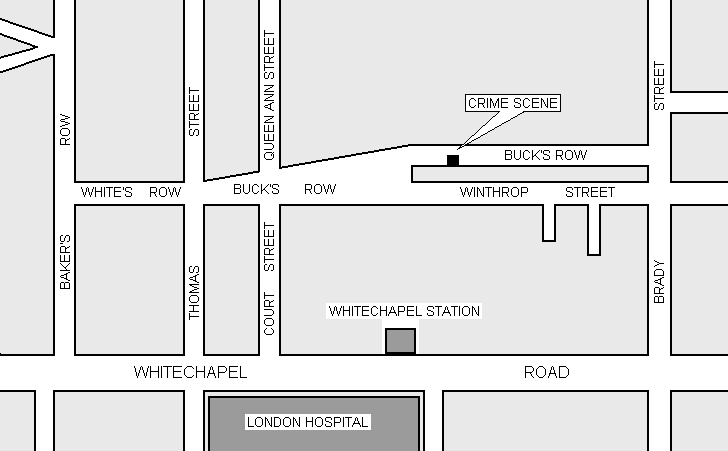
Buck’s
Row was unusually peaceful as local carman Charles Cross interrupted his journey
to work at 3:40am on Friday, 31 August, 1888. Having spotted what in the pre-dawn
darkness looked like an abandoned tarpaulin lying in front of some stableyard
gates on the opposite pavement, he decided to make a closer inspection. Only
when halfway across the road, about ten feet from the gates, did Cross realize
that the ‘tarpaulin’ was the supine form of a woman, her skirts
lifted and draped around her midriff, her legs exposed and splayed wide apart.
He immediately concluded that “she had been outraged and had gone off
in a swoon.”
Cross was
joined seconds later by Robert Paul, another Bethnal Green carman making toward
his Whitechapel workplace. Touching the stranger’s shoulder, Cross gestured
in the direction of the gateway and said, “Come and look over here. There’s
a woman.” Although apprehensive, Paul accompanied Cross to the woman and
crouched down beside her. Both men felt for signs of life.
“I
think she’s dead,” said Cross after examining her hands. Paul touched
her face and declared it still warm. Encouraged, he explored her chest, hoping
to find a heartbeat. He soon detected what he took to be a slight undulation,
a discovery that prompted him to remark, “I think she’s breathing,
but it’s very little if she is.”
Thinking
that the woman might have collapsed in a drunken stupor, Paul suggested that
they “shift her” – hoist her to her feet. “I’m
not going to touch her,” responded Cross emphatically.
With both
men now running behind schedule, they decided to resume their journey to work,
intent upon finding a policeman along the way. Before departing, however, Paul
resolved to restore to the woman at least a semblance of dignity by drawing
her skirts back over her legs. Yet, despite a determined effort, the clothing
proved difficult to reposition and Paul abandoned the task having covered only
the upper thighs.
Cross and
Paul now set off together, reaching the western extremity of Buck’s Row
before heading north along Baker’s Row. Here, a few yards further on at
the corner of Hanbury Street, they met and related their story to PC Jonas Mizen,
56 H (Whitechapel), who was engaged in ‘knocking up’.
“She
looks to me to be either dead or drunk,” concluded Cross.
“I
think she’s dead,” avouched Paul.
“Alright,”
replied Mizen, who, after rapping two or three times on the door nearest to
him, parted company with the carmen and made directly for Buck’s Row.
The time was now 3:45am.
At the same
time another policeman chanced upon the woman, though unlike Charles Cross or
Robert Paul, PC John Neil, 97 J (Bethnal Green), came equipped with a bullseye
lamp. Illuminating the area to the front of the stableyard gates he was left
in no doubt that here was a case of murder, for still oozing blood the woman’s
throat gaped with a savage, jagged wound that spanned from ear to ear. Composing
himself, Constable Neil bent over the body and discovered that, despite the
early morning chill, the face and upper arms were still warm. He felt certain
that she had been killed where she lay and was equally positive that the body
had not been present when he had last patrolled the street thirty minutes earlier.
Before he
had time to deliberate further, Neil heard the distinctive step of a colleague
crossing the street’s eastern entry. Raising his bullseye he signalled
for assistance and was hurriedly joined by PC John Thain, 96 J, who attempted
to take in the scene. “For God’s sake, Jack,” implored Neil,
“run and fetch Doctor Llewellyn.”
Thain sped
off toward Divisional Surgeon Dr Ralph Llewellyn’s Whitechapel Road surgery,
missing by seconds the arrival of PC Mizen fresh from his encounter with Cross
and Paul. Mizen’s stay was brief, however, since he was despatched for
an ambulance while Neil remained with the body.
News of
the murder was even now circulating the neighbourhood. Already present on Thain’s
return with Dr Llewellyn were Harry Tomkins and rough-looking James Mumford,
two horse-slaughtermen who worked in nearby Winthrop Street. Dr Llewellyn set
about examining the victim under the gaze of a steadily expanding gallery of
police and civilian onlookers and, to no-one’s surprise, pronounced life
extinct shortly thereafter. “Move the woman to the mortuary,” he
enjoined. “She is dead and I will make a further examination of her [there].”
Within minutes, as policemen roused and questioned neighbouring residents, the
deceased was placed aboard a horsedrawn ambulance and transported to Old Montague
Street Mortuary.
Notwithstanding
its impressive-sounding designation, this facility was nothing more than a decrepit,
woefully insanitary shed abutting Whitechapel Workhouse Infirmary. Most of its
menial duties were performed by the House inmates, two of whom, Robert Mann
and James Hatfield, took delivery of the body at approximately 4:30am, apparently
under explicit police instructions not to interfere with it until after Dr Llewellyn’s
re-examination. Mann and Hatfield would later deny all knowledge of this directive
and, much to the exasperation of investigators, not only stripped and washed
the woman, but threw her clothing into the yard. Still, in a bitter twist of
irony, they did uncover a gruesome and as yet unsuspected feature of the crime.
Not content with inflicting the throat injuries, the killer had further mutilated
the abdomen, meting out a series of deep and jagged wounds through which the
victim’s entrails were clearly visible.
Quite how
the epileptic Mann and elderly Hatfield reacted when confronted with this hideous
apparition is perhaps best left to the imagination. Predictably, Dr Llewellyn
was requested to conduct a second and more comprehensive medical examination
as a matter of urgency. He duly complied and delivered his official postmortem
report the following morning, Saturday, 1 September, wherein he noted a minor
injury to the tongue, a circular bruise on the left side of the face and an
elongated contusion marking the right jawline – superficial traumas probably
sustained preparatory to throat-cutting as the assailant immobilized the victim’s
head with finger and thumb pressure. Additional bruising to the left side of
the neck was coupled with an abrasion to the right. Two separate cuts, each
running left to right, had severed the neck tissues back to the cervical vertebrae,
the more prominent extending to a length of eight inches. Mutilation to the
lower abdomen consisted of one large, jagged wound and a series of slashes inflicted
across and downwards. While no body parts were absent, the fact that many of
the vital organs had been worried inclined Llewellyn to infer that the killer
was possessed of at least some anatomical knowledge. Moreover, given his interpretation
as to the assailant’s position and posture during the crime’s execution,
the Doctor discerned from the angle of mutilation evidence suggesting left-handedness.
The primary
task of the murder inquiry was now that of identifying the anonymous victim.
Her personal effects amounted to scarcely anything at all: a white handkerchief,
a comb and mirror, the latter possibly signifying an owner who had frequented
low lodging houses. More promising was a petticoat bearing the legend Lambeth
Workhouse – P.R. The garment was clearly Union issue and, since
the ‘PR’ pinpointed its place of origin, police attention now switched
to Prince’s Road, Lambeth. There the Matron was questioned and then taken
to the mortuary, but failed to recognize the deceased. After consulting her
records, however, she provided the names of two former inmates whose present
whereabouts were unknown. Mrs Mary Ann Monk, an associate of one, was located,
and once confronted with the murdered woman immediately and unequivocally identified
her as Mary Ann or ‘Polly’ Nichols.
Born in
1845, Polly Nichols began drinking heavily at some point during the mid-1870s.
Just as the frequency of her bibulousness increased, so too did the urge to
up and leave husband William and their five children. After absenting herself
on several occasions she deserted the family home altogether in 1880 and thereafter
hawked her body whenever short of money. In March, 1883, having grown accustomed
to drifting in and out of Lambeth Workhouse, she moved in with her father, Edward
Walker, at 131 Trafalgar Street, Walworth. But the arrangement wasn’t
to last and within two months Polly’s insobriety (coupled, one suspects,
with her streetwalking activities) culminated in a quarrel that prompted her
return to Lambeth Workhouse.
A month
later she was living in pseudo-wedlock at 15 York Street, Walworth, with blacksmith
Thomas Drew. This period of cohabitation apparently continued until she resurfaced
in the House four and a half years later at St Giles’s, Endell Street.
On 19 December, 1887, she was removed along with other down-and-outs amid a
police clearance of Trafalgar Square and consequently renewed her association
with the Lambeth Union. Following brief spells in Mitcham Workhouse and Holborn
Infirmary, Polly next enjoyed a three-month stint of legitimate employment,
working as a domestic in the household of Samuel and Sarah Cowdry at Rose Hill
Road, Wandsworth. Unusual though this lapse into humble respectability might
have been, it is clear from a letter written to her father that Mary Ann was
proud of her newfound status.
I just write to say you will be glad to know that I am
settled in my new place, and going all right up to now. My people went out
yesterday, and have not returned, so I am left in charge. It is a grand place
inside, with trees and gardens back and front. All has been newly done up.
They are teetotallers, and religious, so I ought to get on. They are very
nice people, and I have not much to do. I hope you are all right and the boy
[her eldest son, Edward, who moved in with his grandfather subsequent to the
Nichols’ marital breakdown] has work. So goodbye for the present. From
yours truly, Polly. Answer soon
please, and let me know how you are.
Perhaps
Polly grew tired of the dull, regimented existence at Rose Hill Road and yearned
for another taste of her former debauched lifestyle. Whatever her motivation,
she vanished from the Cowdry residence shortly after writing to her father,
as coincidentally did clothing belonging to her erstwhile employers valued at
£3 10s!
In a few
short weeks Polly had gravitated to East London, paying 4d a night for the dubious
privilege of occupying a shared room at 18 Thrawl Street, Spitalfields. She
completed her descent into the nethermost reaches of human degradation when,
on 24 August, 1888, she took lodgings in ‘perhaps the foulest and most
dangerous street in the whole metropolis’ – Flower and Dean Street.
Here at number 56, otherwise known as the White House, Nichols was free to entertain
clients with impunity owing to a policy of free association between the sexes.
Life became an endless ritual of prostitution, excessive drinking, then more
prostitution once her earnings had been frittered away. But for Polly Nichols
the nightmare was to be short-lived. A week after moving into the White House
she was found butchered and staring glassy-eyed in nearby Buck’s Row.
Police inquiries
unearthed several witnesses who had seen Nichols during her crucial final hours,
each stating that she had been intoxicated. The earliest positive sighting occurred
at 11:30pm when she was observed walking along Whitechapel Road. An hour later
she was spotted on the corner of Brick Lane and Thrawl Street, apparently leaving
the Frying Pan public house. She was sitting in the communal kitchen of her
former Thrawl Street lodgings at 1:20am but was shown off the premises when
the deputy learned she lacked fourpence for a bed. Making light of her predicament,
Polly assured him that obtaining her doss money posed no problem. As if to emphasize
the point, she indicated the new hat perched on her head and said, “See
what a jolly bonnet I’ve got now,” and chuckling, staggered off
into the night.
She was
next seen at 2:20am by Emily Holland, one of the prostitutes with whom she had
roomed at 18 Thrawl Street. Now very drunk and leaning against a wall on the
corner of Whitechapel Road and Osborn Street, her condition was so unstable
that a concerned Mrs Holland tried to coax her back to the relative safety of
her lodgings. But Nichols refused, stating somewhat optimistically, “I’ve
had my lodging money three times today and I’ve spent it. It won’t
be long before I’m back.” On this note the two women parted company.
While Emily made toward Thrawl Street, Polly lurched off in search of one final
customer.
Despite
considerable efforts, police failed to trace anyone who saw Nichols alive after
this encounter. And although she was killed on the spot where Charles Cross
found her body roughly an hour later, nothing even remotely suspicious had been
perceived by neighbouring residents. Self-confessed light-sleeper Emma Green
slept obliviously through the assault, notwithstanding the fact that her bedroom
window sat only a few feet from the crime scene. In another front-facing bedroom
directly opposite, the wife of Essex Wharf manager Walter Purkiss endured a
fitful night and was in all probability pacing the floor when Polly died, yet
still sensed nothing out of the ordinary. Here, entirely exposed to view by
dozens of windows in a thoroughfare not twenty feet wide, someone had throttled
and slashed a woman into extinction without alerting a single person. Not only
were those hunting him acutely aware of his nerve and stealth, they also feared
that he may have killed before – perhaps more than once.
Almost five
months earlier a forty-four year old prostitute named Emma Elizabeth Smith had
spent the Bank Holiday Monday evening of 2 April drinking (and probably peddling
sex) in the vicinity of Whitechapel High Street. It was well after midnight
when she decided to make for her bed. Setting off on the short walk back to
her lodgings from Whitechapel Church, Mrs Smith became conscious of being followed
by three youths, the eldest of whom appeared to be no more than eighteen years
old. After trailing her along Osborn Street they pounced on the corner of Brick
Lane and Wentworth Street. There she was beaten, robbed and raped. She also
sustained dreadful internal injuries as some indeterminate object was thrust
into her vagina. Left for dead and bleeding profusely, Emma struggled to her
feet and, with no little resilience, staggered home to 18 George Street, Spitalfields.
Concerned fellow-lodgers recognized the gravity of her condition and, despite
her tigerish resistance, rushed her to the London Hospital. There she quickly
lapsed into a coma and died on 5 April having never regained consciousness.
Inexplicably, police were only informed of the circumstances attendant upon
her demise the following day, an anomaly that perhaps best illustrates why they
made little headway with the ensuing murder investigation.
Whereas
Smith was domiciled at 18 George Street when killed after celebrating a Bank
Holiday Monday, thirty-nine year old fellow-prostitute Martha Tabram lodged
at number 19 at the time of her death during the corresponding August festivities
four months later. By all accounts she had been drinking heavily on the evening
of Monday 6 August, 1888. Accompanied by a friend, Mary Ann ‘Pearly Poll’
Connolly, she had already visited several pubs prior to a 10:00pm encounter
with two soldiers in the Two Brewers, Brick Lane. Now a foursome, the group
imbibed its way through a succession of other pubs before arriving at the White
Swann, Whitechapel Road, at about 11:00pm. Forty-five minutes later the two
women separated, Pearly Poll taking her corporal to Angel Alley, whilst Tabram
entered George Yard with her client, a private. With business concluded at 12:15am,
Poll and companion strolled to the corner of George Yard. But when, after several
minutes, Tabram still had not returned, Poll departed alone, heading off in
the direction of Aldgate.
At 2:00am
PC Thomas Barrett, 226 H, noticed a Grenadier Guard lingering somewhat suspiciously
at the corner of Wentworth Street and George Yard. When asked to explain himself,
the soldier said that he was “waiting for a mate who has gone off with
a girl.” Constable Barrett accepted his story and took the matter no further.
Almost three
hours later, at 4:50am, John Saunders Reeves discovered the body of a woman
lying in a pool of blood on the first-floor landing of the George Yard Buildings.
She had been murdered, stabbed thirty-nine times in a frenzied knife attack
during which most of her vital organs, as well as her throat, breasts, abdomen
and vagina, sustained numerous puncture wounds. This woman was afterwards identified
as Martha Tabram.
Police soon
established that, at 1:45am, an occupant of the tenement, Mrs Elizabeth Mahoney,
passed the spot on which Tabram had been killed but noticed nothing out of the
ordinary. Another occupant, Alfred George Crow, saw an indistinct form lying
on the landing while ascending the staircase at 3:30am. With his vision impaired
by poor ambient lighting, however, he assumed the figure to be that of a sleeping
drunk. Hence, given the near-certainty that this was Tabram’s body, the
murder must have been committed between 1:45 and 3:30am – probably much
nearer the latter if Dr Timothy Killeen’s projected 3:30am time of death
may be taken as reliable.
Every effort
was now made to find the Grenadier Guard questioned by PC Barrett at two o’clock.
After an identity parade held at the Tower of London proved fruitless, another
the next day prompted Barrett to pick out two soldiers resembling the wanted
man. Whilst one was exonerated when the Constable manfully admitted to having
made a mistake, the second was similarly eliminated once he supplied an independently
corroborated alibi as to his whereabouts on the night of 6/7 August. This line
of inquiry yielded no further leads.
Another
setback was brought about by Pearly Poll’s reluctance to help the police.
No sooner was she questioned about the murder than she went into hiding, her
absence necessitating the abandonment of an identity parade scheduled for 10
August. Although it was reconvened on the 13th after she was located at a relative’s
home close to Drury Lane, Poll denied that either of the men that she and Tabram
had met in the Two Brewers were present. She did, however, inspire a new lead
when remarking that the wanted soldiers’ caps each bore a white band,
opening up the possibility that they were attached to the Coldstream Guards
and not the Grenadiers as had been suspected hitherto. Consequently, a third
identity parade was organized, this time at Wellington Barracks, Knightsbridge,
on 15 August. Poll now picked out two of those in attendance – Privates
Skipper and George. The identification contradicted her original claim that
she had consorted with a corporal on the night of the murder, but it was noted
that one of the privates had earned good conduct stripes, a decoration that
could have accounted for the confusion concerning rank. Yet the issue proved
academic when both men supplied apparently watertight alibis, an outcome that
convinced more than one investigator that Poll had deliberately misled them.
So, for
the second time in four months, a local prostitute had been brutally slain in
Whitechapel only for the proceeding murder inquiry to grind to a halt, stymied
by a dearth of information. But was there a common link between the deaths of
Emma Smith and Martha Tabram, and if so might the Nichols killing provide a
further connection?
Given the
balance of probability, the assaults on Smith and Tabram would appear to have
been unrelated. Emma Smith was clearly a victim of gang robbery, and while the
presence of rape coupled with implementary violation betray an unmistakable
sexual element, economic gain rather than carnal gratification was the attack’s
primary motivation. Conversely, the Tabram murder was overtly sexual in nature,
as witness the multiple stab wounds to the neck, breasts, abdomen and genitalia.
Had Martha’s assailant merely wished to commit murder, he could have done
so quickly and with infinitely less personal risk by cutting her throat or plunging
his knife into her heart. Instead he stabbed again and again at specifically
targeted areas, continuing to pierce the body long after the point of death.
This man was in the grip of acute sexual frenzy, his arousal heightened with
each penetrative thrust of the knife. Only after an onslaught of violence did
emission finally assuage his excitement and thus temper the compulsion to stab
at a lifeless body. Unlike Emma Smith, who undoubtedly fell victim to one of
the marauding extortion gangs whose viciousness was legendary in the Victorian
East End, Martha Tabram died at the hands of a full-blown sex killer, the recognition
of which effectively demolishes any connection between the two crimes.
Though perhaps
not so obviously apparent, Polly Nichols’ murderer was also a sadistic
deviant who derived untold sexual delight by penetrating human flesh with his
knife. He, too, of course, could have taken to his heels the instant he severed
Nichols’ throat had his intention been to commit a mere casual homicide.
Yet, disregarding the risk of discovery, he had elected to remain with the body
to perform a series of postmortem mutilations. Killing simply wasn’t enough
for this man, for his was an altogether more macabre compulsion. Beyond all
doubt a sadosexual psychopath, he had developed a craving for evisceration.
As will
be shown in a later chapter, such crimes are almost invariably the product of
long-term immersion in violent sexual fantasy. Often the offender spends years
contemplating his first attack, planning every aspect in meticulous detail.
As the obsession intensifies, so the accompanying sadosexual imagery becomes
more vivid, ensuring that it is only a matter of time before the killing mechanism
is triggered and he explodes into violence. Henceforth his crimes stimulate
the fantasy which in turn incites further crimes, creating a self-perpetuating
cycle that is normally broken only by incapacitation, incarceration or death
itself.
Apart from
actuating the individual killing episodes, the fantasy serves as a blueprint
for the offender’s crime scene behaviour, inspiring a murder ritual that,
with the majority of perpetrators, remains relatively constant even in an extended
series of homicides. In this context, therefore, it is unlikely that the man
who butchered Polly Nichols on 31 August would have contented himself some three
weeks earlier with merely puncturing Martha
Tabram’s body. Given the opportunity presented there on that dark and
deserted landing, the urge to fulfil a disembowelling fantasy that had probably
been festering within him for several years would have proved irresistible.
That Tabram was repeatedly stabbed rather than slashed and eviscerated provides
powerful evidence indicating that she and Nichols were killed by different men.
Nevertheless, in what should serve as a chilling indictment against the locality,
at least two sadistic sexual deviants were simultaneously and independently
stalking women on the streets of Whitechapel. Bearing in mind the attack on
Emma Smith (as well as countless other similar episodes), one can but wonder
to what extent this wave of misogyny permeated the area as a whole.
To their
credit, those hunting the Whitechapel Murderer
gave little credence to the largely press-inspired theory that he
had despatched Emma Smith – though they were noticably less certain as
regards Martha Tabram. Still, with little or no experience of the random episodic
sex killer, their confusion is both understandable and wholly excusable. Unfortunately
for one woman, however, their sphere of knowledge was about to be expanded in
the most grotesque manner imaginable.
Born illegitimately
to George Smith and Ruth Chapman in September, 1841, Eliza Ann Smith was one
of four children who, with their parents, lived an undistinguished existence
in Paddington before moving to Windsor in 1856. Annie married John Chapman,
a relative of her mother, in May, 1869, and within a year they moved to Bayswater.
The Chapmans moved again in 1873, on this occasion into a court close to Berkeley
Square.
If Annie
and John ever enjoyed a period of wedded bliss it was short-lived. Whereas John
had previously earned his living as a domestic coachman, he now secured the
position of valet to a gentleman residing in Bond Street. According to one source,
however, he either resigned or was dismissed on account of Annie’s dishonesty
– the inference being that she was strongly suspected of stealing money
or valuables from the house. To make matters worse, the couple were developing
an unhealthy predilection for alcohol. Further strain was placed on the relationship
with the birth of a disabled son who was eventually sent to a crippled children’s
home.
The Chapmans
returned to Windsor in 1881 but separated a year later in consequence of Annie’s
“drunken and immoral ways”. Shortly thereafter, Emily, one of two
daughters, died at a tragically early age.
Annie now
moved to East London, sustained in part by a weekly allowance of ten shillings
paid by John. She met and took up with a sieve maker named Jack ‘Sivvey’,
the man with whom she was cohabiting at 30 Dorset Street, Spitalfields, when
in late-1886 her maintenance payments unexpectedly dried up. Desperate for money,
she visited her estranged husband’s brother at his Whitechapel home only
to learn that John had died of cirrhosis of the liver on Christmas Day. She
was also informed that her one surviving daughter had been placed in a French
institution.
Deprived
of her financial safety-net, Annie endeavoured to earn a living by streetselling
and crochet work. Increasingly, though, she resorted to casual prostitution
in the ongoing battle against hunger and homelessness. As the relationship with
Jack Sivvey started to founder, she began seeing bricklayer Edward Stanley.
But it was hardly the stuff of true romance. When in May 1888 Annie moved into
Crossingham’s lodging house (35 Dorset Street), it was Ted who regularly
paid her weekend doss in return for sexual favours.
September
1888 began none too auspiciously for ‘Dark’ Annie. Within days of
Polly Nichols’ murder she entered the Britannia public house, Commercial
Street, and for a while shared the company of two acquaintances, Eliza Cooper
and a gentleman going under the name of Harry the Hawker. Trouble broke out
when Annie alerted Harry to the fact that she had seen Cooper exchange one of
his florins with a polished halfpenny piece. An indignant Eliza Cooper denied
the deception, retaliating with a counter-accusation that called into question
Annie’s integrity regarding a missing bar of soap. Annie reacted by hurling
the offending ha’penny at Cooper, shouting angrily, “There’s
your soap!” The altercation escalated and soon developed into a fierce
exchange of blows. Annie came off badly, sustaining a black eye as well as bruising
to her head, hands and chest.
While her
health had been deteriorating for quite some time, Annie was unaware that she
was terminally ill – dying from brain and lung disease. Eating only frugally,
she was severely malnourished. She presented such a piteous sight when meeting
Amelia Farmer in Dorset Street on 4 September that her equally penurious friend
handed over 2d with which to buy a meal. After promising not to spend the money
on rum, Annie expressed her intention of seeking admission into the Whitechapel
Workhouse Infirmary where she hoped to obtain food and medication. Annie was
probably true to her word since two days elapsed before she was again seen in
her usual haunts.
Amelia Farmer
next encountered her friend on Dorset Street at 5:00pm on Friday, 7 September.
Annie was downcast and there appeared to be no improvement in her health. When
asked if she intended going to Stratford (where she generally prostituted herself),
she responded by saying that she felt too unwell to do anything. But, after
a moment’s contemplation, she acknowledged the cold reality of her situation:
“It’s no use my giving way. I must pull myself together and go out
and get some money or I shall have no lodgings.”
A few hours
later, at 11:30pm, a penniless Annie Chapman arrived at Crossingham’s
and pleaded with deputy Timothy Donovan for permission to enter the kitchen.
With no little compassion, Donovan acquiesced, allowing Annie to rest and warm
herself before returning to the streets to earn her doss at about 12:10am.
Curiously
enough, she reappeared at 1:35am only to tell nightwatchman John Evans that
she had just completed a futile round trip to her sister’s Vauxhall home
for the purpose of borrowing sufficient money to secure her bed. This story
was patently untrue, of course, for not only could Annie ill-afford the expense
of public transport, her wretched health precludes any possibility that she
was able to walk from Spitalfields to Vauxhall in under ninety minutes –
let alone there and back again. This point was not lost on Evans and Donovan;
much less when she tried to explain away her transparent drunkenness by claiming
that she had called in only briefly at the Britannia “for a pint of beer.”
In reality,
Annie probably picked up a punter soon after her 12:10am departure from Crossingham’s
and, perhaps hoping to ease the aches and pains borne of her deteriorating physical
condition, invested the proceeds in a drink or two. Indeed, she was seen in
the Britannia at 12:30am by fellow-lodger Frederick Stevens. She evidently spent
her earnings and at 1:35am returned to Crossingham’s, pouring out the
fanciful Vauxhall tale in the hope of being granted further use of the kitchen.
Both Donovan and Evans were alive to her intoxication, though, and any sympathy
they otherwise might have had was suppressed by the knowledge that she had earned
and squandered her lodging money. So, despite her sorry state, Annie was shown
the door. “Keep my bed for me, I shan’t be long,” she called
back to Evans while shuffling along Dorset Street. Little did Evans know as
he watched her turn north into Paternoster Row that Annie Chapman was about
to encounter death in its most obscene form.
29 Hanbury
Street was an atypical Whitechapel tenement insofar as only seventeen people
occupied its eight dingy rooms. It did, however, comply to the norm in that
most of its residents were engaged in some form of outworking. Cigars were manufactured
on the premises, as were artificial flowers and rough packing cases. One ground-floor
room was tenanted by ‘purveyor of horseflesh’ Mrs Harriet Hardiman
and her fourteen year old son William. Apart from sleeping in this room, the
Hardimans utilized it for the production of cats’ meat.
Of the two
doorways that provided access to the building from Hanbury Street, one led directly
into the Hardimans’ quarters and the second opened into a passage extending
to the rear of the property. Running off this corridor was a staircase by which
lodgers reached their upper-floor rooms. At the end of the passage was a back
door, this allowing for egress into the yard. Seldom slow to take advantage
of such an opportunity, local prostitutes, conversant with the fact that both
passage doors were left permanently unlocked, often wandered into the building
and serviced clients in either the corridor or yard.
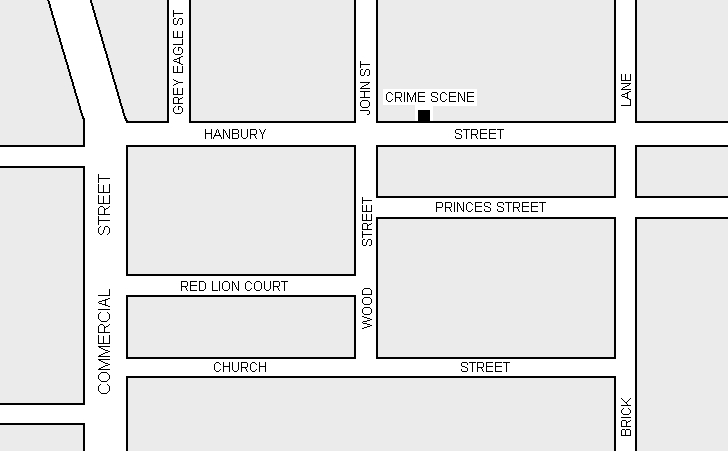
One man
who in only two weeks of residence had repeatedly ejected streetwalkers from
the passage was fifty-six year old John Davis. A carman employed at Leadenhall
Market, Davis reflected on what for him had been a restless night as he rose
for work at 5:45am on Saturday, 8 September. He made a cup of tea, drank it,
and then, a little before 6:00am, left the third-floor room he shared with his
wife and three sons to begin his descent to the ground-floor. Seconds later
he pulled open the back door and immediately recoiled in horror as his gaze
fell upon a sight of which nightmares are made.
Lying with
her head almost touching the lower of the two stone steps which projected down
into the yard was the mutilated body of a woman – later identified as
Annie Chapman. As had Polly Nichols, she lay in a supine position, her skirts
raised and legs spread wide apart. Her bloodsmeared face was angled to the right,
turned away from the boundary fence that ran parallel with the body to the bottom
of the yard. Her face was also rubicund and swollen, as was her tongue, which
jutted just beyond her front teeth. Two jagged incisions ran all the way round
the neck, wounds inflicted with such ferocity that they had all but resulted
in decapitation. While her right arm rested on the ground alongside the body,
her left forearm was draped across her chest. Flaps of abdominal tissue lay
close to the left shoulder in a pool of blood that had escaped from the throat
injuries. Sat on the right shoulder were several intestinal loops, wrenched
from the viscera through a cavernous abdominal laceration. The womb, too, had
been attacked and plundered of its content. Incongruously, the murderer’s
final act had been to take from Annie‘s pocket a comb, two farthings and
a piece of muslin which he had arranged neatly on the ground between her feet.
Terrified
by the carnage lying beneath him, John Davis backed off, fled along the passage
and hurtled through the front door. Once in Hanbury Street he spotted young
Henry Holland making his way to work. “Come and look in the back yard!”
beseeched Davis. “Come and see this woman!” Even as Holland approached,
Davis beckoned James Green and James Kent from outside their workplace, a packing
case manufacturer’s three doors away. “Come here, men, here’s
a real sight! A woman must have been murdered!” he cried with no little
understatement.
Disturbed
by all this commotion, Harriet Hardiman instructed her son to find out what
was going on. He obediently entered the passage and came upon Davis, Holland,
Green and Kent, who by now were all staring disbelievingly at the body. But
this was no place for a fourteen year old boy and William was sent back to his
mother.
Recognizing
the need to fetch help, Davis, Holland and Kent separated, hurrying off in search
of a constable, leaving James Green to guard the back door. Henry Holland soon
sighted a policeman in Spitalfields Market but was stunned into stupefaction
when the officer insisted that he had been assigned to fixed point duty and
was therefore unable leave the vicinity. Furious at what he perceived as crass
petty officiousness, Holland later lodged a complaint at Commercial Street Police
Station, only to be told that the PC had correctly observed standing orders.
James Kent
fared no better. Despite setting out with the best of intentions, he became
so distressed by what he had just seen that he abandoned the mission entirely,
opting instead to go for a remedial brandy.
John Davis
proved to be made of sterner stuff. Shortly after 6:00am he entered Commercial
Street Police Station and asked to speak to a senior officer. Within moments,
the investigation into the second of the Whitechapel Murders was underway.
Inspector
Joseph Chandler was the first senior policeman at the crime scene. Since news
of the killing was already spreading like wildfire, he had the crowded passage
cleared of sightseers. In order to contain the swelling convocation in Hanbury
Street, he also despatched a constable to Commercial Street under instruction
to return with reinforcements. A second junior was sent to summon Divisional
Surgeon, Dr George Bagster Phillips, from his Spital Square surgery. Yet a third
went off to find something with which to cover the body. At length, he managed
to borrow a piece of sacking from a neighbouring resident.
After jostling
through a crowd now some several hundred strong, Dr Phillips stepped into the
yard at 6:30am. A cursory inspection was sufficient to satisfy him that the
victim was beyond all medical help. With his professional obligations thereby
fulfilled, he directed that the remains be conveyed to Old Montague Street Mortuary
in readiness for a full postmortem examination.
Waiting
at the mortuary gates when the ambulance drew up at 7:00am was none other than
Robert Mann. Inspector Chandler arrived within minutes and, perhaps recalling
Mann’s prior participation in the unauthorized stripping and washing down
of Polly Nichols’ body, emphasized that no-one, absolutely no-one, was
to touch the cadaver until completion of Dr Phillips’ postmortem examination.
Confident that he had made his point, the Inspector handed over responsibility
for the deceased to PC Barnes, 376 H, then set off with Sergeant Edward Badham,
31 H, towards Commercial Street Police Station. This confidence was misplaced,
however, for within hours two female nurses, acting under orders from the Clerk
to the Guardians, stripped and washed the body, though they dared not remove
the handkerchief the victim sported about her neck for fear that the head would
roll off!
A search
of the murder site elicited several items of interest. The first, a rolled up
ball of paper containing two pills, seems likely to have been part of the medication
prescribed during Annie’s supposed two day spell in the infirmary. Also
found was a portion of envelope, one side of which bore a handwritten letter
‘M’ along with a postmark, ‘London, 28 Aug 1888’. On
the reverse was the crest of the Sussex Regiment. Inspector Chandler instigated
an exhaustive search for both the sender and recipient of the letter, an inquiry
that ultimately came to nothing. Only when they interviewed Crossingham’s
patron William Stevens did police learn that the envelope had lain on the lodging
house mantelpiece for several days before Annie took possession of it. Stevens,
in fact, claimed to have seen her placing a number of pills inside it shortly
before the alleged Vauxhall trip. Naturally, this information ruled out any
possibility that the envelope had fallen from the killer’s pocket during
the attack, thus frustrating another promising line of inquiry.
Examination
of the boundary fence adjacent to where Chapman’s body was found revealed
an arterial blood-spray pattern some fourteen inches above ground level that
undoubtedly originated from the neck incision, establishing that Annie was alive
(though in all likelihood unconscious) and lying on the ground when her throat
was cut. But the most sensational discovery of all, certainly in terms of the
newspaper excitement it generated, was that of a water-soaked leather apron
found beside a standpipe at the bottom of the yard.
Police had
followed up Polly Nichols’ death by questioning scores of local prostitutes
in an attempt to ascertain whether any of them had been threatened or assaulted
by extortion gangs. One name came up time and again: Leather Apron.
According
to some sources, this fearsome individual had for some considerable time been
demanding money with menaces and had lately extended operations to Holborn as
well as several other districts. After his name first appeared in print on Tuesday,
4 September, the portrait of him painted by the media became increasingly theatrical,
evoking a rebarbative amalgam of Mr Hyde and the Marquis de Sade. Here follows
a typical depiction run by the Manchester Guardian:-
He is 5ft 4ins or 5ft 5ins in height and wears a dark,
close fitting cap. He is thickset and has an unusually thick neck. His hair
is close clipped. His age is about 38 or 40. He has a small black moustache.
The distinguishing feature of costume is a leather apron, which he always
wears, and from which he gets his nickname. His expression is sinister and
seems to be full of terror for the women who describe it. His eyes are small
and glittering. His lips are usually parted in a grin, but excessively repellent.
He is a slippermaker by trade, but does not work ... [He] always carries a
leather knife, presumably as sharp as leather knives are wont to be. The knife
a number of women have seen. His name nobody knows, but all are united in
the belief that he is a Jew or of Jewish parentage, his face being of a marked
Hebrew type. But the most singular characteristic of the man is the universal
statement that in moving about he never makes any noise. What he wears on
his feet the women do not know, but they agree that he moves noiselessly.
His uncanny peculiarity to them is that they never see him or know of his
presence until he is close by them.
Besides
his knife, Leather Apron reportedly carried around a cudgel and occasionally
even a revolver. One of his regular haunts was the Princess Alice, a public
house situated on the south-east corner of the Commercial/Wentworth Streets
intersection. He was said to have been friendly with a character named ‘Mickeldy
Joe’, in whose company he frequented low lodgings in or close to Brick
Lane. Timothy Donovan claimed in newspaper reports to have ejected Leather Apron
from Crossingham’s following an attack on a female lodger, an incident
that occurred just prior to the Nichols murder. Nevertheless, despite a wealth
of background information, a police search of more than two hundred local doss
houses failed to turn up the ‘aproned one’. Then, in a report submitted
to Scotland Yard on 7 September, Inspector Joseph Helson of J Division stated
that
… a man named Jack Pizer, alias Leather Apron,
has for some considerable period been in the habit of illusing prostitutes
in this, and other parts of the Metropolis, and careful search has been and
is continued to be made to find this man in order that his movements be accounted
for on the night in question, although at present there is no evidence whatever
against him.
John ‘Jack’
Pizer was a thirty-eight year old boot-finisher of Polish/Jewish extraction.
Though resident at 22 Mulberry Street, Whitechapel, with his elderly stepmother
and five brothers and sisters, Pizer was prone to staying at lodging houses
in a variety of districts. His appearance, if a report in the East London Observer is to be believed, was
somewhat less than comely. At 5ft 4ins he was below average height. His dark,
close-cropped hair was thinning on top, his swarthy face distinguished by dark
sideburns and a drooping moustache. Aside from a large head and an abnormally
thick neck, nature had endowed Pizer with splayed feet and curious tufts of
long black facial hair. As for his disposition, family and friends regarded
him as a quiet, inoffensive man with a delicate constitution. Yet strangely
at odds with this benign image was his arraignment before Thames Magistrates
on 4 August, 1888, charged with indecent assault. Given that the charge was
dismissed, apparently without evidence having been heard, one is led to infer
that, as commonly occurred at such hearings, the police case collapsed due to
the prosecutrix’s nonappearance in court. Moreover, the Paul Begg/Martin
Fido/Keith Skinner team, in their sublime The
Jack the Ripper A to Z, postulate
that Pizer was the John Pozer who
in August 1887 was sentenced to six months’ hard labour after stabbing
a man in the hand during an argument over work.
Due almost
entirely to the media in first instigating then inflaming public hysteria concerning
the anonymous ‘mad Jew’, it was amid an atmosphere of rumbling xenophobia
that Detective Sergeant William Thicke (H Division) called at 22 Mulberry Street
on Monday, 10 September, and came face-to-face with John Pizer.
“You’re
just the man I want,” said Thicke to the individual he had known for about
eighteen years. Trembling, Pizer asked him why he was wanted.
“You
know what for,” said Thicke. “You will have to come with me.”
“Very
well,” responded Pizer. “I will go with you with the greatest of
pleasure.”
“You
know you are Leather Apron,” imputed Thicke.
According
to Pizer, he was unaware that anyone referred to him as such. But, recognizing
the futility of further argument, he went unprotestingly with Thicke to Leman
Street Police Station where he was interrogated before being placed on an identity
parade. To his astonishment, he was picked out by Emmanuel Delbast Violenia,
a Spanish/Bulgarian immigrant, who identified him not only as Leather Apron,
but also as the man he had seen threatening to stab Annie Chapman in Hanbury
Street during the small hours of Saturday, 8 September. After again denying
that he was Leather Apron, Pizer insisted that Violenia, as a virtual stranger,
could know him by neither this nor any other cognomen. As for the allegation
that he had been in Hanbury Street in the hours preceding Chapman’s murder,
he had, he maintained, spent the entire night with his family and had not once
stepped out of doors.
The odds
stacked against Pizer were formidable. With his uncanny resemblance to the published
description of the Jewish extortioner, his previous brushes with the law, his
tendency to sleep at different lodging houses, his occupation and the declaration
of Violenia linking him to both Leather Apron and the Hanbury Street incident
involving Dark Annie, Pizer’s future looked at this juncture to be somewhat
less than rosy.
Fortunately
for Pizer, the men of H Division were not looking for a convenient peg on which
to hang a conviction. Scepticism concerning Violenia’s integrity began
to surface when, having viewed Chapman’s remains, he had proved unable
to identify her as the woman he allegedly saw being menaced by Pizer in Hanbury
Street. Back at Leman Street his credibility crumbled significantly during an
interrogation lasting almost three hours. Inconsistencies in his story eventually
exposed him as a time-waster, a man who police believed had come forward with
a fabricated version of events through some morbid desire to glimpse the victim’s
corpse. Whilst this hypothesis cannot be wholly discounted, it is certainly
interesting to note that Violenia was at the time both broke and planning to
emigrate to Australia with his wife and two children. As an alternative to the
scenario postulated by police, therefore, consideration might be given to the
possibility that he falsely implicated Pizer in order to sell his story to the
highest bidding newspaper and thereby secure his passage to the Antipodes. Merely
accusing Pizer of being Leather Apron would not have elevated Violenia to his
desired status, particularly if other emergent witnesses were to echo the same
accusation. So the attempt to place Pizer and Chapman together prior to the
murder may have been Violenia’s clumsy bid to enhance his potential bargaining
power with sensation-seeking journalists. If so, it was a pattern of subterfuge
that would be repeated over and over again in the coming weeks, one that clearly
irritated the Illustrated Police News:-
‘... so many stories have been invented for the
sake of gain by people who live in the locality, since these murders became
the sensation in the newspapers, that it is difficult to ascertain whether
they are accurate or otherwise.’
Quite. And
with Violenia now discredited, Pizer set about providing a detailed account
of his movements over the previous twelve days.
Two separate
warehouse fires had stirred great excitement in and beyond the East End on the
night of 30/31 August, their iridescence illuminating an ordinarily tenebrous
night sky from dusk until dawn. The first blaze caught hold at approximately
9:00pm and burned fiercely at the London Docks before firemen succeeded in bringing
it under control two hours later. It was finally extinguished at midnight –
just as a second fire roared into life at Shadwell Dry Dock. What began as a
minor incident spread to a nearby depot containing 800 tons of coal and quickly
escalated into a blaze of inferno proportions. John Pizer claimed to have been
staying at Crossman’s (otherwise known as the Round House) common lodging
house, Holloway, on the night of the fires. Intrigued by the distant glowing
sky, he walked from the Round House to Seven Sisters Road at 11:00pm where he
allegedly discussed the conflagration with a policeman. After wandering the
streets for some time, he returned to his lodgings and there chatted to the
deputy as well as a second policeman before retiring to bed at 1:30am.
According
to Pizer, he left the Round House the next morning and took new lodgings in
the Holborn area. In a puzzling incident that purportedly occurred a few hours
later, Pizer maintained that he was stopped by two unknown women while walking
through Church Street Market, one of whom inquired, “Are you the man?”
Taking this to be a reference to the person who had killed Polly Nichols earlier
in the day, Pizer began to feel distinctly ill-at-ease and beat a hasty retreat.
Oddly enough,
no description of the Whitechapel Murderer existed on Friday, 31 August. Stranger
still, it would be another four days before any newspaper published details
relating to Leather Apron. Hence, excluding the possibility that the woman had
gleaned her information from, say, one of the prostitutes who had come into
contact with the Jewish extortioner, it must be assumed that this episode either
occurred at a later date or else was an apocryphal story invented by either
Pizer or the press. At any event, it is unlikely to have transpired on 31 August
as was claimed.
Having spent
almost a week in West London, Pizer returned to Mulberry Street on the evening
of Thursday, 6 September, whereupon he was cautioned by his brother about the
searing hostility felt by local Gentiles towards the now well-publicized Leather
Apron. Therefore, since he “had proofs that I should have been torn to
pieces” at the hands of a lynch-mob were he to venture outdoors, Pizer
ensconced himself in the family home until arrested by Sergeant Thicke four
days later.
Chaired
by the Coroner for the South-East Middlesex Division, Wynne Edwin Baxter, the
inquest into Annie Chapman’s death opened at the Whitechapel Working Lads’
Institute on Wednesday, 12 September, and was reconvened on 13, 14, 19 and 26
September. It was the stuff of pure soap opera, providing for newsmen an abundance
of material with which to mesmerize a salivating readership.
After eyewitness
testimony outlined Dark Annie’s known movements on the night of 7/8 September,
Wynne Baxter endeavoured to pinpoint the precise time of death by airing the
testimonies of those with relevant information regarding the crime scene. First
up was market porter John Richardson who, although principally employed at Spitalfields
Market, frequently helped out with the packing case manufacturing business operated
by his mother from the first-floor of 29 Hanbury Street. Following a theft of
tools from his mother’s rented cellar some months previously, it had become
Richardson’s custom to call in at number 29 en route to the market from
his nearby John Street lodgings to ensure that the cellar door remained securely
padlocked. This he had done at 4:45am on 8 September. Satisfied that all was
in order, he had decided to attend to one of his boots (which had been causing
some discomfort), so opened the back door, sat on the top step and, using an
old table knife he sometimes carried around, cut away the offending piece of
leather. He was positive that Annie Chapman’s body was not lying at the
foot of the steps at the time of his visit.
Before concluding
his testimony, Richardson also exploded the speculation surrounding the leather
apron found close to Chapman’s body. This garment, he avouched, was his
own and had been washed and left in the yard to dry by his mother, Amelia Richardson.
Mrs Richardson later corroborated the claim, severing any connection between
the apron and Dark Annie’s killer.
Throwing
light of a different nature on the case was Albert Cadosch, a twenty-three year
old carpenter who lived next door to Mrs Richardson at 27 Hanbury Street. Having
risen for work at 5:15 on the morning of the murder, he briefly entered his
yard a few minutes later and discerned hushed voices coming from the rear of
number 29. He distinguished only the word “No!”, and since the partition
fencing prevented him from seeing who was on the other side, assumed the voices
to be those of his neighbours and returned indoors, suspecting nothing untoward.
He went back into the yard at roughly 5:30am and now heard a muffled thud, a
sound that suggested someone had fallen against the boundary fencing. Again,
though, this early morning activity aroused no hint of suspicion. He then set
off for work, passing Spitalfields Church at 5:32am, having seen no-one in Hanbury
Street.
Elizabeth
Long did perhaps see something of significance. Walking along Hanbury Street
at approximately 5:30am, she noticed a man and woman standing outside number
29. On passing by she heard the man ask “Will you?”, to which the
woman replied “Yes”. Though the man had his back to her, Mrs Long
thought him to have been about forty and of shabby-genteel appearance. She estimated
his height at 5ft 4ins and recollected that he had worn a dark coat and a deerstalker
hat. He also conveyed the impression of being a foreigner, a euphemistic term
that almost invariably meant Jewish. Mrs Long expressed initial doubt when asked
if she would recognize the female again but, once taken to the mortuary, identified
Annie Chapman as the woman she had seen.
We know,
of course, courtesy of the arterial blood-spray pattern found on the partition
fencing, that Dark Annie’s heart was pumping the moment her throat was
cut – hence the certainty that she entered the yard alive. And since this
blood spattering indicates that the body was not moved to an appreciable degree
after the throat wounds were inflicted, we may be equally certain that the murder
had not been perpetrated when John Richardson tended his boot at 4:45am. Common
sense therefore dictates that the voices heard by Albert Cadosch at 5:20am were
those of Chapman and her killer, with the bump some minutes later being Annie’s
body impacting with the fence, her weight thrust backwards as the assailant
seized her by the throat. Accordingly, allowing for some latitudinal scope with
the timings proffered by Elizabeth Long, it may well be that she witnessed the
crime’s preliminaries – though this is by no means conclusive. What
is certain, however, is that Annie Chapman
died at around 5:30am, approximately half an hour before John Davis discovered
her body.
Incredibly,
Dr George Bagster Phillips postulated a much earlier time of death when presenting
medical testimony before the hearing. Owing to an increasing stiffening of the
body during his 6:30am examination, Phillips concluded that death had occurred
at no later than 4:30am, though he qualified this statement by emphasizing that
the heavy blood loss and chill atmospheric conditions might have combined to
impede the accuracy of his calculations. Indeed. And another factor worth mentioning
is that Chapman’s stomach had been largely emptied of its content through
a gaping abdominal wound, this permitting cold air to circulate internally,
thereby greatly accelerating the normal postmortem cooling process. Nevertheless,
despite its inherent implausibility, Coroner Baxter and the police accepted
Dr Phillips’ evaluation rather than the agenda that had emerged through
the testimonies of John Richardson, Albert Cadosch and possibly that of Elizabeth
Long. This, it has to be said, was a serious mistake, one that introduced the
possibility of the killer allaying suspicion by supplying an alibi for 4:30am
when, in actuality, attention ought to have been focused on a 5.30am time of
death. Moreover, Phillips’ opinion requires that we somehow reconcile
the notion of John Richardson being so deeply engrossed in the repair of his
boot that he failed to notice the butchered body of a woman lying less than
three feet away amongst a mangled mess of blood, flesh and intestines. Patently,
the fact that Richardson saw nothing of importance at 4:45am indicates that
there was nothing of importance to be seen. And if Dark Annie’s body was
not in evidence at this juncture, it follows that she was still alive. Thus
Phillips’ proposed 4:30 time of death collapses.
His errant
guesswork apart, Dr Phillips also became embroiled in an extraordinary battle
of wills with Wynne Baxter over which medical testimony was and was not material
to the case in hand. The main bone of contention concerned the mutilations,
all of which, excluding the throat injuries, Phillips asserted, were inflicted
post-obit and therefore should not be disclosed in open court since they were
irrelevant as regards the cause of death. Adding a cautionary note, the Doctor
warned that the placing of such knowledge in the public domain might ultimately
prove prejudicial to justice. Whether this was a genuine reservation is questionable.
As will be seen in a later chapter, those coordinating the manhunt were seemingly
not averse to sanitizing inquest proceedings as a means of curbing some of the
more melodramatic press coverage that contrived to further excite an already
volatile East End. If this was such a ploy, it was one that was accorded short
shrift by the indomitable Baxter who sharply reminded Phillips of his legal
responsibility to enumerate the full array of injuries irrespective of any personal
misgivings.
When eventually
the reluctant Phillips yielded to Baxter’s authority, his testimony provided
confirmation that the Whitechapel Murderer had evolved a lethally efficient
method of despatch. First the victim would be debilitated by manual strangulation,
whereupon the throat was incised with two vicious left-to-right knife slashes.
Only then, with a dead women lying beneath him, would the killer direct his
attention to the abdomen and genitalia. And whereas the same weapon was almost
certainly used on Nichols and Chapman – the blade of which, Phillips surmised,
was roughly an inch wide, between six and eight inches in length, pointed at
the tip and exceptionally sharp – medical opinion differed as to the assailant’s
handedness. Whereas Dr Llewellyn had opined that Polly Nichols’ murderer
had exhibited sinistrality, Dr Phillips arrived at a contrary conclusion during
his postmortem examinations of Annie Chapman. In view of this confusion, emphasis
should perhaps be placed on the fact that Dr Llewellyn completely misinterpreted
the killer’s modus operandi,
conjecturing that Nichols had been standing
upright as her throat was cut. It is further apparent that he mistakenly
believed the murderer to have been facing her feet when performing the abdominal
mutilations. Ergo, Dr Llewellyn’s assumption was based on an entirely
false premise, one that severely attenuates his left-handed theory.
Dextral
or sinistral, the issue paled into temporary insignificance as Dr Phillips unleashed
his final bombshell on a stunned courtroom:-
“… the uterus and its appendages with the
upper portion of the vagina and the posterior two-thirds of the bladder had
been entirely removed. No trace of these parts could be found …”
So merely
butchering Annie Chapman had failed to slake the murderer’s bloodlust.
In this, the second act of his one man horror show, he had transcended even
the abominations of Buck’s Row by taking away some of Dark Annie’s
internal organs. If Nichols’ death had been enigmatic, this latest atrocity
confirmed beyond all doubt that there lurked deep within the man responsible
a force of pure malevolence.
The appearance
of John Pizer on Wednesday, 12 September, proved decidedly anticlimactic from
a journalistic perspective. Contradicting his earlier emphatic denials, Pizer
opened his testimony by acknowledging that he was indeed Leather Apron. His
alibis for the Nichols and Chapman killings were reiterated, claims which Coroner
Baxter affirmed had been substantiated by police inquiries. So whilst it seems
probable that Pizer was an extortion racketeer, he was nonetheless cleared of
any involvement in the Whitechapel Murders. With his innocence thus established,
an often mercilessly maligned John Pizer afterwards set about obtaining financial
redress from some of those newsmen who had somewhat recklessly condemned the
‘crazy Jew’ without the merest atom of proof. According to some
sources, Pizer received settlements amounting to thousands of pounds, though
this was disputed by others who implied that the actual compensation payments
fell well short of a hundred pounds.
After five
days of often harrowing testimony, Coroner Wynne Baxter drew the inquest to
a conclusion on 26 September by advancing a quite extraordinary motive for Annie
Chapman’s death. “The uterus,” he expounded, “had been
taken by one who knew where to find it.” Its abductor was cognisant with
“what difficulties he would have to contend against and how he should
use his knife as to abstract the organ without injury to it. No unskilled person
could have known where to find it or have recognized it when found. For instance,
no mere slaughterer of animals could have carried out these operations. It must
have been someone accustomed to the postmortem room. The conclusion that the
desire was to possess the missing abdominal organ seems overwhelming.”
Expanding
upon this ill-informed suppositional chain, Baxter cited a case that had recently
come to his notice. An American doctor had visited London eighteen months previously
with a view to buying specially preserved specimens of human uteri. His offer
of £20 per acquisition received a polite but firm rebuffal from both the
Middlesex and University College Hospitals. When questioned by medical staff
about his bizarre request, the Doctor explained that he was in the process of
compiling an anatomical journal and proposed to issue with each number an individual
organ sample! Drawing on this alleged incident, Baxter postulated a scenario
wherein someone equipped with the requisite surgical knowhow had embarked upon
a systematic campaign to secure body parts for which he, the perpetrator, believed
that there already existed a highly profitable outlet. In other words, the killer
was liable to be a medical man and his motive strictly commercial.
Media reaction
to the Coroner’s explication varied enormously. The Times,
for example, applauded Baxter’s deductive prowess and, in a
barely disguised attack on perceived police incompetence, declared its conviction
that he had now set the manhunt on a firm investigational footing – one
that, if pursued diligently, would surely expedite the murderer’s apprehension.
Others were less impressed, however, challenging the wisdom of voicing such
potentially misleading heterodoxy in open court. The Law Journal criticized Baxter for his failure to produce the
source of the American doctor information. This deficiency it regarded as a
glaring error in judgement, just as it did his subsequent pontification –
which in any event amounted to nothing more than hearsay, a criterion that rendered
it technically inadmissible.
The jury
was thankfully unaware of the hornets’ nest being disturbed by Baxter’s
summing up. Having heard a great deal of contentious, not to mention distressing
evidence during the five day inquiry, it finally returned a verdict identical
to that which had concluded the Nichols hearing.
Annie Chapman
had been unlawfully killed by some person or persons unknown.
Chapter Three
LESS IS
MORE
With London
in the grip of a crime wave that had persisted for more than a century, 1729
saw the appointment of Thomas de Veil as Magistrate for Westminster and Middlesex.
Although blatantly corrupt and possessed of a carnality that produced almost
fifty children (half of them illegitimately), de Veil was blessed with a remarkably
perceptive mind. This he applied in an anti-crime crusade that established his
reputation as a brilliant detective. In 1739, with neither his powers of deduction
nor seduction showing any hint of decline, he installed himself in a house in
Bow Street, wherefrom his campaign went from strength to strength. His death
in 1746 created a void that was only filled two years later when novelist Henry
Fielding was appointed as his successor. Fielding, himself an innovative thinker,
astonished the Government of the day by proposing a revolutionary law enforcement
prototype. His idea was simple – rather than meting out increasingly severe
sentences to those caught committing crime, form an organized police force which,
apart from just catching criminals, would prevent
many offences from being committed in the first place. While initially
it met with a sceptical response, Fielding’s recommendation soon gained
Parliamentary approval and a £600 grant was placed at his disposal.
Fielding
now recruited six former parish constables, each of whom had amassed a formidable
working knowledge of local rogues and their haunts. Thus prepared, Fielding’s
strategy was simple yet devastatingly effective. Whenever word of an offence
reached Bow Street, even a vague description of the perpetrator was guaranteed
to throw up several likely suspects. The constables would then sprint off in
search of their quarry before stolen money or valuables could be disposed of.
Such was the speed with which these raids were executed that their protagonists
became known as the Bow Street Runners. As
for their success rate, the Runners surpassed even Fielding’s expectations.
Not only did the experiment halt a long and unremitting plague of criminality,
it did so at the cost of just £300.
Despite
the efficacy of the Runners, public resistance to the idea of a police force
proper thwarted every attempt to expand upon Fielding’s concept. The overwhelming
fear of most people involved the equation between the policeman and the spy.
Far better, it was argued, to tolerate a degree of lawlessness than risk the
introduction of a crime fighting entity that might compromise civil liberties
by resorting to covert or underhand measures. Crime was one thing, but the notion
of an insidious detective body was something altogether different. This suspicion
persisted way beyond 1829 when Home Secretary Sir Robert Peel pushed through
Parliament the Metropolitan Police Act, a piece of legislation that effectively
gave birth to the Met.
Metropolitan
Police headquarters were initially established at 4 Whitehall Place. To the
rear of this building lay a courtyard known as Great Scotland Yard – a
name that would become synonymous in fact and fiction with astounding feats
of detection. For the present, though, large sections of the general public
were deeply mistrustful of the ‘Peeler’ or ‘bobby’,
regarding this custodian of law and order with nothing short of contempt.
When in 1830, for instance, one constable attempted to pacify two brawling Irishmen
in Somers Town, the pair promptly forgot their differences, combined forces
and set about the officer, launching an attack of such brutality that they kicked
the policeman to death. This fatality was witnessed by a large group of bystanders,
yet no-one sought to intervene. In another incident a few years later, an officer
was stabbed to death while engaged on crowd control duty at a political meeting.
At the subsequent trial the jury returned a verdict of ‘justifiable homicide’!
The Bow
Street Runners remained operational until 1842 when they were supplanted by
a unit consisting of two inspectors and six sergeants. Headed by Henry Goddard,
the Detective Office remained for almost thirty years an unimpressive and severely
undermanned department. Then, in 1878, amid a general overhaul of the Met, Commissioner
Sir Edmund Henderson instituted the Criminal Investigation Department, and in
so doing opened the door to what would become a systematized, scientific approach
to detective methodology.
In February
1886 a huge crowd of the unemployed met at Trafalgar Square, wherefrom it intended
to march to Hyde Park. When a confrontation with clubmen in Pall Mall sparked
violence, some three thousand demonstrators began a riot that culminated in
a rampage through Piccadilly, Mayfair and Oxford Street. With no little insensitivity,
Queen Victoria condemned the episode as a “monstrous riot”, while
Gladstone proffered that the event had sullied the British reputation throughout
the civilized world. Matters weren’t helped when a few days later rumour
had it that the mob was planning to return to the West End under cover of thick
fog. As a precautionary measure, Scotland Yard instructed shopkeepers to close
their premises. But when the expected horde failed to materialize these same
shopkeepers, furious at an unnecessary loss of trade, vented their anger on
the police, accusing them of overreacting to what turned out to be nothing more
than scurrilous gossip. An official inquiry into the police handling of the
affair was scathing, leaving Commissioner Henderson little alternative but to
resign. Although regretted by many, his departure was seen as an ideal opportunity
to inject a renewed sense of discipline into the force – a process, it
was hoped, that might also provide a boost to its flagging public image.
The man
chosen to succeed Henderson was Sir Charles Warren, a vastly experienced soldier
who had served variously in Egypt and Africa during a military career spanning
almost thirty years. While Warren’s appointment met with a positive media
response, one problem involved his accountability to the Home Office. All was
harmonious during his first five months of tenure, but a general election in
1886 saw the incumbent Liberal Government defeated by the Conservatives. As
a consequence, Home Secretary Hugh Childers was replaced by Henry Matthews,
so beginning with Sir Charles a working relationship punctuated by an endless
series of petty squabbles, many of which seem to have been wholly unnecessary.
In Warren’s defence, he probably accepted his new post under the impression
that he would be given a relatively free hand in initiating those improvements
essential to uplifting the Met’s efficiency and credibility. Yet whereas
Childers interfered little (if at all) with his objectives, Matthews’
ascention to Whitehall set in motion a war of attrition that placed neither
man in a particularly favourable light.
Aside from
their professional differences, Warren and Matthews developed an intense personal
antipathy towards one another. All things considered, this should come as no
great surprise. While Warren was a man of action, a Gordonesque-type most comfortable
when in the presence of the salt-of-the-earth soldier or policeman, Matthews
conveys the impression of having been a somewhat wet, vacillatory individual,
a man lacking the resolve to stand up and be counted. Indeed, Warren would discover
to his cost over the next two years Matthews’ penchant for allowing others
to shoulder the responsibility for his own inadequacies. Time and again Matthews
neglected to defend Warren against unjust newspaper criticism, preserving his
own neck at the expense of the Commissioner’s ever-dwindling public esteem.
A typical case in point involved the vilification accompanying Warren’s
failure to post a reward on the Whitechapel Murderer. In reality, neither Warren
nor Matthews were averse to the idea. Unfortunately for Warren, he was unable
to appease his detractors because the policy of offering Government rewards
had been effectively abandoned upon the discovery in 1884 that criminals were
endeavouring to cash in on their own serious of fences by informing on perfectly
innocent individuals. Even so, Matthews’ disinclination to clarify the
situation led many to believe Warren betrayed a class bias in not providing
a financial incentive for information that might have unmasked the killer. His,
it was argued, was the attitude of a man who cared little about the fate of
East London’s down-and-outs, a standpoint that would have been entirely
different had the victims emanated from the middle- or upper-classes.
Warren’s
problems were further exacerbated by his rancorous relationship with head of
CID, Assistant Commissioner James Monro – the man who for some years had
been immersed in Secret Service work dealing with the Fenians’ terrorist
activities. Monro maintained these duties even after his 1884 appointment with
the Met and was additionally placed in charge of the Secret Department (Section
D) in 1887. These high-level links with the Home Office caused Warren considerable
consternation, for he believed (probably correctly) that he was often bypassed
in important matters by politicians and civil servants in favour of his second
in command. The rift between the two men deepened to chasmic proportions when
Monro demanded that Warren relinquish his authority over the CID. Despite the
absurdity of his argument, Monro insisted that the Detective Department be run
on the same lines as Section D – falling under the aegis of the Home Office
rather than the Metropolitan Police.
Matters
finally came to a head when in mid-1888 Monro offered the post of Assistant
Chief Constable to Melville Macnaghten, a man he had come to know some years
earlier whilst Inspector General of the Bengal Police. When he heard of it,
Warren opposed the appointment on the grounds that Macnaghten was ‘the
one man in India who had been beaten by the Hindoos’, a reference to an
1881 incident wherein Macnaghten had been attacked and knocked senseless by
natives on a tea plantation. Whether this was a valid objection or merely a
point-scoring exercise in the ongoing feud with Monro is unclear, but Warren’s
intervention caused the appointment to be rescinded, a development that so incensed
Monro that he immediately tendered his resignation. He later wrote of the incident:-
Sir Charles Warren made life so intolerable that I resigned.
What the Home Secretary thought of the merits of the matter at issue between
us may be gathered from the fact that he retained me as Chief of the Secret
Department.
Indeed.
And from his position as head of Section D, Monro, with the connivance of the
Home Office, kept in constant touch with his former department. His continued
influence within the CID was such that, unknown to Sir Charles, officers actively
engaged on the Whitechapel manhunt regularly reported to him with important
case-related information.
Equally
bizarre were the circumstances surrounding the induction of Monro’s successor,
Dr Robert Anderson. Like his predecessor, Anderson had a thorough grounding
in intelligence work, having been involved amongst other things in the protracted
anti-Fenian campaign. This experience was to prove invaluable during the introductory
phase of his new assignment, since feelings amongst the Yard’s CID personnel
were running high, with many lamenting Monro’s departure and some even
having to be dissuaded from resigning. Thus, rather than risk wholesale dissent
from within the ranks, Anderson was cautioned by his superiors to keep the appointment
secret – leastways, until such time as the internal situation was less
volatile. Unfortunately, from an investigative perspective, the posting took
effect on 1 September – the day after Polly Nichols was murdered in Buck’s
Row. Even worse, Anderson’s doctor allegedly prescribed two months’
sick leave to combat the long-term fatigue incurred by his Home Office duties.
Anderson did, however, retain sufficient reserves of strength to review the
case notes on Martha Tabram and Polly Nichols, after which he wrote:-
I am convinced that the Whitechapel murder case is one
which can be successfully grappled with if it is systematically taken in hand.
I go so far as to say that I could myself in a few days unravel the mystery
provided I could spare the time to give undivided attention to it.
On this
confident, not to say arrogant note, Anderson upped and left for Switzerland
– on the very day Annie Chapman was found mutilated in Hanbury Street!
Given Anderson’s
impending absence, overall charge of the manhunt was placed in the hands of
Chief Inspector Donald Swanson, CID. A room was made available at Anderson’s
insistence, through which every scrap of case-related data was funnelled for
Swanson’s scrutiny. As the ‘eyes and ears of the Commissioner’,
Swanson’s role was effectively that of the modern-day police computer.
In charge
of gathering information at street level was Inspector Frederick Abberline,
a detective who had previously spent fourteen years with H Division before being
transferred to Scotland Yard in 1888 at the request of James Monro. Regarded
as highly professional and with a working knowledge of the East End and its
villains reputedly second to none, Abberline was assigned to the case immediately
upon the discovery of Polly Nichols’ body, a sure indication if any were
needed of the seriousness with which the authorities viewed a potential series
of murders.
Notwithstanding
the high esteem in which officers like Swanson and Abberline were generally
held, the press was often contemptuous of police methods employed during the
manhunt. Yet while those petty squabbles involving senior policemen, politicians
and Home Office mandarins were at best undignified, the investigation’s
overall strategy was surprisingly sophisticated given the unfamiliarity of those
concerned with the sadosexual serial offender. At odds with the risible theories
advanced by some of their sternest critics, the Met prudently concentrated inquiries
on a local level. More than two hundred low lodgings were searched and their
patrons questioned; suspicious characters were stopped, quizzed and when necessary
detained; eighty thousand leaflets were delivered locally; reinforcements from
other divisions were drafted into the area; detectives adopted disguises and
maintained watch on streetwalkers and their haunts; couples out late at night
were paid special attention; an area of search, roughly half a mile square and
centred in Flower and Dean Street, was targeted and house-to-house inquiries
concentrated therein. In addition, hundreds of letters arriving weekly from
ordinary citizens, naming men to whom suspicion was attached, were each painstakingly
followed up.
All the
same, the Yard’s accountability to a deeply unpopular Conservative Government
induced many Radical newspapers to ridicule their efforts as a means of heaping
indirect embarrassment on Lord Salisbury and his party. After lambasting the
police for their handling of the 1886 and 1887 riots, Socialist rags like the
Pall Mall Gazette and the Star turned their politically motivated attention
to the ‘Whitechapel Horrors’, sensationalizing the deaths of Emma
Smith and Martha Tabram with such lurid overkill that circulation soared dramatically.
Recognizing the story’s commercial potential, and not wishing to be eclipsed
by a competitor, rival newspapers leapt in droves aboard the sanguinary bandwagon
until all were giving the ‘Fiendish Crimes’ saturation coverage, transforming
what in certain respects was no more than a parochial scare into first a national
then an international sensation. Whipped into fever-pitch activity, journalists
routinely distorted or embellished facts in order to keep the pot boiling. Neither
were they averse to sustaining the story by resorting to invention. Wild and
imaginative theories as to the murderer’s methods, motives, religious
convictions and identity were abundant. And when all else failed the police
became an irresistible target, as was demonstrated by the East London Observer:-
It is clear that the Detective Department at Scotland
Yard is in an utterly hopeless and worthless condition; and that if there
were a capable Director of criminal investigations, the scandalous exhibition
of stupidity and ineptitude revealed at the East End inquests, and the immunity
enjoyed by criminals, murder after murder, would not have angered and disgusted
the Public feelings as it has done.
In similar
vein, the New York Times informed
its readership that ‘The London police and detective force is probably
the stupidest in the world’. Of course, irresponsible and underinformed
journalese of this variety could have done little for police morale and beyond
question helped to turn the tide of public opinion firmly against Warren and
his officers. Then on 10 September, with confidence in the men of H Division
at rock bottom, sixteen local tradesmen met in the Crown public house, 74 Mile
End Road, where they formed the Whitechapel Vigilance Committee. With building
contractor George Lusk elected president, the group contacted several newspapers
and announced:-
Finding that, in spite of murders being committed in
our midst our police force is inadequate to discover the author or authors
of the late atrocities, we the undersigned have formed ourselves into a committee
and intend offering a substantial reward to any one, citizens or otherwise,
who shall give such information as will be the means of bringing the murderer
or murderers to justice.
The Committee
met daily in the Crown and quickly attracted the support of Whitechapel MP Samuel
Montagu along with that of most of his constituents. But George Lusk would soon
experience an altogether more unsavoury side to his new role in the public eye.
Within a month he was to be shadowed by a fearsome-looking man who on a number
of occasions was seen loitering close to the Lusk family’s Globe Road
home. Later still, he would receive a communication from the murderer himself.
As one of
twelve children, Catharine Eddowes was born to George and Catharine in Wolverhampton
on 14 April 1842. Two years later the family moved to Bermondsey, south-east
London, where Catharine senior died in 1855. While her brothers and sisters
continued their educations in Bermondsey Workhouse, Kate returned to Wolverhampton,
moving into her aunt’s Biston Street home. Here she attended Dowgate Charity
School for a short time until, with her scholastic career completed, she endeavoured
to earn a living by charring. Pretty, auburn haired and of a happy disposition,
Kate attracted the romantic attentions of an older man named Thomas Conway in
or about 1863. Conway, a former member of the 18th Royal Irish Regiment, received
an army pension under the name of Quinn, an income he augmented by writing and
selling cheap manuscripts in and around the Midlands. Kate began accompanying
Conway on these excursions and was soon telling friends that she and Tom had
married. Whether a legal ceremony actually took place is questionable, but Kate’s
aunt disapproved of the relationship and demonstrated her depth of feeling by
refusing Kate entry into the adoptive home. Kate reacted to the snub by having
the initials ‘TC’ tattood on her arm before she and Conway turned
their backs on the Midlands and headed for London.
Though the
‘marriage’ produced two boys and a girl between 1865 and 1873, the
relationship came under increasing strain as a result of Kate’s drinking
and Conway’s propensity toward domestic violence. Like both Polly Nichols
and Annie Chapman, Kate took to drifting away from the family orbit, spending
on average three months of every year apart from Conway and the children. While
Conway appears not to have been a particularly heavy drinker, he had a tendency
to get drunk on pension days, a habit that frequently led to him maltreating
Kate.
The couple
separated permanently in 1880, at which point Kate took custody of daughter
Annie and Conway accepted responsibility for their two sons. Within a year Kate
had taken up with Irish Catholic John Kelly after the two had been “thrown
together” fairly regularly at various doss houses. They eventually ended
up by cohabiting at 55 Flower and Dean Street, otherwise known as Cooney’s
lodging house. Kelly earned his living by market portering and had received
intermittent employment for some years from a fruitier named Lander. Sadly,
while those who knew Kelly described him as a quiet, handsome, unassuming man,
he was plagued by ill-health and suffered from a kidney complaint as well as
a chronic cough. Meantime, Kate’s daughter Annie met and married Louis
Phillips and spent the next seven years moving about Bermondsey in an attempt
to evade her mother’s continual scrounging.
As had become
their autumnal custom, September 1888 hastened Kate and John to Hunton, near
Maidstone, where they combined a break away from London with the potentially
remunerative seasonal demand for hop-pickers. Having apparently made little
money from their labours, however, they decided to “hoof it” home,
accompanied part-way by fellow hoppers Emily Birrell and her chap. Approaching
the Cheltenham Road, where the two couples intended to separate, Emily gave
Kate a pawn ticket so that she might redeem a flannel shirt previously popped
for 2d in a London pawn shop. The garment, Emily said, was in good condition
and would make an ideal replacement for that presently worn by Kelly. On this
thoughtful note they bade farewell and parted.
Soon after
arriving in London on 28 September, Kelly secured a few hours’ casual
work, for which he received 6d. Keeping 2d for herself, Kate insisted that Kelly
take the remaining fourpence and obtain a bed at Cooney’s. Kate herself
opted to spend the night at the Shoe Lane Casual Ward, a workhouse where she
was well known. According to the superintendent, Eddowes hadn’t been seen
there for several months, but made up for lost time by recounting her hop-picking
exploits. She then announced that she had returned to London to collect the
reward on the Whitechapel Murderer. “I think I know him,” she allegedly
confided. As far as is known, though, Kate communicated no such suspicion to
Kelly, so the likelihood is that the remark was either idle chit-chat or journalistic
invention. At all events, when cautioned to take care she wasn’t murdered, Kate reportedly
replied, “Oh, no fear of that!”
The next
morning, Saturday 29 September, Kate entered Cooney’s at about eight o’clock.
Since she and John were hungry and penniless, Kelly resolved to raise some cash
by pawning a spare pair of boots. Kate took them to Church Street, pledging
them under the name Jane Kelly for
2/6, a sum that allowed for the purchase of tea, sugar and bread. Later, at
between ten and eleven o’clock, Eddowes and Kelly were seen consuming
these provisions by lodging house deputy Frederick Wilkinson.
While it
cannot be stated with absolute certainty, Kate and John probably drank away
what remained of their half-crown, for they were broke once again at 2:00pm
when in Houndsditch Eddowes pronounced her intention of visiting her daughter
to borrow money. What she neglected to tell Kelly, however, is that her antics
had so incensed Annie two years earlier that mother and daughter had not communicated
since. The indications, therefore, are that Kate’s proposed visit to south-east
London was a ruse to rid herself of Kelly so that she might resort to a spot
of casual prostitution.
She was
next seen performing drunkenly before a crowd of onlookers outside 29 Aldgate
High Street at 8:30pm. After delighting her audience by mimicking a fire engine,
she accepted her plaudits in true theatrical fashion – then defied convention
somewhat by laying down on the pavement and going to sleep! PC Louis Robinson,
31 City, now appeared on the scene, hauled her to her feet and tried to persuade
her to move on. When she slid back on to the footway via an adjacent wall, Robinson
inquired of the gathering whether she was known to anyone. She wasn’t,
so he called over PC George Simmons, 959 City, and together they delivered her
into custody at Bishopsgate Police Station. When asked her name at the station,
Kate replied “Nothing”. She was placed in a cell and monitored at
regular intervals. At 8:50pm she was sleeping and smelt strongly of drink. Almost
an hour later PC George Hutt, 968 City, noted that she remained comatosed. He
found her ‘sober’ and singing gently at 12:15am. Fifteen minutes
later Kate called out to him, asking when she might be allowed to leave.
“When
you can take care of yourself,” said Hutt.
“I
can do that now,” chirped Kate.
When finally
released from her cell at 12:55am Kate asked Hutt the time.
“Too
late for you to get any more drink, missus,” he quipped.
“I
shall get a damn fine hiding when I get home,” said Kate.
“And
serve you right too,” responded Hutt. “You have no right to get
drunk.”
In completing
her release papers, Kate gave her name and address as ‘Mary Ann Kelly
– 6 Fashion Street’. Hutt then pointed her towards the exit and
asked that she close the door on her way out.
“Alright
then. ‘Night old cock,” she offered as a parting rejoinder. On leaving
the station she turned left and began walking along Bishopsgate in the general
direction of Aldgate High Street ...
Elizabeth
Gustafsdotter, the daughter of Gustaf Ericson and his wife Beata Carlsdotter,
was born into a rural existence on her parents’ farm close to Gothenburg,
Sweden, in November 1843. She moved to Gothenburg itself when, aged sixteen,
she obtained a position in domestic service with one Lars Frederick Olufsson,
a plebeian father of four children. Two years later, in 1862, she entered into
service with another Gothenburg family and there fulfilled her duties much as
before. Within six years, however, Liz had given birth to an illegitimate still-born
daughter, had become a registered prostitute and was treated on at least two
occasions for venereal disease.
She moved
to London in February 1866 and possibly worked as a servant to a foreign family
residing near Hyde Park. In March 1869 she married carpenter John Thomas Stride
at St Giles in the Fields and settled into her first wedded home, a room at
21 Munster Street, just off the Hampstead Road. Over twenty years younger than
her husband, Liz apparently adapted easily to her new lifestyle, maintaining
a veneer of semi-respectability that revealed nothing of her former occupation.
The couple ran a coffee shop at Upper North Street, Poplar, between 1870 and
1872 and later kept another on Poplar High Street from 1872 to 1875.
In September
1878 a disaster on the Thames claimed more than six hundred lives when a steamer,
the Princess Alice, collided with another vessel, the Bywell Castle. Thereafter
Liz maintained that she and John had been working aboard the Princess Alice
on the day of the accident and that her husband as well as several of their
children had perished as a result. She insisted that she had only survived by
hanging on to the funnel but suffered a permanent injury to the roof of her
mouth when, amid the mayhem, she was dealt a severe kick to the face. Yet this
story was untrue. Apart from the fact that neither she nor John had ever worked
on the Princess Alice, the Stride marriage almost certainly produced no children.
Her hard palate was perfectly healthy, moreover, having sustained no damage
serious or otherwise. And far from drowning in 1878, John Stride survived until
1884 when, as an inmate of Poplar Workhouse, he died of heart failure aged sixty-three.
In reality,
the Strides’ marriage disintegrated for reasons of incompatibility, and
by 1882 Liz was living intermittently at 32 Flower and Dean Street. Three years
later she began cohabiting at 33 Dorset Street with Michael Kidney, a dockside
labourer some nine years her junior. It was a turbulent relationship, one from
which a now hard-drinking Liz would periodically absent herself. These disappearances
obviously irked Kidney, for he took to padlocking her inside their room when
he went out to work. Unbeknown to him, though, Liz had obtained a key of her
own so was seldom constrained for long.
Kidney showed
himself to be capable of violence on occasions. Stride laid charges against
him in April 1887 but, as was common with victims of domestic assault, failed
to appear in court and the case was dismissed. He was less fortunate in July
1888, however, when he received three days’ imprisonment after police
found him using foul and abusive language whilst drunk. For her part, Liz was
convicted on at least eight separate counts of drunkenness between 1887 and
1888. Curiously, she always refuted being drunk at the time of her arrest, pleading
instead that she had suffered a fit.
Although
Kidney later denied it, he and ‘Long’ Liz almost certainly quarrelled
on Tuesday 25 September. When after they parted in Commercial Street Stride
failed to materialize at their Dorset Street lodgings, Kidney assumed that she
had “gone on the spree” and would return in her own good time. But
Kidney was unaware that she had renewed her association with a former haunt,
one where she was seen on Wednesday, 26 September, by Dr Barnardo. Writing in
The Times, the
Doctor later recalled:-
I visited number 32 Flower and Dean Street, the house
in which the unhappy woman Stride occasionally lodged. I had examined many
of the common lodging houses in Bethnal Green that night, endeavouring to
elicit from the inmates their opinions on a certain aspect of the subject.
In the kitchen of No. 32 there were many persons, some of them being girls
and women of the same unhappy class as that to which poor Elizabeth Stride
belonged. The company soon recognised me, and the conversation turned upon
the previous murders. The female inmates of the kitchen seemed thoroughly
frightened of the dangers to which they were presumably exposed. In an explanatory
fashion I put before them the scheme which had suggested itself to my mind,
by which children at all events could be saved from the contamination of the
common lodging houses and the streets, and so to some extent cut off the supply
which feeds the vast ocean of misery in this great city.
The pathetic part of my story is, that my remarks were
manifestly followed with deep interest by all the women. Not a single scoffing
voice was raised in ridicule or opposition. One poor creature, who had evidently
been drinking, exclaimed somewhat bitterly to the following effect: ‘We’re
all up to no good, and no one cares what becomes of us. Perhaps some of us
will be killed next! If anybody had helped the likes of us long ago we would
never have come to this!
Impressed by the unusual manner of the people, I could
not help noticing their appearance somewhat closely, and I saw how evidently
some of them were moved. I have since ... recognised [Elizabeth Stride] as
one of those who stood around me in the kitchen of the common lodging house
...
Following
this encounter, Liz spent the afternoon of Saturday, 29 September, cleaning
rooms at the lodging house, for which she was paid 6d by deputy Elizabeth Tanner.
Perhaps thirsty due to her exertions, she called in at the Queen’s Head
on the corner of Commercial and Fashion Streets before returning home at 7:00pm.
Prior to leaving again at 7:30 she borrowed a clothes brush from fellow lodger
Charles Preston and chatted briefly to another patron, Catherine Lane.
She was
next seen leaving the Bricklayer’s Arms, Settles Street, at eleven o’clock
in the company of a man of clerkly appearance. The two were sheltering in the
pub doorway, seemingly reluctant to walk out into the downpour that was soaking
John Best and John Gardner. As they prepared to enter the pub, Best and Gardner
noticed that the man with Stride was about 5ft 5ins tall and wore a black morning
suit along with a billycock hat. He sported a thick black moustache and had
sandy coloured eyelashes. According to Best, “... they did not appear
willing to go out. He was hugging and kissing her, and as he seemed a respectably
dressed man, we were rather astonished at the way he was going on with the woman.”
No doubt this was why one of them decided to tease Liz with the remark, “Watch
out, that’s Leather Apron getting round you!” The last Best and
Gardner saw of Stride was as she and her amorous gentleman friend made a dash
through the rain in the direction of Commercial Road.
When next
positively sighted Long Liz was almost certainly with the same man and standing
opposite 64 Berner Street, the home of labourer William Marshall. Although he
paid the couple scant attention, Marshall, like Best and Gardner, recalled the
flower pinned to Stride’s dark jacket. He also echoed their observation
relating to the man’s excessive exhibition of affection. At one point
during the ten minutes or so the couple remained in view Marshall overheard
the man say in a gentle, English voice, “You would say anything but your
prayers.” They left the vicinity shortly afterwards, walking north along
Berner Street towards Commercial Road.
She was
probably with this same individual when seen standing opposite 40 Berner Street
– the International Workingmen’s Educational Club – as PC
William Smith, 452 H, passed along the thoroughfare while patrolling his beat
at 12:30am. In describing the smartly dressed man, Smith recollected that he
wore a dark coloured deerstalker hat, a long dark overcoat, dark trousers, and
appeared to be carrying in his right hand a newspaper parcel some eighteen inches
in length by six inches wide. Constable Smith was certain that the woman he
saw was Elizabeth Stride.
Charles
Letchford, occupant of 39 Berner Street, returned home at approximately 12:30am
but saw no-one in the thoroughfare. Bearing in mind that PC Smith saw Stride
and companion standing adjacent to Letchford’s front door at roughly the
same time, the indications are that Liz had either just arrived as Smith made
his appearance or left soon after his departure.
As has been
mentioned, the International Workingmen’s Educational Club was situated
directly over the road from the spot on which Smith saw Stride at 12:30. This
establishment, alternatively known as the Socialists’ Club, had served
as a rendezvous point for Russian/Jewish Socialists since 1885, though it attracted
Radicals of many nationalities. While the property itself was an ordinary converted
dwelling, special events such as lectures, poetry readings and musical evenings
often drew an audience of two hundred or more. The club also formed the central
office of Arbeter Fraint (Worker’s
Friend), a leading Jewish Socialist publication which reflected the club’s
underlying ideology.
Beside the
club stood a pair of wooden gates which spanned the entrance to a narrow, partially
cobbled courtyard. Roughly nine feet wide and twenty feet deep, the area was
enclosed by the club on the right-hand side, several outworkers’ cottages
to the left, and by various outbuildings lining the bottom. Beyond these outbuildings
lay a carriageworks owned by Arthur Dutfield – hence the court had acquired
the name Dutfield’s Yard. Though the gates were seldom closed, the yard
was unlit and became enshrouded by darkness after nightfall. Indeed, with no
illumination reaching the yard from Berner Street, its only light source was
the club’s ground-floor kitchen window close to the bottom right-hand
corner, but even this did little to alleviate the gloom that enveloped the area.
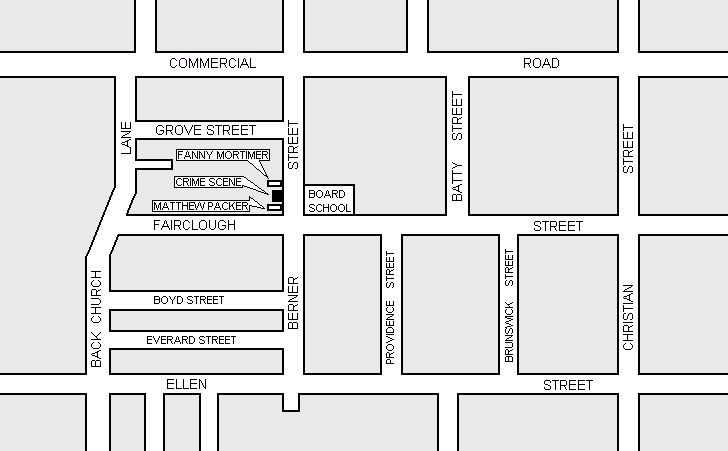
The club
had been fairly busy on the evening of Saturday, 29 September, with about a
hundred members involving themselves in a discussion concerning the necessity
for Socialism amongst Jews. When proceedings concluded at eleven o’clock,
most headed home, leaving perhaps thirty people to enjoy the music and singing
that followed. Louis Diemschutz had been employed as club steward since 1882,
a duty he combined with hawking cheap jewellery. It was in this latter capacity
that he had been engaged from early afternoon at Westow Hill Market prior to
returning to the club aboard his pony and trap at 1:00am. Recounting what happened
next, he told reporters:-
My pony is rather shy, and as I turned into the yard
it struck me that he bore too much to the left-hand side, against the wall.
I bent my head to see what it was he was shying at, and I noticed that the
ground was not level. I saw a little heap, which I thought might perhaps be
some mud swept together. I touched the heap with the handle of my whip, and
then I found out that it was not mud. I jumped off the trap and struck a match,
when I saw that it was the body of a woman. I did not wait to see whether
she was drunk or dead, but ran indoors and asked whether my wife was there.
I did this because I knew my wife had rather a weak constitution, and anything
of that kind shocks her. I saw my wife sitting downstairs, and I at once told
the members that something had happened in the yard. I did not tell them whether
the woman was murdered or drunk, because I did not then know. A member called
Isaacs went down into the yard with me, and we struck a match. We saw blood
right from the gate up the yard ... [The victim] was a little better dressed,
I should say, than the woman who was last murdered. Her clothes were not disarranged.
She had a flower in the button of her dress. In one hand she had some grapes
and in the other some sweets. She was grasping them tightly. I had never seen
her before. She was removed about a quarter to five to Cable Street mortuary.
When I first saw her she was lying on her left side, two yards from the entrance,
with her feet towards the street.
Louis Diemschutz
had only called in at the club to offload some merchandise before stabling his
pony in nearby Cable Street. With his plans now disrupted he acted promptly,
setting out with a club member named Jacobs in search of a policeman. Running
through the streets shouting “Murder!” at the top of their voices,
the two men came upon Edward Spooner outside the Bee Hive public house, on the
corner of Fairclough and Christian Streets. After telling Spooner of the murder,
all three returned to the body. Meanwhile another club member, Morris Eagle,
who had also gone for help, encountered PCs Lamb, 252 H, and Collins, 462 H,
in Grove Street. Once acquainted with the facts, Lamb and Collins raced to the
yard and quickly surveyed the crime scene. The woman, later identified as Liz
Stride, lay on her left side close to the right-hand wall, her knees slightly
bent, her dress having ridden a little way up her legs. Blood that had oozed
from the throat wound had run from the body on a course parallel with the wall
and was dripping into a grate in the far right corner of the yard. She had clearly
been murdered.
PC Lamb
reacted swiftly. After instructing Morris Eagle to report the discovery at Leman
Street Police Station, he sent Constable Collins to Dr Blackwell’s Commercial
Road surgery. Once Eagle and Collins had departed he closed the yard gates,
preventing anyone from leaving or entering the court.
Dr Blackwell
arrived within minutes, his appearance timed at 1:16am. Following a cursory
examination, he pronounced Stride dead, estimating that death had occurred in
the previous twenty or thirty minutes and that it had resulted in consequence
of the throat incision. Blood smears on the right hand indicated that the victim
had put up a struggle. He also conjectured that she had been pulled backwards
by the silk handkerchief that adorned her neck and that the throat wound had
been inflicted while she maintained an upright position.
By 1:30
Superintendent Arnold, Chief Inspector West, Inspectors Reid and Pinhorn, Dr
Phillips and a small army of constables had converged on the crime scene. Amid
protestations, the particulars of those club members present were noted before
each was searched for weapons, examined for bloodstains and questioned about
his movements during the evening. When this failed to turn up anything of significance,
the club was searched and house-to-house inquiries instigated. But it was all
to no avail. Even those outworkers who had lain awake listening to the club’s
music at the time of the murder had heard nothing suspicious from the yard.
With their
efforts frustrated, police began to entertain the possibility that the Whitechapel
Murderer, having apparently struck once more, had been disturbed by the arrival
of Louis Diemschutz and thus deprived of the opportunity of mutilating Stride’s
abdomen. It was a theory that would come to gain general acceptance.
Situated
roughly half a mile west of Berner Street, Mitre Square lay in the angle formed
by Aldgate and Houndsditch. With its coffee shops, second-hand stalls, Orange
Market and Great Synagogue, the locality had absorbed an overspill of Jewish
immigrants settling into neighbouring Whitechapel and Spitalfields and had consequently
acquired a distinctive Hebrew flavour. Although commonly regarded as part of
the East End, the square itself nestled just inside the City boundary and so
was beyond Metropolitan Police jurisdiction.
Three separate
entrances provided access to the square: a carriageway leading from Mitre Street,
and covered passages running from Duke Street and St James’s Square respectively.
With its widest point at only seventy-five feet, Mitre Square was a relatively
confined area enclosed by ‘two dwelling houses, in one of which, singularly
enough, a City policeman lives, whilst the other is uninhabited. The other buildings,
of which there are only three, are large warehouses. In the south-east corner,
and near to the entrance from Mitre Street is the back yard of some premises
in Aldgate, but the railings are closely hoarded.’
Glancing
into the south-east corner at 1:30am on a beat that normally took him through
the square every fifteen minutes, PC Edward Watkins, 881 City, encountered nothing
unusual. Five minutes later, three men left the Imperial Club on Duke Street,
having earlier delayed their departure because of heavy rain. All three were
Jewish and either lived or worked in the immediate locality. Harry Harris, a
furniture dealer, resided in Castle Street, Whitechapel; Joseph Hyam Levy, a
butcher, lived in nearby Hutchinson Street; and commercial traveller Joseph
Lawende, though resident in Dalston, traded from St Mary Axe.
Over the
road, less than twenty feet from the club’s entrance, the three friends
saw a man and woman talking quietly together on the corner of Duke Street and
Church Passage – one of the covered entries leading into Mitre Square.
While the woman had her back to them, they could see that her hand rested on
her companion’s chest in a friendly rather than defensive posture. Lawende’s
attention was drawn to them not because they did anything out of the ordinary,
but because, on seeing them, Levy remarked that the court ought to be watched
in consequence of “Persons standing at that time of the morning in a dark
passage are not up to much good ... I don’t like going home by myself
when I see these sorts of characters about – I’m off!” Lawende
subsequently identified Kate Eddowes’ clothing as that worn by the woman.
Five minutes
later, at 1:40, PC James Harvey, 964 City, reportedly entered Church Passage
from Duke Street and walked along its length as far as Mitre Square. The man
and woman sighted by Lawende were nowhere to be seen and, shining his bullseye
toward the south-east corner some seventy-five feet away, Harvey perceived nothing
out of the ordinary.
PC Watkins
again entered the square from Mitre Street at 1:45 and immediately saw Kate
Eddowes’ body lying in the south-east corner underneath the window of
a vacant house. The Constable would later describe the sight as resembling “a
pig in the market, with bits of her insides flung about her neck.” Watkins
raced across the square and burst into the Kearly and Tonge warehouse where
nightwatchman George Morris interrupted his sweeping-up to ask the visibly shaken
officer what was wrong.
“For
God’s sake, mate,” Watkins panted, “come and assist me. Another
woman has been ripped open.”
“Alright,”
responded Morris. “Keep yourself cool while I light a lamp.”
Clutching
his lantern, Morris scurried along behind Watkins as far as the body. Apart
from being horrified by the victim’s injuries, the night-watchman was
incredulous that the crime could have been committed without him having heard
the slightest sound. According to the Illustrated
Police News:-
As a rule he could hear the footsteps of the policeman
as he passed on his beat every quarter of an hour, so that it appeared impossible
that the woman could have uttered any sound without his detecting it. It was
only on the night that he remarked to some policeman that he wished the “butcher”
would come round Mitre Square and he would give him a doing; yet the “butcher”
had come and he was perfectly ignorant of it.
As an ex-policeman,
George Morris knew precisely what to do next. Leaving Constable Watkins with
the body, he produced a whistle from his pocket and blew it piercingly as he
ran off in search of help. Once in Aldgate, he met PC Harvey who called over
PC Holland, 814 City, from the opposite pavement and all three hurriedly joined
Watkins in Mitre Square.
Dr George
Sequira was the first medical man on the scene, having arrived from his Jewry
Street surgery within minutes of the crime’s discovery. Sequira did little
more than pronounce life extinct, preferring to await the appearance of City
Police Divisional Surgeon Dr Frederick Gordon Brown. Brown’s arrival was
timed at 2:03am and was followed by those of Superintendent James McWilliam
and Detective Superintendent Alfred Foster. With little the doctors could do
other than arrange for transportation of the deceased to Golden Lane Mortuary,
the growing number of policemen now present set about searching the crime scene
and questioning passers-by and neighbouring residents.
Not far
away, experiencing his first stint of duty in the East End after being seconded
from Westminster on account of the murders, PC Alfred Long, 254 A, was unaware
of the Mitre Square crime as he walked along Goulston Street at 2:55. Having
last patrolled the street without incident at 2:20, Long now uncovered a clue
of singular importance. On passing numbers 108-119, a New Model Dwelling erected
the previous year, he noticed a chalked message on the vestibule wall just inside
the front entrance. There remains some dispute as to its precise wording, but
Long noted it down thus:-
The Juwes are the men That Will not be Blamed for nothing
Lying on
the ground beneath the writing was a square of cotton-like material which, upon
closer inspection, was found to be smeared with blood and faecal matter. Long
instinctively felt that the cloth had been discarded by the victim of an assault.
But, after checking the staircase and landings, he found no such casualty nor
further traces of blood. He then took the remnant to Leman Street Police Station
where, after careful examination, Dr Phillips pronounced it to be the missing
portion of Kate Eddowes’ apron.
Also present
at the station when Long reported his discovery was City policeman Detective
Constable Daniel Halse, an officer who, along with Detective Sergeant Robert
Outram and Detective Constable Edward Marriott, had earlier attended the Eddowes
crime scene. Indeed, it was Detective Halse that had instigated the initial
search for clues and suspects. When nothing was found, Halse had expanded the
search by checking on Petticoat Lane (Middlesex Street) and Wentworth Street.
Again with nothing to show for his efforts, he had continued along Goulston
Street (no more than a brisk ten minute walk from Mitre Square) but saw nothing
of the chalked message nor the bloodstained apron remnant later recovered by
PC Long.
Halse was
one of a retinue of policemen that now sped to Goulston Street. There, after
a thorough search turned up no further clues, a major conflict of interests
soon emerged. With Goulston Street lying on Metropolitan Police territory, Warren’s
men were concerned that the message, with its reference to The Juwes,
could well incite an anti-Semitic riot. From his office, Superintendent
Thomas Arnold, the man in overall charge of H Division, insisted that it be
obliterated before the streets filled with early morning market traders. Probably
recalling the racial antagonism that accompanied the Leather Apron scare, Arnold
sent a sponge-wielding Inspector to the scene under orders to erase the message
without delay once instructed to do so. Horrified, Detective Halse argued that,
since the text constituted valuable evidence, it ought to be preserved until
six o’clock when ambient lighting conditions would permit a photograph
to be taken. But his argument fell on deaf ears. The streets were already beginning
to reverberate with activity as preparations got underway in nearby Petticoat
Lane for the busiest market day of the week. Thousands of volatile East Enders
would soon throng these narrow roadways, each aware that the Whitechapel Murderer
had just completed his most abominable night’s work yet. Clearly, the
men from the Met regarded the message as potentially explosive.
Sir Charles
Warren and Superintendent Arnold appeared on the scene at a little after five
o’clock and instantaneously became embroiled in a heated debate with their
City counterparts. After stating his intention of removing the script, Warren
rejected the suggestion that it be covered over until daylight. Neither would
he consider removing only the word ‘Juwes’ or even isolated extracts.
In an atmosphere tense with anger and frustration, Constable Long was instructed
to copy the message into his notebook, a responsibility shouldered on behalf
of the City Police by Detective Halse. Then, at 5:30am, just thirty minutes
before a photographer could have set to work, Commissioner Warren himself erased
the message.
The ramifications
of Warren’s decision were no more in evidence than at the Eddowes inquest
hearing when PC Long and DC Halse gave conflicting versions of the message’s
text. Without the benefit of his notebook Long misspelt the word ‘Juwes’;
and whereas he had transcribed ‘The Juwes are the men That Will not be
Blamed for nothing’, Halse had noted down ‘The Juwes are not The
men That Will be Blamed for nothing’. Which, if either, interpretation
was accurate remains a matter for continued debate. However, given that Halse
conveys the impression of having been a signally able detective, whilst Long
not only misspelt ‘Juwes’ but was dismissed from the force the following
year for drunkenness on duty, it is likely that Halse’s version was the
more reliable of the two.
At best,
it may be concluded that the message was possibly
authored by the killer and that, if it was indeed his handiwork,
it was calculated to further inflame racial tension. But it is of limited significance
from an investigative perspective. The real interest here concerns the discarded
portion of apron – though this is an avenue that will be accorded deeper
exploration in a later chapter.
As witnesses
were located and medical examinations completed, the full horror of the Mitre
Square crime became all too apparent. Kate Edddowes, like Polly Nichols and
Annie Chapman before her, had suffered two cuts to the throat, lacerations inflicted
so violently that the knife had gouged her spinal column. The tip of her nose
and a small portion of earlobe had been cut clean away. There were further mutilations
to the upper lip, the corner of the mouth and the left side of the face. One
particularly ferocious wound ran from the bridge of the nose and across the
right cheek, terminating at a point level with and about an inch away from the
edge of the mouth. Each lower eyelid had been carefully nicked with a downward
motion of the knife, below which, into both cheeks, the killer had carved an
inverted ‘V’. Another curiously delicate cut ran horizontally for
half an inch between the left eyelid and eyebrow.
While Kate’s
arms, legs and clothing rested in the now familiar attitude, the abdominal wounds
were even more dreadful than those meted out to Annie Chapman. A deep, jagged
gash had opened up the trunk from the pubes to the centre of the sternum; the
labial lips and rectum had been attacked, as had the crease of the right thigh;
and, as if to emphasize the assault’s sexual component, the groin had
also been stabbed. Having opened up the abdominal cavity, the assailant had
removed handfuls of intestines, placing them on or beside both shoulders. In
addition, the liver, pancreas and spleen had each been cut or stabbed. Moreover,
to add to the body parts taken from Annie Chapman, the killer had plundered
Kate’s left kidney and most of her uterus.
In presenting
evidence before the inquest hearing presided over by Coroner Samuel Frederick
Langham, Dr Frederick Gordon Brown gave it as his opinion that Eddowes’
throat had been cut whilst she was lying on the ground. He perceived no sign
of a struggle, and with remarkable forensic awareness revealed that he had found
no foreign body fluids on or about the thighs, nor any indication of recent
sexual intercourse. As for the knife that had inflicted the wounds, Dr Brown
thought it likely to have been at least six inches long, pointed and extremely
sharp. In removing the kidney, he said, the murderer exhibited a degree of medical
knowledge in that the organ is covered by a membrane and is therefore difficult
to locate. A slaughterman, he opined, might have had the proficiency to complete
the task.
Dr George
Sequira, on the other hand, discerned no anatomical skill from the character
of the wounds. He was inclined to believe that the missing organs were abstracted
more by chance than design, an opinion concurred with by another witness, Dr
William Sedgwick Saunders. It is also known that Dr Phillips embraced a similar
viewpoint, a consideration that reinforced his belief that the Eddowes murder
was a copycat crime committed by a medically maladroit imitator. This in turn
probably influenced an identical theory proposed by Wynne Baxter during his
summation of the Stride inquest. Again, though, Baxter’s conclusions were
often imprudent and so must be accorded some scepticism.
Taken in
conjunction with the medical evidence stating that Eddowes was killed where
she was found, it appears that the murder, along with its attendant mutilations,
occurred within the period separating PC Harvey’s 1:40am visit to the
square and Constable Watkins’ arrival five minutes later. If so, there
emerges a glaring inconsistency which, thusfar, has either gone unnoticed or
has never been properly addressed.
If, as is
generally agreed, Joseph Lawende did
see Kate standing at the Church Passage entrance at 1:35am, where did she go
next? Presumably, she eventually entered Mitre Square in the belief that she
was about to service an ordinary punter, a misapprehension that left her with
no qualms about accompanying him to the square’s darkest corner. But did
she enter the square via Church Passage immediately after the Lawende sighting,
or might she have first gone elsewhere?
The problem
here concerns the fact that PC Harvey claimed to have walked along Church Passage
at 1:40, yet saw nothing unusual as he halted on the periphery of Mitre Square.
The man and woman seen by Lawende were no longer standing in the passage entrance,
and Eddowes’ body was apparently not on the spot where Watkins would find
it five minutes later. So where was Kate at 1:40?
Anyone who
has visited the site must be aware of the improbability that Eddowes and companion
were in the square yet somehow escaped Harvey’s attention, particularly
since his field of vision when approaching through Church Passage would have
been focused on the south-east corner. It has been argued that the couple may
have entered one of the empty warehouses, where Kate was strangled into unconsciousness
before being moved to the spot on which she was then killed and mutilated. But
this is unlikely, not least because it would have entailed transporting her
to the south-east corner from an infinitely better illuminated part of the square.
Not only would such a manoeuvre carry with it the risk of being seen by a casual
passer-by, it would also have necessitated the abandonment of an intended victim
in the event of the killer being forced to take flight. Hence it seems far more
plausible to suppose that Kate would have been mutilated on the spot had the
initial attack taken place in one of the surrounding buildings, with her assailant
taking care to leave the corpse in such a position that it might be easily found
afterwards.
On the face
of it, therefore, it appears that Kate must have left the vicinity subsequent
to the Lawende sighting and returned with her slayer shortly after 1:40. If
so, this opens up the possibility that the man seen by Joseph Lawende was not
the murderer at all, merely an innocent passer-by who bumped into Kate just
before she wandered away and encountered her real killer.
Lying at
the heart of this conundrum is Harvey’s claim that he entered the square
at 1:40, without which the facts become perfectly straightforward. So might
there be an alternative explanation?
Remembering
that the night of 29/30 September was punctuated by heavy rainfall, it may be
that PC Harvey was not where he later claimed to have been at 1:40. If, for
example, he resolved to avoid a soaking, he too might have sheltered from the
same downpour that deterred Lawende and company from leaving the Imperial Club
before 1:35am. Had he called in somewhere for a warming cup of tea (or something
a little stronger), only to resume his beat immediately prior to meeting George
Morris in Aldgate, the consequences could have been personally as well as professionally
calamitous. Thus, in order to avoid the ignominy of summary dismissal, he may
have felt compelled to fabricate the 1:40 patrol along Church Passage and thereafter
sustain the assertion that Mitre Square was deserted at the time of his visit.
Speculative though it may be, this scenario remains a considered possibility
for one very good reason – PC James Harvey was dismissed from the City
Police Force the following year under circumstances which suggest a similar
serious breach of regulations.
When examined
objectively, the many teasing contradictions which surface in the wake of Harvey’s
previously accepted timetable are easily reconciled with his 1:40 absence from
the square. Thus, Eddowes could have entered at 1:36 or 1:37 with the man seen
by Lawende, Harris and Levy, allowing the killer at least eight minutes in which
to complete his agenda. Had Harvey put in an appearance, however, there remains
the inherent improbability that the murderer managed to enter the square, reach
the south-east corner, subdue Kate, cut her throat, inflict a formidable array
of injuries (including the delicate nicks around her eyes), remove the internal
organs, slice away a portion of apron, then make good his escape – all
within a maximum of four minutes. Patently, in view of these constraints,
PC Harvey could not have visited the square at 1:40 as claimed – which
brings us once again to Joseph Lawende and party.
Though Harry
Harris and Joseph Levy admitted to recalling few details of the man they saw
standing with Kate at the entrance to Church Passage, Joseph Lawende emerged
as a far more valuable eyewitness. His description of the man, which ‘in
the interest of justice’ was not revealed at the inquest, ran as follows:-
Aged about 30; 5ft 7ins or 5ft 8ins tall; fair complexion;
fair moustache; medium build; pepper-and-salt coloured loose jacket; grey
cloth cap with matching peak; reddish-brown handkerchief tied in a knot around
the neck; appearance of a sailor.
While this
description was withheld from the general public, police issued an alternative
to the press:-
Aged about 30; 5ft 9ins tall; fair complexion; small
fair moustache; peaked cap; of shabby appearance.
On 8 October,
four days after the inquest jury concluded that she had been wilfully murdered
by person or persons unknown, Kate Eddowes was buried in an unmarked grave at
Ilford, transported to her final resting place in an open-glass hearse. The
route taken by the funeral cortege was lined by thousands, many of whom were
‘exceedingly rough-looking’. But the conduct of all was impeccable,
gracing the occasion with a dignified solemnity that astonished a number of
newspapermen apparently unfamiliar with East London mores. Even the undertaker
provided his services for free, laying Kate to rest with a magnificence that
contrasted starkly with the brutality of her demise. Still, it remains doubtful
that such consolation could have afforded much in the way of comfort during
her final moments when being throttled and slashed into extirpation in a cold,
dark corner of Mitre Square.
Unlike Sir
Charles Warren, whose decision to expunge the Goulston Street message served
only to intensify his wholesale unpopularity, Commissioner of City Police, Colonel
Sir James Fraser, operated under the aegis of the City of London Corporation
and therefore suffered none of the Home Office interference that rendered Warren
largely ineffectual. Even though Fraser was enjoying a spot of leave on the
night of Eddowes’ death, he had no hesitation in ratifying the following
edict:-
Whereas at 1:45 a.m. on Sunday, the 30th of September,
a woman, name unknown, was found brutally murdered in Mitre Square, Aldgate,
in this City, a reward of £500 will be paid by the Commissioner of Police
of the City of London to any person (other than a person belonging to a police
force in the United Kingdom) who shall give such information as shall lead
to the discovery and conviction of the murderer or murderers.
If the events
surrounding Kate Eddowes’ death were sensational, the murder of Liz Stride
provided no little drama itself. As police inquiries gained momentum, they turned
up a number of witnesses who proved vital in piecing together her final movements.
As may be recalled, Stride was seen variously in the doorway of the Bricklayer’s
Arms at 11:00pm, opposite 64 Berner Street three-quarters of an hour later,
and across the road from Dutfield’s Yard at 12:30am – on each occasion
accompanied by a well-dressed man of clerkly appearance. As for the 11:45 sighting,
it will be remembered that William Marshall observed Stride with an amorous
individual who remarked, “You would say anything but your prayers,”
after which the couple ambled away toward the Socialists’ Club. Two doors
down from the club, an elderly man named Matthew Packer eked out a modest livelihood
selling fruit from the front room of his home, 44 Berner Street. Packer claimed
that Long Liz and a man entered his shop around midnight when they purchased
½ lb of black grapes. He described the man as aged between twenty-five
and thirty; 5ft 7ins in height; broad shouldered; wearing a long black frock
coat (buttoned up) and a soft felt hunting hat; no gloves; spoke gruffly and
rather quickly. Yet Packer gave several contradictory accounts of this event.
He also inspires in one the suspicion that he was a publicity seeker. As such,
it is necessary to examine his testimony in some detail before judging the veracity
of his claims.
Packer was
first questioned by police some eight hours after the discovery of Stride’s
body, whereupon he told Detective Sergeant Steve White that he had seen “no
one standing about, neither did I see anyone go up the yard. I never saw anything
suspicious or heard the slightest noise – and I knew nothing about the
murder until I heard of it this morning.”
Meantime
the Whitechapel Vigilance Committee had come to an arrangement with the Evening News. Together they hired two private
investigators named Grand and Batchelor who learned from at least one witness
that a grapestalk had been observed at the crime scene. Acting on this fragment
of information, the pair searched the yard and discovered a bloodied grapestalk
that had apparently been swept into a drain by the police. This led them to
Matthew Packer’s fruit shop two doors away, where they were told of the
midnight grape sale to a woman resembling Liz Stride.
Two days
later, on 4 October, Grand and Batchelor took Packer to the mortuary and there
tested his credibility by showing him the remains of a woman unconnected with
the murder. Although the private investigators inferred that she was Stride,
Packer denied ever having seen her. More compellinglingly still, Packer recognized
Long Liz the moment he saw her body. Now convinced of Packer’s credentials,
Grand and Batchelor led him to the offices of the Evening News where he consented to an interview.
Presumably based on what was then discussed, the police were soon reviled in
print for having overlooked Packer amid their house-to-house inquiries. With
the exception of Grand and Batchelor, Packer bemoaned, “No detective or
policeman has ever asked me a single question nor come near my shop to find
out if I knew anything about the grapes the murdered woman was eating before
her throat was cut!”
Understandably
aggrieved, the police immediately despatched DS White to re-interview Packer
– who, after considerable effort, was eventually located while returning
from another mortuary trip with Grand and Batchelor. Evidently in a more loquacious
mood than he had been previously, Packer now told White that Stride had “bought
some grapes at my shop at about twelve o’clock on Saturday.” Later
that same afternoon he was taken by Grand and Batchelor to Scotland Yard where
he received the attention of Sir Charles Warren himself. It was the Commissioner,
in fact, who took down Packer’s statement, but the timings specified therein
were oddly at variance with those previously given to Grand and Batchelor, Detective
Sergeant White and the Evening News. Accordingly,
Stride and companion now bought the grapes at 11:00pm, after which they “passed
by as though they were going up Commercial Road, but instead of going up they
crossed to the other side of the road to the Board School, and were there for
about half an hour till I should say 11:30 talking to one another. I then shut
up my shutters. After they passed over opposite my shop, they went to the Club
for a few minutes apparently listening to the music. I saw no more of them after
I shut up my shutters.”
If the Evening News adhered to standard journalistic
practice, Packer would have been paid for his disclosures. This might explain
why he again approached the press three weeks later, now claiming to have seen
Stride’s companion on Commercial Road. The man, Packer said, escaped him
only by leaping aboard a tram. Later still, the persistent Packer opted for
another variation, divulging on this occasion his belief that the murderer was
the American cousin of a man he had met whilst out buying rabbits! Hardly surprisingly,
Chief Inspector Swanson submitted to the Home Secretary a report in which he
pointed out that Packer ‘has unfortunately made different statements so
... any statement he made would be rendered almost valueless as evidence.’
Despite
this self-evident truth, it remains probable that Long Liz and the clerkly individual
did enter Packer’s shop after leaving William Marshall’s vicinity
at 11:45pm. Having bought a quantity of grapes, they seem to have stood around
in the drizzle listening to the music that could be heard from the Socialists’
Club. Certainly they were seen opposite the club as PC Smith passed along Berner
Street at 12:30am.
William
West left the club by its side entrance at roughly the same time, traversing
the bottom of the yard as far as the outhouse that served as headquarters to
the Arbeter Fraint. On returning
shortly thereafter, he looked out towards Berner Street but noticed nothing
unusual. Moments later he left the club by the street door accompanied by his
brother and another man. Again he saw nothing to cause concern.
Morris Eagle
had chaired a discussion before leaving the club at 11:45pm to take home his
girlfriend. On returning at 12:35am he crossed the courtyard and entered through
the side door. Like William West he saw nothing to cause alarm.
Another
patron, Joseph Lave, stepped into the yard for a breath of air at approximately
12:40. He spent the next five minutes pacing the court and was therefore able
to state with virtual certainty that the body was not then lying on the spot
where it would be found fifteen minutes later.
What has
come to be regarded as a pivotal piece of testimony emanated from another witness,
Hungarian immigrant Israel Schwartz. Making for Ellen Street, Schwartz entered
Berner Street from Commercial Road at 12:45am. Walking in the same direction
some distance ahead was a broad shouldered man who looked to have been drinking.
The man halted by Dutfield’s Yard and began speaking to a woman standing
in the gateway. Suddenly the man made a grab for her, apparently attempting
to pull her out into the street. As a struggle developed, she either fell or
was thrown to the ground, wherefrom she screamed three times – ‘but
not very loudly’. Not relishing the prospect of becoming mixed up in what
he took to be a marital dispute, Schwartz sought to avoid the couple by crossing
to the opposite footway. From here he noticed another man standing close to
Matthew Packer’s fruit shop, seemingly lighting a clay pipe. Schwartz
now heard the woman’s assailant call out “Lipski!” –
an anti-Semitic remark perhaps but by no means certainly directed at the Pipe
Man. Being overtaken by fear, Schwartz increased his pace, then broke into a
gallop when he realized that Pipe Man was following him. At some point a petrified
Israel Schwartz looked behind and found to his immense relief that he was no
longer being pursued.
Schwartz
spoke so little English that his police statement was dictated through an interpreter.
Even though he later identified Stride as the woman he saw being assaulted,
he was unable to say with any real conviction whether the two men were known
to one another. He did, however, furnish descriptions of them, the first of
which ran thus:-
Aged about 30; 5ft 7ins tall; fair complexion; dark hair;
small brown moustache; full face; broad shoulders; wore a dark jacket and
trousers; black peaked cap; carried nothing in his hands.
And the second man:-
Aged about 35; 5ft 11ins tall; fresh complexion; light
brown hair; wore a dark overcoat and an old black hard felt hat with a wide
brim; carried a clay pipe.
Despite
the language barrier, police regarded Schwartz as an eminently important witness.
As far as they were concerned, he had seen an unprovoked assault on Long Liz
within feet of the spot on which she was found murdered fifteen minutes later.
More significant
testimony emerged through resident of 36 Berner Street, Mrs Fanny Mortimer.
Initial press reports indicated that she had stood outside her front door for
a thirty-minute period commencing shortly after hearing what sounded like the
rhythmic step of a policeman pass by her house. Whereas it was assumed that
this was PC Smith patrolling his beat at 12:30, Mrs Mortimer could not have
ventured outdoors before 12:45, for she saw none of the comings and goings of
William West, Morris Eagle or Israel Schwartz between 12:33 and 12:45. In point
of fact, later reports make it plain that she stepped outdoors at roughly 12:47
and remained there for only ten minutes, not thirty. Moreover, the only person
she saw was “a young man carrying a black, shiny bag, who walked very
fast down the street from the Commercial Road. He looked up at the club and
then went round the corner by the board school.” This individual subsequently
presented himself at Leman Street Police Station where he provided a satisfactory
account of his movements. His name was Leon Goldstein, and his bag, it transpired,
had contained nothing more sinister than empty cigarette boxes. Goldstein had
been heading for his Christian Street lodgings when seen shortly before the
discovery of Stride’s body and clearly had no involvement in the crime.
That he was eliminated as a suspect is of secondary importance, however. For
Leon Goldstein’s intrinsic value lies with his inferential corroboration
of Fanny Mortimer’s doorstep vigil. And with independent evidence to support
her story, consideration must be accorded to the possibility that the policeman’s footfalls she heard moments before going outside were, in
fact, those of either Schwartz, Pipe Man or the broad shouldered character.
At any event, it seems certain that she stood by her door between 12:47 and
12:57. Then, some four or five minutes after returning indoors, she became conscious
of “a commotion outside and immediately ran out thinking that there was
another row at the Socialists’ Club close by.”
Expert opinion
has consistently endorsed the theory linking the deaths of Liz Stride and Kate
Eddowes, giving rise to the concept that these two crimes were the murderer’s
ne plus ultra – his double event. This is a view rooted in the
belief that, after being disturbed by the arrival of Louis Diemschutz and thus
deprived of the opportunity to eviscerate Stride, the killer slipped away and
promptly went in search of a second victim to satiate his bloodlust –
hence the murder of Eddowes. But was this really the case?
There are
a number of objections to this hypothesis, not least of which is the fact that
the injuries sustained by Polly Nichols, Annie Chapman and, most significantly
of all, Kate Eddowes, were wholly inconsistent with those meted out to Liz Stride.
As has heen illustrated, the killer’s modus
operandi entailed first subduing a victim by manual strangulation,
after which life was snuffed out with two left-to-right knife slashes to the
throat. In this context certain telltale injury patterns were apparent on the
bodies of all the known victims – asphyxiation, for example, induced a
swollen tongue and floridity in the facial and neck tissues. Once immobilized,
the victim sustained jawline bruising as the face was gripped during the throat-cutting
process, itself so ferocious that in each case the knife incised the vertebrae.
The weapon was at least six inches in length, an inch wide and pointed at the
tip. Yet Stride’s postmortem examination revealed no indications of strangulation
or facial contusions. Further, her throat sustained only one incision, and even
this lacked sufficient penetration to worry the spinal column. Indeed, according
to Dr Phillips, the neck wound showed no sign of having been caused by a pointed
instrument, and he stressed the likelihood of the knife used on Long Liz being
much shorter than that utilized in the other murders.
This final
discrepency is all the more astounding when one considers the fact that, within
an hour of the Berner Street crime, Kate Eddowes was despatched with a pointed
knife some six inches in length. And, in marked contrast with Stride, her tongue
was swollen and her jawline bruised. So why, given that the killer was carrying
his familiar weapon on the night of the supposed ‘double event’
and that his method in disposing of Eddowes was identical to that employed on
Nichols and Chapman, were Stride’s injuries at such variance to the established
pattern?
In order
to place the Stride killing in its proper perspective, it is necessary to take
a closer look at the events which led up to it – which brings us back
to the incident witnessed by Israel Schwartz.
Despite
her earlier dalliances with the clerkly man, Liz was alone and probably touting
for business when approached and then assaulted by Broad Shoulders in the entrance
to Dutfield’s Yard. As Schwartz fled the scene in a blind panic, she was
left alone with an aggressive drunk and possibly even Pipe Man.
Fanny Mortimer
opened her front door moments later and spent the next ten minutes idly surveying
Berner Street. With the exception of Leon Goldstein, no-one came within her
vicinity and nothing aroused any hint of suspicion from the Socialists’
Club two doors away. Having returned indoors, four or possibly five minutes
elapsed before she discerned some kind of disturbance at the club. This was
not, as she assumed it to be, “another row”, but rather the excited
reaction of club members as they entered the yard and viewed Elizabeth Stride’s
body.
When reflecting
upon the four or five minutes Mrs Mortimer spent indoors, it should be remembered
that part of it was eaten away as Louis Diemschutz turned into Berner Street
from Commercial Road and steered his pony to the entrance of Dutfield’s
Yard – a journey that took perhaps thirty seconds to complete. Another
thirty seconds must have evaporated as he attempted to manoeuvre his frightened
animal away from the left-hand wall, poked around with his whip handle, then
alighted from the cart to discover Stride’s body. He next ran into the
club and, after first locating his wife, went upstairs to tell members about
the “drunk or dead woman” lying outside. Again, this may account
for a minute. By the time news of the murder had permeated the entire building
and the yard had absorbed a sufficient number of excited onlookers to convince
Fanny Mortimer that there was another outbreak of trouble on the premises, a
further minute must have ticked away. Therefore, the temporal indications suggest
that roughly three minutes elapsed between Diemschutz’s ingress into Berner
Street and the cacophony heard by Mrs Mortimer. This in turn implies that only
two minutes at most could have
separated her return indoors and Diemschutz’s appearance in the street.
Given this
simple deduction, it seems that Stride could only have entered Dutfield’s
Yard between either 12:45 and 12:47 (the interval between Schwartz’s departure
and Fanny Mortimer’s appearance on Berner Street) or 12:57 and 12:59 (the
two minute period separating Mrs Mortimer’s return indoors and Diemschutz’s
appearance in Berner Street). Yet, of these two possibilities, the latter requires
a scenario wherein Stride was attacked by Broad Shoulders at 12:45, then picked
herself up and left the vicinity before Fanny Mortimer appeared at her front
door, returning at precisely the time Mrs Mortimer went back indoors, only to
be assaulted for the second time in the space of fifteen minutes – but
this time fatally so. Preposterous? The odds against such a concatenation must
be astronomical. What’s more, the rivulet of blood that had already trickled
to the bottom of the yard two minutes after Louis Diemschutz stumbled upon the
body provides every indication that death had occurred at least ten minutes earlier.
Far more
persuasive is the prospect that Stride was killed shortly after the fracas witnessed
by Israel Schwartz. Moreover, accepting the parameters set by Mrs Mortimer’s
presence on Berner Street, the possibility of a second unprovoked attack on
Liz by a casual passer-by must be considered remote. Thus it remains virtually
certain that the murderer was the broad shouldered drunk described in Schwartz’s
police statement. This being so, any potentiality that Long Liz fell victim
to the Whitechapel Murderer may be dismissed on two counts. First, even setting
aside the forensic objections already enumerated, the man who killed Nichols,
Chapman and Eddowes displaying all the predatory instincts of a stalking tiger
is hardly likely to have instigated a murderous assault on Stride in full view
of two witnesses. Secondly, if Liz was bundled into the yard by Broad Shoulders
at 12:45, it also follows that she was murdered shortly thereafter – in
which case, who interrupted the
attack, preventing the customary abdominal mutilations? So far as is known,
and police closely questioned all club members and neighbouring residents as
regards this point, no-one other than Stride and her killer entered the yard
between 12:45 (the time at which Joseph Lave returned indoors after taking a
breath of air) and one o’clock when Diemschutz arrived aboard his pony
and trap. Only Leon Goldstein passed along Berner Street in our critical fifteen
minute timeframe. But Goldstein’s presence on the opposite footway did
not induce the killer’s crime scene departure, for had it done so the
assailant would have been observed in his egress by Fanny Mortimer.
In view
of the preceding, common sense alone ought to tell us that Long Liz was murdered
between 12:45 and 12:47am and that her assailant was in no way prevented from
inflicting the posthumous mutilations as has been previously contended. Whatever
else he may have been, Stride’s killer was not a man driven
by a compulsive urge to disembowel. His aim was merely to apply the coup de grace. And having achieved his objective by running
his knife across the victim’s throat, he had no reason whatever to remain
with the body. Hence he left the yard before
12:47 and was almost certainly the person Mrs Mortimer heard walking
past her home shortly before she stepped out of doors.
Contrasting
sharply with the Berner Street incident, Kate Eddowes’ death bore the
Whitechapel Murderer’s archetypal crime scene signature. Moreover, when
Joseph Lawende and party walked along Duke Street they witnessed no histrionics
and no overtly drunken or menacing behaviour. What they saw was an unruffled
woman talking quietly to a male companion. Neither was Kate dragged kicking
and screaming down Church Passage to her death in Mitre Square. She accompanied
her killer consensually, doubtless gulled by his calm demeanour and soothing
verbal assurances. Could this really have been the man who had less than an
hour earlier staggered along Berner Street, launching an unsolicited attack
on Elizabeth Stride while hurling racial abuse at an innocent passer-by?
Palpably
not. Which leads one to conclude that the so-called double event of 29/30 September
was nothing of the sort. A bizarre coincidence, perhaps. But not the murderer’s
ne plus ultra. For that was a
horror yet to come.
Chapter Four
A NICE
HULLABALOO
As had occurred
at the previous crime scenes, thousands of sightseers huddled into Mitre Square
and Berner Street in the days following the supposed double event. Interest
was so fervent that movement through and about their vicinities proved all but
impossible. Never slow to scent a profit, an army of costers descended on the
area, filling the air with an endless refrain of lyrically hoarse cries as they
promoted the drinks and edibles weighing down their handcarts. Others vying
for trade only added to the wall of sound. Newspaper vendors and purveyors of
hastily prepared pamphlets detailing the ‘Latest Outrages’ did brisk
business, as did sellers of roasted chestnuts, baked potatoes, flowers, matches,
lucky charms, cigars and cigarettes. But by far the most sought after commodity
was sold at a penny a time – the window space that afforded a brief view
of the incredible scene below.
Further
afield, almost a thousand people attended a meeting in Victoria Park during
which repeated demands for the resignations of Sir Charles Warren and Home Secretary
Henry Matthews were received with enthusiastic approbation. Other gatherings
in Mile End conveyed similar sentiments. Meanwhile, Queen Victoria was presented
with a petition calling on the Government to post a reward for the murderer’s
capture. But even the Monarch’s influence cut no sway with the intractable
Matthews, who persisted with his view that such a measure would prove counterproductive.
Warren, however, unknown to his detractors, wasn’t averse to the idea,
but was shackled by Matthews who felt that a climbdown in the face of mounting
public pressure would provide ammunition for his many critics. To wriggle free
of this dilemma he informed Warren that he would reconsider the matter when,
and only when, the Commissioner admitted defeat over the case – provided
that any such declaration might be made public. In other words, Sir Charles
was placed in a position whereby the subject of a Government reward would only
be broached once he’d surrendered his dignity, and almost certainly his
post, by throwing in the investigative towel. Under these circumstances it isn’t
difficult to understand how Warren came to regard Matthews with derision.
As the debate
over rewards continued, the murders of Stride and Eddowes effected a steep upsurge
in the number of letters received by police. One that pre-empted the ‘double
event’ and bore a London East Central postmark dated 27 September, arrived
at the Central News Agency on the 28th, from where it was forwarded to Scotland
Yard the next day. Written in an educated hand, it read:-
25 Sept.
1888
Dear Boss,
I keep on hearing the police have caught me but they
wont fix me just yet. I have laughed when they look so clever and talk about
being on the right track. That
joke about Leather Apron gave me real fits. I am down on whores and I shant
quit ripping them till I do get buckled. Grand work the last job was. I gave
the lady no time to squeal. How can they catch me now. I love my work and
want to start again. You will soon hear of me with my funny little games.
I saved some of the proper red stuff
in a ginger beer bottle over the last job to write with but it went thick
like glue and I cant use it. Red ink is fit enough I hope ha ha. The next job I do I shall clip the ladys ears off and
send to the police officers just for jolly wouldnt you. Keep this letter back
till I do a bit more work, then give it out straight. My knifes so nice and
sharp I want to get to work right away if I get the chance. Good luck.
Underneath,
the letter bore a postscript:-
Dont mind me giving away the trade name
wasnt good enough to post this before I got all the red
ink off my hands curse it. No luck yet. They say I’m a doctor now ha ha
This epistle
might have been consigned by police to the cranks’ file were it not for
the author’s threat to ‘clip the ladys ears off’. For within
a day of Scotland Yard receiving it, as Kate Eddowes’ body was placed
on a mortuary table, a portion of her right earlobe tumbled to the floor from
the folds of her jacket. So had the killer fulfilled his own prophesy?
Certainly
those newsmen engaged on the case needed little convincing of the letter’s
probity – especially since the sender, after threatening to kill once
again, had apparently done so within five days and had attacked his victim’s
ears as predicted. Yet the factor that exerted the greatest influence from a
journalistic standpoint was undoubtedly the ‘trade name’ alluded
to therein. Whereas reporters had attached a variety of epithets to the killer,
none had stamped itself indelibly on the collective public consciousness. The
Fiend, the Butcher, Leather Apron, the Red Terror, all had been tried without
capturing the essential nature of the killer or his crimes. But now, or so it
seemed, the murderer had supplied his own cognomen, a name that evoked chilling
images of malevolent brutality like nothing before: Jack
the Ripper.
Details
of the ‘Dear Boss’ letter appeared in print on Monday, 1 October
– the day after the perceived double event. Received the next day was
a follow-up communication purportedly from the same source. This time it was
a message written in red crayon on a postcard franked ‘London East’.
Like its earlier counterpart, it reached police via the Central News Agency,
a circuitous route guaranteeing maximum publicity. It ran:-
I was not codding dear old Boss when I gave you the tip,
youll hear about saucy Jackys work tomorrow double event this time number
one squealed a bit couldnt finish straight off, had not time to get ears for
police thanks for keeping last letter back till I got to work again
Jack the Ripper
Scotland
Yard initially believed that both communications had emanated from a common
source – the killer. This rationale transmitted itself to the general
public and was further reinforced when, on 3 October, the Met signalled their
eagerness to trace the mystery correspondent by circulating facsimile posters
of the letter and postcard. Once details of these missives became common knowledge,
however, imitators deluged the press and police with hoaxes, most of which were
addressed to ‘the Boss’ from ‘Jack the Ripper’. Though
some were genuinely amusing, a great many more appear to have been conceived
by certifiably psychotic individuals. Yet the fact that the two originals were
ever taken seriously is perhaps the greatest enigma of all.
Taken in
isolation, the ‘Dear Boss’ letter attained significance only when
a portion of Kate Eddowes’ earlobe was found to be detached, prompting
a reappraisal of the advance threat to ‘clip the ladys ears off’.
A link of common authorship was seemingly established with the postcard’s
arrival, the wording of which implied that it had been mailed on the Sunday
– the day before particulars of the Dear Boss epistle appeared in print.
All well and good. But the Mitre Square murderer not only inflicted a series
of time-consuming nicks to the area surrounding Kate’s eyes, he also took
the trouble to remove part of her apron, not to mention her left kidney and
most of her uterus. Is it therefore conceivable that he lacked an additional
three or four seconds in which to slice off her ears had he desired them? Patently
not. The very idea is absurd. This criterion is especially applicable to the
postcard, with its lamely contrite ‘had not time to get ears for police’.
Moreover, the author leaves no doubt as to his mendacity when claiming to have
perpetrated a ‘double event this time’. Unfortunately for him, it
was no such thing. As was demonstrated in the previous chapter, the deaths of
Liz Stride and Kate Eddowes were totally unconnected, the recognition of which
demolishes any semblance of credibility he otherwise might have had. Another
damning inconsistency was highlighted by Richard Whittington-Egan in his erudite
A Casebook on Jack the Ripper when
he revealed that the Post Office operated a Sunday service in 1888. Thus if,
as the author infers, the postcard was mailed on the day of Kate’s death,
it ought to have been franked (Sunday) 31 September and not (Monday) 1 October
as was indeed the case. That it wasn’t strongly suggests that it was written
at a point when the murders of Stride and Eddowes had already featured in Monday’s
newspapers. What’s more, since these same editions also carried details
of the Dear Boss epistle, the letter and postcard need not have originated from
a common source, much less the killer.
In view
of the foregoing, it is manifest that the Dear Boss letter and saucy Jacky postcard
were, as several senior policemen engaged on the case later came to believe,
the work of at least one hoaxer. Whether there was any truth regarding a rumoured
journalistic involvement is an issue that need not detain us here. Suffice to
say, neither communication assumes an atom of relevance from an investigative
perspective, their only real significance being that they contributed the striking
monicker by which the Whitechapel Murderer would reserve his special seat at
the table of infamy.
Still including
Emma Smith and Martha Tabram in their schedule of victims, the press now attributed
six murders to the Ripper, sensationalizing the latest two with unprecedented
journalese. And with information at a premium, reporters seized on any hint
of a police breakthrough like sharks in a feeding frenzy:-
Superintendent Farmer, of the River Tyne Police, has
received information which, it is considered, may form a clue to the Whitechapel
Murders. An Austrian seaman signed articles aboard a Faversham vessel in the
Tyne on Saturday, and sailed for a French port. Afterwards it was found that
his signature corresponded with the facsimile letters signed ‘Jack the
Ripper,’ and that the description of the man also corresponds with that
of the Whitechapel murderer circulated by the Metropolitan Police.
Upwards of seven hundred letters giving information have
been inquired into by the police, with a vast amount of trouble, and with
no success. The difficulties the police have to contend with have been enhanced
by so many men wandering about the East End who, by their strange behaviour,
unaccountable movements, and apparent resemblance to the vague description
of the man who is wanted, have given rise to the suspicions which have necessarily
terminated in police investigations. The murder scare has spread to other
parts of the Metropolis, as an instance of which, about noon on Saturday,
a sensation was occasioned in the locality of High Holborn. A gentleman was
proceeding along Holborn in the direction of the City, when he was suddenly
pounced upon by a strange man of the labouring class, who exclaimed, “This
is Jack the Ripper.” A struggle ensued, and the two men fell heavily
to the ground. The scene soon attracted a very large crowd of people, who
quickly collected, thinking that the Whitechapel murderer had been arrested.
Much excitement prevailed, and the man was conveyed to the police-station.
As with
all ‘respectable’ individuals given into custody on the whim of
a stranger, the gentleman involved in this far from unusual fracas would have
regained his liberty soon after furnishing police with details of his name,
address and occupation. Those orchestrating the manhunt sought the murderer
not amongst the reasonably affluent, but amongst working-class locals, and therefore
tended to eliminate anyone of a fair social standing who resided outside the
Whitechapel ambit. While undoubtedly risky, it was a policy that, given our
present understanding of the Ripper-type killer, can be shown to have been absolutely
correct. Still, in their voracious search for new melodrama, the press seldom
allowed common sense to stand in the way of a good story:-
A news agency has received a telegram from New York with
respect to a statement alleged to have been made in that city by an English
sailor bearing the peculiar name of Dodge. The statement is that he arrived
in London from China on the 13th of August by the steamship Glenorchy; that
he met at the Queen’s Music Hall, Poplar, a Malay cook, and that the
Malay said he had been robbed by a woman of bad character, and unless he found
the woman and recovered his money he would murder and mutilate every Whitechapel
woman he met. The statement also includes the following description of the
Malay: ‘He was about 5ft. 7ins. in height, 130lbs. in weight, and apparently
thirty-five years of age.’ Judging from these precise figures relating
to the Malay’s appearance, it is evident that Dodge must have scrutinised
him very closely. Inquiries have been made in London, but no information has
been obtained in verification of the sailor’s story.
A Reuter’s telegram says the New York Herald declares that Dodge said
he knew the street where the Malay stayed, but that he would not divulge the
name until he had learned what chance there was of a reward. He stated, however,
that the street was not far from the East India Dock Road, but he was not
certain about the house where the man lived. Another seaman said he thought
the Malay was now on a vessel plying the North Sea.
Another
report ran:-
The man who was arrested on Friday night [14 September]
in the neighbourhood of Flower and Dean Street is named as Edward M’Kenna,
and he gave an address at 15 Brick Lane, Whitechapel. Being slightly built,
about five feet eight inches in height, having a head of hair somewhat inclined
to be ‘sandy’, with a beard and moustache of the same colour,
and wearing a skullcap, it is concluded that he may be the man seen by Mrs.
Lloyd and her daughter in Heath Street, Commercial Road. M’Kenna also
resembled the man seen by the potman at the Ten Bells public-house [Commercial
Street] to put his head inside the door and angrily call a woman out of the
bar on the morning of the [Chapman] murder. He was also like the man followed
by [Joseph] Taylor into Bishopsgate Street from the Prince Albert [Brushfield
Street] after the murder. Mrs. Lloyd and her daughter, therefore, were summoned
to Commercial Street Police Station on Saturday morning, where she made a
complete statement of what she had seen, and indignantly denied much that
had been imputed to her. She said she was standing near her front door, and
her daughter was sitting on the steps, when some boys chased a man up the
street. The man crossed the road, went up to her daughter, looked her in the
face, and then continued on his course without saying a word. She could not
say that he carried a knife, but he kept one hand behind his back, and appeared
to be holding something in it. Mrs. Lloyd was then confronted with M’Kenna,
but failed to recognise him as the man she had seen. In the afternoon a detective
made inquiries at 15 Brick Lane, a common lodging-house, and it was found
beyond doubt that M’Kenna slept there on Friday night; accordingly he
was liberated. Inquiries were also prosecuted regarding a man arrested in
Holloway [struggling butcher Joseph Issenschmidt], with the result that he,
too, was discharged, it being maintained that he was a harmless lunatic. Attention
was also directed to another incident which had been reported. About ten o’clock
Friday night, a man passed through the Tower Subway to the Middlesex side,
and said to the caretaker, “Have you caught the Whitechapel murderers
yet?” He then produced a knife about a foot in length with a curved
blade, and remarked, “This will do for them.” He was followed,
but ran away, and was lost sight of. The police have obtained a description
of the man, but attach no importance to the statement. The explanation of
his proceedings furnished by Edward [Ted] Stanley, the pensioner, have thrown
no light upon the crime. They are regarded, however, as affording no ground
for connecting him with it in any way.
Undeterred
by this disappointment reporters turned their attention on another ‘suspicious
character’:-
The landlord of the hotel in Finsbury, where the man
Weitzell [German barber, real name Charles Ludwig], now in custody, charged
with attempting to stab a youth in Whitechapel [several hours previous to
which he had also threatened prostitute Elizabeth Burns with a large knife
in the Minories], stayed at various times, made the following statement to
a representative of the Press Association on Wednesday morning [19 September]:
“I must say I have been very suspicious of the man since the [Chapman]
murder in Whitechapel. On the day after that event, that is, Sunday, he called
in here about nine o’clock in a very dirty state and asked to be allowed
to wash. He said he had been out all night, and began to talk to me about
the Spitalfields affair. He wore a felt hat, a dirty greyish suit, and yellow
seaside slippers. He brought with him a case of razors, and a large pair of
scissors, and after a time he wanted to shave me. I did not like the way he
went on, and refused. Previous to this I had not seen him for about eighteen
months, and he made most contradictory statements as to where he had been.
I did not see whether he had any blood on his hands, as has been said, for
I did not watch him very closely, and wanted to get him away as soon as possible.
He is a most extraordinary man, is always in a bad temper, and grinds his
teeth in rage at any little thing which puts him out. I believe he has some
knowledge of anatomy, as he was for some time an assistant to some doctors
in the German army, and helped to dissect bodies. He always carries some razors
and a pair of scissors with him, and when he came here again on Monday night
he produced them. He was annoyed because I would not let him sleep here, and
threw down the razors in a passion, swearing at the same time. If there had
been a policeman near I should have given him into custody. I noticed on this
occasion a great change in his dress. Whereas on the former visit he looked
very untidy, he was this time wearing a top hat and looked very smart. He
has told me that he has been living in the West End, but I believe he is well
known at the cheap lodging-houses in Whitechapel. From what he has said to
me I know he was in the habit of associating with low women. On Monday he
remained here until about one o’clock, and then I turned him out, as
he is a very disagreeable fellow and very dirty in his habits. The police
have not been to see me yet about him.”
Hundreds
of men like Charles Ludwig were prowling London at the time of the murders,
any one of whom could have been the Ripper. Many unstable individuals did attract
police attention but none were ever linked to the crimes. Something that is
frequently overlooked, however, is that Whitechapel, for all its violence and
lawlessness, was but a tiny part of a vast metropolis that embraced numerous
other violent and lawless districts. Hence Sir Charles Warren’s problems
might be better appreciated upon examination of just some of those incidents
that featured in the Illustrated Police News
between September and November 1888:-
We are informed that a horrible discovery has been made
at the Whitehall end of the Embankment at Westminster. Some workmen engaged
in taking down some buildings discovered the body of a woman in one of the
vaults of the structure. One of her arms had been cut off, and after a search
was made for it no trace of it could be found. What other signs of violence
the body bore time has not permitted us to ascertain, but there seems to be
no doubt that another case of murder and mutilation has been brought to light.
It will be remembered that a very short time ago an arm was discovered in
St. George’s Road, and it is possible it may be that of the unfortunate
woman. The body was in a good state of preservation, and the murder, therefore,
must have been perpetrated quite recently.
Another outrage was committed in London on Wednesday
morning [19 September] at the West End. A woman was stabbed in the breast
in Down Street, Piccadilly, by a man, who also attempted to cut her throat.
He was seen and pursued, but escaped. The woman was taken to St. George’s
Hospital. The man, who escaped, is described as tall, dark, and well dressed.
Further inquiries show that the outrage partakes rather of the character of
a violent assault than of an attempted murder. It seems that the injured woman,
Adelaide Rogers, of 21 Stangate, Westminster Bridge Road, ran out of Down
Street between two and three o’clock in the morning, and informed a
policeman stationed at Piccadilly that she had been stabbed. She was bleeding
profusely from a wound on the right cheek, and had already become faint from
the loss of blood. She was at once conveyed to St. George’s Hospital,
near by, where her injuries were tended by Dr. Ward, and where she still lies
in a state of considerable prostration, but in little danger. Dr. Ward is
uncertain whether the wound was inflicted by a thrust of a blunt knife or
by a blow from a stick. The police incline to the latter view, and are not
disposed to attach much importance to the case. The unsatisfactory nature
of Mrs. Rogers’s statements may be due to the condition in which she
was found to be when the hospital was reached; but in any case there seems
little chance that her assailant will be discovered. The wildest rumours were
flying about the West End, and the general belief was that a murder analogous
to the Whitechapel tragedies has been attempted.
At five minutes after eleven o’clock on Saturday
forenoon [five hours after the discovery of Annie Chapman’s body] a
man suddenly attacked a woman in Spitalfields market while she was passing
through. After felling her to the ground with a blow, he began kicking her
and pulled out a knife. Some women who had collected, having the terrible
tragedy that brought them there still fresh in their minds, on seeing the
knife, raised such piercing shrieks of “Murder” that they reached
the enormous crowds in Hanbury Street. Seeing the immense crowd swarming around
him, the man who was the cause of the alarm made more furious efforts to reach
the woman, from whom he had been separated by some persons who interfered
on her behalf. He, however, threw these on one side, fell upon the woman,
knife in hand, and inflicted various stabs to her head, cutting her forehead,
neck, and fingers before he was again pulled off. When he was again pulled
off the woman lay motionless – the immense crowd took up the cry of
“Murder,” and the people who were on the streets raised cries
of “Lynch him.” At this juncture the police arrived, arrested
the man, and after a while had the woman conveyed on a stretcher to the police
station in Commercial Street, where she was examined by the divisional surgeon.
On Monday, at the Southwark Police Court, Michael M’Carthy,
nineteen, a respectably-dressed young man, was charged before Mr. Wyndham
Slade with assaulting Mrs. Poole, the wife of Richard Poole. It appeared from
the evidence that early on Sunday morning the prosecutrix and her husband
were returning to their home after visiting some friends, and when they were
passing along the Neckinger Road, Bermondsey, Mrs. Poole saw the prisoner
cross the road and deliberately knock down a woman named Elizabeth Rudkin,
and then walk away. The prosecutrix, seeing that the latter woman was unable
to arise, went to her assistance. Prisoner saw this, returned, and without
saying a word, gave her a blow on the face with his clenched fist, knocking
her to the ground, and then ran away. Mr. Poole, the husband, followed, and
with assistance he secured the prisoner, who was given into the charge of
Police Constable 332 M. The officer told him that he would have to go to the
station. He said that he did not care. He was “Jack the Ripper”
for that night. At the station he denied assaulting the women, saying, “You
can do what you like with me. You can’t hang me.” The prisoner
now said that he had got into this bother through defending the first woman
from being assaulted. He never knocked either of the women down, and only
pushed Mrs. Poole. Mr. Slade said that the prisoner had been guilty of two
serious assaults. Such unmanly ruffianism could not be tolerated, and he must
go to prison. The accused begged the magistrate to inflict a fine. Mr. Slade
said he could not do that. Prisoner must go to gaol for two months with hard
labour.
James Henderson, twenty-two, well-dressed, described
as a tailor, of Woodland Street, Dalston, was charged with assaulting a woman
named Rose Goldstein, by striking her on the head with a stick in Dalston
Lane. The prosecutrix gave evidence of the assault, and said prisoner threatened
to “rip her up, the same as a few more had been done.” Her head
was dressed at the German Hospital. The prisoner, who told the constable he
had taken too much to drink at the time, was fined 40 shillings, or a month.
Edward Sell, a lodging-house porter, of 50 Duke Street,
Westminster Bridge Road, was charged with assaulting Annie Butters, a single
woman with whom he lived. On the last occasion Police Constable Thompson,
123 L, proved that he was called to Gray Street, Waterloo Road, and found
the woman lying on the pavement in an insensible condition, suffering from
severe kicks to the head and body, and from what was told him he took the
prisoner into custody. On the way to the station he said that he had kicked
her and would do so again. When the charge was being entered he told her that
if she appeared against him when he came out of prison he would give her something
that she would remember as long as she lived, and next day prosecutrix failed
to appear, and the magistrate remanded the prisoner and made an order for
her attendance. She now appeared and stated that although the prisoner assaulted
her and knocked her down it was owing to her tantalizing him. She did not
wish him sent to prison. Mr. Shell said that was likely enough. The prisoner
was a brutal fellow, and he sent him to prison for two months with hard labour.
At the Bow Street Police Court, on Monday, William Russel,
an army pensioner, was charged on remand, before Mr. Bridge, with stealing
furniture, value £3, the property of Michael Donworth. Mr. Bridge said
there were two distinct charges now. Apart from the stealing charge there
was a charge of trying to induce a young girl to take an immoral course of
life. Mr. Inman recalled Mary Donworth, the wife, who, in addition to her
evidence given on a previous occasion, said that it was when she came out
of prison she found the prisoner had sold her furniture. She had heard the
prisoner say to her daughter Ellen, “If you don’t follow your
sister’s example and go on the streets I’ll stab you, and you
shan’t be kept here.” Ellen Donworth, the daughter of the last
witness, said she was seventeen years of age. She remembered her mother being
convicted on May 6th. Shortly after that the prisoner removed the furniture
from Stanhope Street. Witness said she had been urged by prisoner to adopt
an immoral mode of life, but she said she would not disgrace her parents.
He said, “Never mind, that is no disgrace.” She told her sister,
who began talking to him about it. He took out a razor, and threatened to
cut her throat. Mr. Bridge remanded the prisoner.
Besides
containing a miscellany of assaults with knives, sticks, bottles, bricks, hammers,
coshes and even acid, newspapers were laden with reports on burglaries, extortion,
counterfeiting and arson. But most alarming of all, particularly when bearing
in mind the widespread Victorian propensity toward brutality, was the staggering
number of offences involving firearms. Revolvers, presumably ex-service weapons,
were absolutely everywhere and had the disconcerting habit of falling into the
hands of extremely unstable individuals. Not surprisingly, perhaps, considering
that there were those who habitually carried guns into public houses, drunken
altercations sometimes culminated in a volley of shots – usually, though
not exclusively, to serve as a warning. Still, in view of the fact that tub-thumping
British moralists have in the recent past persistently lobbied for a return
to good old- fashioned Victorian values, the following extracts expose an even
uglier side to this supposed exemplar of righteousness:-
Elizabeth Bottwood was charged on remand with unlawfully
assaulting her step-daughter, aged nine years, by shutting her in a box ...
[T]he prisoner now said she was sorry for what had taken place, but she had
had a drop to drink at the time and the child annoyed her. Mr. Biron sentenced
the prisoner to one month’s hard labour.
Margaret Anson, thirty-four, was charged on remand, at
the Thames Police Court, on Saturday, with being drunk, disorderly, and with
cruelly ill-treating her female child. On the afternoon of Friday week the
attention of Inspector Crawford, K Division, was called to the prisoner and
a man, who were both drunk. He followed them, and saw them ejected from two
public-houses. Anson was carrying a female child fourteen months old. She
went with the man to a piece of waste ground, and Anson flung the child down.
The Inspector arrested them, and the child was taken to the police-station.
The child was in a deplorable state; its clothes were wringing wet, and it
could hardly breathe. Some milk was prepared for it, and it was removed to
the infirmary. Dr. Edwin Godfrey found that the child’s clothes were
wet. The poor babe was suffering from bronchitis and exposure. [This incident
was recorded in the issue dated 17 November.] A gentleman named Scarrell,
who was also a witness of the prisoner’s cruelty, saw the prisoner on
Thursday with the child, which was only half-clad and very wet. She said she
was “Jack the Ripper’s wife.” She asked him where the waterside
was, because she wanted to drown herself. Prisoner’s husband was an
old army man seventy years of age, and she was always leaving him. She had
been convicted all over the kingdom for drunkenness and disorderly conduct.
Mr. Montagu Williams said the prisoner’s conduct was simply disgraceful.
In point of fact she was a filthy and disgusting woman. She would be sentenced
to three months’ hard labour. Prisoner was removed from the dock screaming
and struggling.
Emily Noakes, twenty-five, a young woman, having no fixed
abode, and giving her mother’s address in Ebury Street, Pimlico, was
charged, at the Westminster Police Court, on Saturday, on remand, before Mr.
Partridge, with deserting and endangering the life of her female illegitimate
child, aged eighteen months. On the night of 30th ult. the baby was left all
night, insufficiently clothed, underneath a stone staircase in St. Michael’s
Church, Chester Square. Prisoner, it was stated, left a Home in February last
with this infant and two other children, one of whom has since died. This,
it appeared, was the second desertion of the baby the mother had been found
guilty of. Prisoner, who said nothing, was committed for trial.
On Monday the police burst open a locked room at No.
3 Ogleby Street, Woolwich, and found the body of a child with its head, arms,
and legs cut off and missing. Lily Smith, last occupant of the room, a half-starved
single woman, aged twenty-two, is in custody, and states she burnt the head,
arms, and legs. She says that the father was a soldier and that she had been
living with him.
On Saturday, at the Westminster Police Court, Louisa
Eldridge, thirty, a dissipated-looking woman, living at 102 North Street,
Chelsea, was charged before Mr. Partridge with being drunk and disorderly.
Police Constable Anderson, 114 B, deposed that at nine o’clock on Friday
night he was called to 102 North Street, and found a little girl crying and
terribly agitated through being forced to sleep on a bed on which was lying
the corpse of her father. The little girl said that her mother, who was drunk,
insisted on her sleeping with the dead body all night. Witness found the woman
in the street drunk and making a great disturbance, and he locked her up.
Lydia Jones, a neatly-attired woman, who carried a child in her arms, said
she was the landlady of the house in which the poor man died. He was ill a
fortnight, and the prisoner, his wife, was drunk almost the whole time, and
shamefully neglected him. When he was dying she went out, and in his last
moments he was attended only by witness and her husband. Before they entered
the room the poor man sprang out of bed, struggled to get breath, and fell
back exhausted on the pillow. He told witness that he was “going home,”
and she stopped till the end. Since his decease, which took place on Thursday
night, prisoner had been continually under the influence of liquor, and on
Friday she said that her little girl should sleep with the dead body. She
dragged her up the stairs to force her to bed, the girl screaming, “Oh,
mother, don’t, pray don’t; you have frightened me with poor father
this afternoon!” Once the child broke away from the prisoner, but she
seized her again and dragged her back to the dead body
Mr. Partridge: “What did this poor man die of?”
Witness: “He broke a blood-vessel of the lungs,
and inflamation followed. He was very poor, and did not get proper nourishment.
The prisoner used to drink the spirit which the parish doctor sent for him.”
Mr. Partridge: “What was the deceased?”
Witness: “He was at work as a printer up to the
time of his illness. Sometimes the child was kept without food. I did all
I could, but my husband is only a labourer, and I have five children.”
Mr. Partridge: “You have acted very properly. What
does this woman” (the prisoner) “have to say?”
Prisoner (whining): “I am truly very sorry, sir.
I had a glass.”
Mr. Partridge: “Had a glass! You are a disgrace
to humanity – a cruel, good-for-nothing wife, and a most unnatural mother.
I will punish you as severely as I can, and I only wish I could punish you
more severely. I will send you to hard labour for a month.”
Mrs. Jones volunteered to take charge of the little girl
until after her father’s funeral, when his worship suggested that the
child should go to the workhouse.
Even if
journalists were only semi-accurate in depicting the extent of social turmoil
during this era, maintaining at least some semblance of order must have been
an onerous and often dangerous undertaking. And since much of the mayhem was
alcohol-related, it was probably with a sense of trepidation that the majority
of beat policemen prepared for night duty in London’s more notorious districts.
At the Worship Street Police Court, on Monday, Thomas
Cox, eighteen, described as a boot maker, a tall youth of slight build, was
charged, on a warrant, with maliciously wounding John Murphy, Police Constable
173. The constable, whose head was bandaged, said that on the 8th inst. he,
with Police Constable 143 J, was in Virginia Road, Bethnal Green, when he
saw a notorious burglar, then wanted for house-breaking, enter the Feathers
public-house. The officers entered after him and found him with the prisoner
and other men, the ‘wanted’ man being seated on a form. Directly
the officers, who were in plain clothes, arrested him the prisoner Cox left,
but entered the public-house again, and from another compartment looked over
the partition. The arrested man called out, “Don’t let them take
me,” and Cox, disappearing, called some men from the taproom. They,
armed with pewter pots and sticks, rushed into the compartment where the officers
were and a fight took place to effect a rescue. Whilst it was proceeding,
the officer Murphy, struggling to retain his prisoner, received a blow on
the head which laid him low on the floor insensible. It was given from over
the partition, and Police Constable Gordon 143 J (the other officer) deposed
that he saw the prisoner Cox strike the blow, the weapon being a piece of
iron about two feet long. The constable, 143 J, found it impossible to secure
the arrested man single-handed against about a dozen fighting for him, and
the man escaped, and had not since been apprehended. The officer, Murphy,
was conveyed in a cab to the divisional surgeon’s, where his wound was
dressed. It was described as two inches in length, laying bare the bone of
the skull. Mr. Montagu Williams, Q.C., said that the limit of punishment he
was able to impose was too slight for such an assault, and he would probably
send the prisoner for trial. With that view, he remanded him.
At the Clerkenwell Police Court, Edward Jenkins, twenty,
labourer, of Nickelsy Road, Upper Holloway, was charged with assaulting Police
Constable Baynes, 194 Y, and Police Constable Barrett, 406 Y, at Elsborne
Road, Upper Holloway. Barrett’s leg was broken. It was stated that the
man who had broken the officer’s leg was known, but was not in custody.
The accused was remanded.
At the Hammersmith Police Court, Jeremiah O’Leary,
a powerful-looking man, who was described as a scaffolder, was charged with
being drunk and disorderly in Goldborne Road, North Kensington, and assaulting
three constables. It was stated that in consequence of the prisoner’s
violence the police were compelled to “Frog march him.” The prisoner
said he had been cruelly used. He then took off his clothes to show marks
of violence on his back. He said he was a hard-working man, and asked why
he was subjected to such treatment. Mr. Paget said it was because he, the
prisoner, was in the street half naked and very drunk. A constable said the
prisoner had suffered six months and nine months for assaults on the police.
After some further proceedings, prisoner was sentenced to two months’
hard labour.
Drink-related
offences were committed in what seems to have been epidemic proportions, combined
with which were the exploits of a great many who might perhaps have been better
served had they been referred to the Lunacy Commission. Hence the following
extracts constitute representative examples of incidents that occurred in profusion
every day and in almost every part of the capital:-
On Monday, at the Bow Street Police Court, twelve women
were charged with drunkenness, and the greater number of them were old offenders.
Kate Sheehan was charged with disorderly conduct. On Saturday morning, she
was at the Sun public-house, Drury Lane, and was ejected in consequence of
the disturbance she had created. When outside she caused a crowd to assemble,
and when requested to go away, she refused. She threw herself on the ground,
and kicked in every direction. The prisoner said that she was not drunk. It
was stated that she was a very old offender, and on the last occasion Mr.
Bridge discharged her with a caution, and gave her three shillings, on the
understanding that she left the neighbourhood and would lead a different life.
Mr. Vaughan advised her to give up frequenting public-houses, and, taking
into consideration that she had been locked up since Saturday, he discharged
her.
On Monday, at the Marlborough Street Police Court, two
young women, Ethel Bruce, from the Fulham Road, and Ida Lennard, Edith Grove,
were charged with being disorderly in Piccadilly at eleven o’clock on
Sunday night. Constable 21 CR said that the pair had “a battle royal”
outside the St. James’s Restaurant. They seized each other by the face
and hair, and tore away with their finger nails. A large crowd of loose women
and others assembled, and urged them on, and he had great difficulty in separating
them. Lennard would not be pacified, but again seized hold of Bruce by the
hair and tugged away as though she would deprive her of all the locks that
remained. So violent were the women that it was fully half an hour before
he could get them to the station. They were sober, but appeared to have had
a row before, and both of them said they would be revenged, and that they
did not mind being locked up. The thoroughfare was completely blocked by the
crowd. Bruce, in defence, said that Lennard struck her first, giving her a
deliberate blow without the slightest provocation. Lennard denied the insinuation,
and said that as she was walking along Piccadilly “this woman”
insulted her. Three weeks ago she did the same thing, and then she jumped
into a cab and got away. On Sunday night she bit her (Lennard’s) finger,
and then she was obliged to scratch her face to make her let go.
Bruce: “Oh, my! You put your finger in my mouth.”
(Laughter.)
Mr. Hannay: “Both of you will be bound over in
forty shillings, each to be of good behaviour for a fortnight.”
Hannah Moran, a feeble-looking old woman, was charged
at the Marlborough Street Police Court, on Monday, with being drunk and ‘riotous’
at half-past five on Saturday afternoon. She was found lying prone in Tudor
Square, and when a kindly-disposed constable offered to assist her she became
violent, and told him to go to a place which is supposed to be more hot than
comfortable. This constituted the ‘riotous’ conduct alleged against
her.
The prisoner: “Do let me go this time; you’ll
never see me any more. I had an ‘empty inside’ on Saturday, and
‘a little drop’ got over me.
Mr. Hannay: “How old are you?”
The prisoner: “I was seventy yesterday, so that
I am going on seventy-one. Do let me go.”
Mr. Hannay: “I will listen to your appeal and let
you off, so go away. Prisoner: “God bless you. It will be a lesson to
me for the rest of my life.”
On Friday, at the Westminster Police Court, Thomas Davis,
an elderly man, described as an agricultural labourer, was charged with begging
in the Fulham Road. Loader, a plain-clothes constable, said that on the previous
night the prisoner was in the Fulham Road singing in doleful strains an apparently
interminable refrain called ‘The Farmer’s Boy.’ He appeared
to be doing well. Witness, knowing that he was a persistent beggar, took him
into custody.
Prisoner: “I was brought up a farmer’s boy.”
Mr. Partridge: “How old are you?”
“I dunno – I reckon about sixty.”
“You don’t suggest that you are in your second
childhood, do you? You call yourself a farmer’s boy at sixty years of
age. Where were you born?”
“I dunno.”
“Where do you come from – your parish?”
“That I dunno. I never had a parish.”
“Have you any relations or friends?”
“Not that I know of.”
“Where have you been sleeping lately?”
“Sometimes in lodging-houses, when I could not
get a job with the hay-carts.”
“You look able-bodied. Do you say that there is
something the matter with you?”
“Yes mister; I am subject to fits.”
Constable Loader: “I have known him about the streets
for a long time, your worship, and he is always getting a living as a ‘hard-up
country man.’ He was here a little while ago, and discharged by Mr.
D’Eyncourt, after a remand, with a caution.”
Mr. Partridge: “I will remand him again for a week
to hear what the mendacity officers know about him.”
At the Marylebone Police Court, on Friday, Blanche Cox,
a smart, middle-aged little woman, was charged with being drunk and disorderly.
Police Constable 104 Y said he found the prisoner in Kentish Town Road at
one o’clock that morning very drunk, and behaving in a very unbecoming
manner. Her conduct was so disgraceful that he took her into custody.
Mr. de Rutzen (to the prisoner): “What do you have
to say?”
The prisoner: “I don’t know, your worship,
for I was talking to Mr. Barrett” (the assistant-gaoler) “while
the policeman was giving his evidence.”
Inspector Collins (to the magistrate): “She was
threatening to smack the assistant-gaolers face.”
Barrett: ‘‘She has smacked my face once this
morning.”
Mr. de Rutzen told the prisoner to behave properly.
The prisoner: “What are you going to do with me,
Mr. de Rutzen? You can send me away for my ‘natural’” (for
life) “if you like. You know you are fair down on me.”
“What have you to say to being drunk?”
“Well, I know I was drunk. I don’t remember
being taken to the station.”
“Have you any witnesses to call?”
“If I was drunk and don’t recollect anything,
how can I have witnesses to call?”
Mr. de Rutzen [to the assistant jailer]: “When
was she last here?”
Barrett: “The 20th of last month, your worship.”
The prisoner: “Yes, I got twenty-one days for breaking
a window.”
Mr. de Rutzen: “How many times has she been here?”
Barrett: “Nineteen times.”
Prisoner: “And I’ll make it twenty times
to-day. I’ll be like ‘Leather Apron’. I’ll give in
then.”
Mr. de Rutzen: “It’s a great pity that a
woman ”
Prisoner: “Oh, I know – it’s more to
my own disgrace, I know it. But I’ve had trouble.”
Mr. de Rutzen: “Well, this sort of conduct will
make your trouble greater.
Prisoner: “No doubt.”
Mr. de Rutzen told the prisoner that her conduct was
such that she deserved to be sent to prison for a long term. There might be
some truth in her statement that she had trouble, but she made it ten thousand
times worse by behaving as she had. He sentenced her to seven days’
imprisonment. As the prisoner was leaving the dock she gave the assistant-gaoler
a meaning smile, and said, “God bless you,” and then went down
the court passage jumping and dancing.
At the Bow Street Police Court, on Monday, John Sullivan,
eighteen, was charged with stealing a file, value 3d., the property of George
P. Freeman, describing himself as a reporter, living at 2 Vine Street, Leather
Lane. The prosecutor, who was very eccentric in his manner, said he was reporter
and a private man under the solicitors. Mr. Bridge asked him what he meant.
The prosecutor said he went about “tapping old ladies.”
Mr. Bridge: “What do you mean by ‘tapping
old ladies’?”
“Well, you know, looking after them for their own
benefit.”
“For what firm of solicitors do you work?”
“I’m a private detective under the Sheriff
of London.”
“Where do you live?”
“In Vine Street; I think it’s No. 24. I also
have a house in Woodfield Lane, Harrow Road. You know, near the Prince of
Wales.”
“What is the prisoner and what has he done to you?”
“He’s a newspaper boy, and a member of a
gang of thieves. Whenever I get down off the ‘bus at Chancery Lane he
calls out to me, ‘Hallo, old Leather Apron!’” (Laughter.)
Shouting: “Silence in the gallery there.” (To Mr. Bridge) “Well,
on Saturday night, the prisoner came up and was kind enough to undo this parcel,
in which I had three files.”
“What sort of files – newspaper files?”
“No, ordinary files, and they dropped to the ground.
The prisoner put a newspaper over my head, and battered in my hat while his
friend picked up one of the files. He wanted to give it me back again, but
I wouldn’t have it. You see, if I’d taken it I should have had
a whole crowd round me, and a nice hullabaloo.”
“What did you want these files with you for?”
“Why, for my business.”
“Your business as a reporter?”
“Well, if you must know, I’m a jeweller.”
The prisoner said he had never seen the old gentleman
before. He was running to sell his papers, and accidentally knocked against
him, and the files fell out of the parcel. He picked one up, and offered it
to the prosecutor, who gave him into custody. The police reported that the
prisoner bore a very good character. The prosecutor had never complained of
being annoyed by the boy at this particular spot before. Mr. Bridge discharged
the prisoner.
The prosecutor: “You remand him for a week, and
the School Board officer will prosecute him.”
As the boy was leaving the court the prosecutor shouted
at him: “You’ll see me again very soon.” (Laughter.) Then,
to a spectator in court: “Who are you laughing at, stupid?”
The prosecutor then left the court.
Besides
their entertainment value, these extracts deliver a priceless insight into the
violent, dissolute, often comical, sometimes unfathomably strange characters
roaming the streets of London while the Ripper murders were in progress. Although
it may be true to say that Whitechapel was the most lawless district in the
metropolis, its criminality was merely the tip of a gigantic iceberg that extended
into virtually every locality under Sir Charles Warren’s jurisdiction.
Again, to re-emphasize a point made in the opening chapter, the latter-day notion
of the Victorian East End as a gaslit idyll peopled by upright, charmingly deferential
chirpy cockneys bears no relationship whatever to reality. Stripped of its superficial
respectability, Jack the Ripper’s London was a largely crumbling conurbation
wherein drunkenness, nurtured by misery, begat crime on a quite monumental scale.
And with his dominion teeming with multifarious delinquency, Sir Charles was
compelled to bow to outside demands, redirecting desperately needed manpower
to intensify the hunt for a lone killer in Whitechapel.
With his
grip on the commissionership looking more tenuous by the day, it would seem
that Warren was prepared to countenance any contingency that might help to snare
his quarry. The possibility of deploying of bloodhounds was a proposition that
prompted him to contact Edwin Brough of Scarborough. Brough obligingly took
two of his animals, Barnaby and Burgho, to London where they underwent extensive
trials. On the morning of 8 October the dogs preformed impressively in a frosty
Regent’s Park, successfully tracking a policeman given fifteen minutes’
start. Another test conducted in near-darkness produced a similarly encouraging
result. Although a third outing, this time in Hyde Park, proved less satisfactory,
Warren nevertheless pondered long and hard over whether he should purchase the
dogs on behalf of the Metropolitan Police. Meantime, while Burgho was lodged
in the Hemel Hempstead kennels of Edward Taunton pending the Commissioner’s
decision, Barnaby returned to Scarborough with his owner.
To his dismay,
Mr Brough learned a few days later that police had taken Burgho to the scene
of a burglary in a bid to assess the dog’s tracking prowess under more
realistic conditions. Brough’s objection concerned the fact that Burgho,
as an uninsured animal, would have represented a considerable financial loss
had he been badly injured or even killed prior to the projected change of ownership.
As it turned out, though, Burgho proved incapable of following the burglar’s
trail through streets already contaminated by the myriad odours of casual passers-by,
a shortcoming that ultimately convinced Sir Charles that bloodhounds would be
of no intrinsic value in the event of future Ripper crimes. Even so, some newspapers
misrepresented the episode by introducing several fallacious variants which
inevitably gained credence, further damaging Warren’s kudos into the bargain.
According to one story, both dogs had been lost when undergoing additional trials
on Tooting Common, while another stated it as fact that Sir Charles himself
had acted as the lure on one of these exercises – only to suffer the ignominy
of being mauled when eventually the animals caught up with him!
Warren,
at this juncture, must have felt like a man afflicted by all the worries of
the world, so it was cause for relief when on 6 October (the day of Liz Stride’s
funeral) Robert Anderson returned to duty after his break on the Continent.
And having previously blustered of the ease with which the murderer’s
identity might be resolved, it was the Assistant Commissioner who now came under
pressure to produce results. Later in his memoirs he recalled:-
I spent the day of my return to town, and half the following
night, in reinvestigating the whole case, and the next day I had a long conference
on the subject with the Secretary of State and the Chief Commissioner of Police.
‘We hold you responsible to find the murderer,’ was Mr. Matthews’s
greeting to me. My answer was to decline the responsibility. ‘I hold
myself responsible,’ I said, ‘to take all legitimate means to
find him.’
Critical
of certain facets of the manhunt, the puritanical Anderson suggested that every
known prostitute found walking the streets after midnight should be arrested!
Not surprisingly, this tactic was rejected as being overly extreme. Instead
Anderson was permitted to adopt a less drastic compromise, one whereby streetwalkers
were warned that, if they now chose to tout for late-night business, they did
so at their own peril.
The killer
must have been quaking in his boots.
George Lusk
meanwhile persevered with his activities on the Whitechapel Vigilance Committee,
addressing meetings and liaising with the press, as well as continuing to gather
intelligence from local informants. Then on Tuesday, 16 October, he received
by post a cardboard box roughly three inches square and wrapped in brown paper.
Inside was a letter – along with a portion of kidney! The letter read:-
From hell
Mr Lusk
Sor
I send you half the Kidne I took from one women prasarved
it for you tother piece I fried and ate it was very nise I may send you the
bloody knif that took it out if you only wate a whil longer
signed Catch me when you Can
Mishter Lusk
At first
Lusk dismissed the letter as a sick joke, assuming the concomitant kidney portion
to be that of a dog or some other animal. But his fellow committee members were
less sure and after some discussion persuaded him to take it to the Mile End
Road surgery of Dr Frederick Wiles. Since the Doctor was absent, his assistant,
Dr Reed, examined the specimen and lost little time in pronouncing it human.
Seeking a second opinion, Reed took it for analysis at the nearby London Hospital
where anatomical expert Dr Thomas Openshaw confirmed the original diagnosis
and stated his further belief that the organ had been preserved in spirits of
wine.
As it now
appeared possible that the specimen was part of Kate Eddowes’ missing
left kidney, it was delivered posthaste to City Police headquarters. There,
Acting Commissioner Major Henry Smith arranged an analysis by Dr Henry Sutton,
described in Smith’s autobiography as ‘one of the greatest authorities
living on the kidney and its diseases’. According to Smith’s uncorroborated
version of events, Dr Sutton’s evaluation revealed it to be a left human
kidney formerly belonging to a woman of about forty-five – evidently a
heavy drinker given the presence of Bright’s disease. He estimated that
it had been disembodied some three weeks earlier and supported Dr Openshaw’s
hypothesis that it had been placed in spirits shortly after removal from its
nephric cavity.
Taken at
face value, Smith’s account leaves no room for doubting that here indeed
was the kidney looted from Kate Eddowes’ body. Unfortunately, as several
of the leading Ripper cognoscenti have been at pains to point out, the Major’s
reminiscences are so scattered with exageration and inaccuracy that nothing
he says can be accepted unreservedly. The age and sex of a kidney’s owner,
for instance, could not have been determined as Smith contended. And yet, having
said this, a recently recovered postmortem report has revealed that Kate’s
surviving kidney evidenced the same symptoms of Bright’s disease as those
allegedly detected by Sutton in the Lusk specimen. Also, there seems to be little
doubt but that the organ bore traces of spirits rather than formaldehyde –
the latter being Victorian medicine’s standard organ preserving medium.
Naturally, this enervates the widely held assumption that the kidney had been
stolen by a prankster from a hospital dissecting room.
Demonstrably,
then, whilst one area of the Major’s narrative was inaccurate, others
evince more than a hint of plausibility. This being so, it is interesting to
note that the timescale purportedly stipulated by Dr Sutton regarding the kidney’s
extraction accords favourably with the Mitre Square murder – just as the
combined length of artery attached to the kidney along with that which remained
inside Kate’s body fitted the precise dimension one would expect were
the two of a common radix.
Yet, even
disregarding Major Smith’s admittedly unconfirmed contentions, the kidney’s
provenance may be established beyond any reasonable doubt by the accompanying
‘From hell’ letter. Of prime significance here is the fact that
all hoaxers wishing to be taken seriously after 1 October observed the precedent
set by the ‘Dear Boss’ communication, a letter unquestionably (albeit
erroneously) considered genuine by the police. These cranks immediately adopted
a similar style of hackneyed phraseology – ‘Old boss you was rite
it was the left kidny’ – and, as might be expected, invariably signed
their handiwork with the Ripper cognomen.
Now the
From hell author must have been well acquainted with the case in order to have
known about the theft of Eddowes’ left kidney. Given this element of specific
knowledge, he must surely have been aware that the police, press and public
all believed the murderer to be the source of the Dear Boss/Jack the Ripper
missive. So why, if he was just another hoaxer – a hoaxer who went to
the extraordinary length of obtaining a human
kidney to lend his deception plausibility – did he then make
no reference to Jack the Ripper, being content merely to ‘sign’
his letter with an enigmatic ‘Catch me when you Can’?
Why? In
terms of both common sense and all the available evidence, it seems virtually
certain that, unlike any of those claiming to be Jack the Ripper, claiming to
have perpetrated a double event, promising in future to inflict all manner of
injuries on specific dates and at specific locations, this man was the genuine
article. As will become apparent when the psychology of the serial killer is
examined in Chapter Six, this predatory subspecies does not take kindly to interlopers
and rarely, if ever, regards imitators with anything less than contempt. As
such, the From hell author’s vanity precluded any acknowledgement of either
the Dear Boss impostor, his mendacious claims, or the monicker under which he
had had the temerity to assume responsibility for another’s ‘achievements’.
Not to be eclipsed, the real murderer authenticated his letter in the most explicit
of terms – by accompanying it with part of Kate Eddowes’ missing
kidney. Furthermore, he regained the psychological ascendancy by confirming
the tacitly held suspicion that, besides the ghastly butchery of his killing
episodes, he had now acquired an even more hideous depravity.
Cannibalism.
Chapter Five
STORM BEFORE
THE CALM
Although
attractive, intelligent and still only in her mid-twenties, Mary Jane Kelly
had reached rock-bottom as she sat in her small, sparsely furnished room with
young friend Lizzie Albrook. Six weeks had elapsed since the murder of Kate
Eddowes, yet still Mary Jane remained petrified of the killer. She spoke of
her desire to get away, to leave London altogether and escape not only the Ripper’s
lingering threat, but the empty, atrabilious existence of the common prostitute.
“Whatever you do,” she cautioned Lizzie, “don’t you
do wrong and turn out as I have.”
Anecdotal
evidence suggests that Mary was born in Limerick in or about 1863. Her father,
John Kelly, appears to have secured employment in a Welsh foundry when she was
very young and relocated his wife and eight children in either Carmarthenshire
or Carnarvonshire. In the years that followed she learned to speak Welsh and
developed artistic as well as academic flair. She married a collier named Davis
or Davies when aged sixteen but the union ended with her husband’s death
in a mining explosion three years later. Yet instead of remaining close to her
immediate family as one might expect amid such a crisis, Mary moved to Cardiff
where she lived both with a cousin and by prostitution. It has been suggested
that she bore a son in 1881 or 1882 but, as in accordance with so much of her
personal history, this has still to be definitely established. The same can
also be said of her claim that she was confined to a Cardiff infirmary for eight
or nine months – though why an apparently healthy young woman should have
spent such a lengthy period in hospital remains yet another unresolved mystery.
The facts
become less nebulous following her move to London in 1884. According to her
own version of events, Mary soon began working at an elegant brothel somewhere
in the West End, and from there transferred to another in Paris. The experience
wasn’t to her liking, however, so she left France a fortnight later and
made for East London where she settled into the less than sumptuous environs
of the Ratcliff Highway. There she told her new landlady about having formerly
driven around the West End in a carriage, and of the expensive clothes she had
owned prior to the French sojourn. Indeed, this woman subsequently accompanied
Kelly to West London where they recovered some of this apparel.
She next
moved into the lodgings of a Mrs Carthy in nearby Breezer’s Hill, an establishment
that a future paramour would describe as “a very bad house.” After
leaving in late-1886 she appears to have cohabited somewhere in Bethnal Green
with a plasterer’s mate named Joseph Fleming, a man of whom Kelly remained
extremely fond. There is also the possibility that she took up with a man named
Morganstone, though the chronology and duration of these liaisons are admittedly
vague. What is beyond dispute, however, is that she was living alone at Cooley’s
lodging house, Thrawl Street, on Good Friday, 8 April, 1887, the date on which
she met Joseph Barnett on Commercial Street. Whether she was soliciting at the
time is unknown, but they agreed to go for a drink together and later arranged
a rendezvous for the following day.
By all acounts
Joe Barnett was a decent, hard-working man. A Londoner by birth, he shared with
Mary Jane an Irish lineage. He earned his living as a market porter at Billingsgate
but occasionally resorted to hawking or dock labouring. At any event, his personal
qualities obviously impressed Kelly, for it was during their second meeting
that she opted to leave Thrawl Street and cohabit with him in his nearby George
Street lodgings. The relationship blossomed and within weeks they found a room
of their own in Little Paternoster Row. The fact that they were evicted a couple
of months later for drunkenness and nonpayment of rent did pose a temporary
problem, but they soon obtained alternative accommodation in Brick Lane –
a thoroughfare wherein riotous behaviour was the rule rather than the exception.
In February
or March 1888 Kelly and Barnett moved into a self-contained room at the rear
of 26 Dorset Street, a property owned by chandler-cum-slum-landlord John McCarthy.
The room itself had been annexed from the rest of number 26 and was accessible
only via a door that had previously served as a rear entrance. Because this
door lay just beyond a covered passage running north off Dorset Street into
a courtyard containing six tenement buildings, the room was designated 13 Miller’s
Court. It measured twelve feet by ten, and to the left of the door was a wall
containing two windows; opposite was a fireplace; and to the right, hidden from
view with the door ajar, stood a table. Tucked between the table and the right-hand
wall was a bed. Some commentators have expressed surprise at Kelly’s willingness
to pay a weekly rent of 4/6 for this ill-furnished, oppressively cramped acquisition,
the inference being that something sinister lay behind what is often perceived
as an excessively high defrayment. In point of fact, nothing could be further
from the truth. If anything, Mary Jane had obtained a bargain, since 9d per
day with Sunday thrown in gratis (as was standard practice) represented a far
cheaper proposition than many similar rooms in a locality where demand for accommodation
had catapulted rents exorbitantly. Less easy to understand is the fact that,
by 8 November, Kelly had accrued rent arrears of thirty shillings – stranger
still when one attempts to rationalize this debt with Elizabeth McCarthy’s
reputation for ensuring prompt payment from her husband’s tenants.
Mary Jane
settled easily into Miller’s Court, conveying the impression among neighbours
of having been a thoughtful, personable young woman when sober, if a little
noisy and quarrelsome in drink. For his part, Barnett did all he could to deter
her from prostitution. But old habits die hard and Kelly continued to patrol
her Leman Street beat whenever in need of money. She allegedly frequented a
pub in Fish Street Hill (close to London Bridge) until October 1888. Another
source claimed that she often visited a fellow streetwalker somewhere in the
Elephant and Castle district. Unfortunately, as with Barnett’s assertion
that she had a six or seven year old son, few of the so-called facts relating
to her existence can be substantiated.
What we
do know is that Kelly had already begun to tire of Barnett when on Tuesday,
30 October, the two had a drunken argument at home, a clash during which she
broke a pane of glass in the window nearest the door. Barnett later explained
that the disagreement arose because he voiced disapproval after learning that
she had recommenced streetwalking. Later still he insisted the real bone of
contention was the fact that she had taken to allowing other prostitutes to
stay overnight in the room. In view of subsequent events, however, he endeavoured
to place her character in a more favourable light by adding, “She only
let them [stay] because she was good hearted and did not like to refuse them
shelter on cold bitter nights.” Perhaps. But one is left with the feeling
that something other than altruism lay behind Kelly’s motivation here.
Being desperately short of money at this juncture, she may have sought to alleviate
her own financial problems by charging each of her guests, say, twopence per
night – an arrangement that would have doubtless proved mutually beneficial.
Something else that merits consideration is the remark reportedly made to a
confidante wherein Kelly disclosed that she had come to detest Barnett. If so,
she may have encouraged these women to stay for the secondary purpose of irritating
him, thus contriving an area of domestic conflict from which her erstwhile lover
would feel morally obliged to depart.
And depart
he did. Having assembled his few possessions, Barnett moved into Buller’s
boarding house, New Street, Bishopsgate. He was soon visiting Kelly every day,
however, handing over whatever money he could afford. But by now Mary Jane was
plummeting headlong in a downward spiral of prostitution and drinking binges.
She even lost the key to her room and thereafter secured it by reaching inside
through the recently broken window to engage a bolt affixed to the door.
Reading
between the lines of Joe Barnett’s narrative, it is clear that Kelly was
providing shelter for at least two ‘unfortunates’, one of whom was
apparently a German woman named Julia. Interestingly enough, reporters would
interview a Julia within a fortnight of Barnett’s departure, a friend
of Kelly said to have been of German extraction and resident at 1 Miller’s
Court. If, as seems likely, this was the
Julia, the names variously attributed to her fluctuated between Venturney,
Vanturney and Van Teurney. The fact that she lived opposite Mary Jane in Miller’s
Court insinuates that she too was a prostitute, as does her given occupation
of laundress – a euphemistic metier frequently adopted by Victorian streetwalkers.
Since the only other information relating to Mrs Venturney/Vanturney/Van Teurney
indicates that she had been widowed and currently lived with a man named Harry
Owen, we have no details concerning her age or possible offspring. That said,
the 1881 census returns reveal that forty-one year old Dutchwoman Julia Ventura
occupied nearby 11 Fashion Court with her cigar-maker husband Abraham
and their nine children. The rarity value of the Ventura/Venturney name alone
suggests that these two women were one and the same, with possibility becoming
probability when the proximity of their homes and likely idiomatic similarities
are duly considered.
If correct,
this deduction possibly explains Elizabeth McCarthy’s uncharacteristically
languid attitude in relation to Kelly’s rent arrears. The simple truth
of the matter could be that Mary Jane, as a relatively long-term tenant who
numbered among her inner circle of friends and acquaintances many local streetwalkers,
was accorded a certain latitude in exchange for assistance in filling those
rooms in McCarthy’s Court which
became vacant as a result of the Ripper scare. It is known, for example, that
the impact exerted on local prostitutes by the supposed double event of 30 September
(which, according to the press, brought the killer’s tally to five victims
in seven weeks) was such that many fled the neighbourhood in preference of safer
working environs. Similarly, the ubiquitous threat of a lonely and violent death
persuaded others to seek sanctuary in women’s refuges or even the hated
workhouse – hardly a welcome state of affairs for a man like John McCarthy
whose Miller’s Court properties were tenanted almost exclusively by streetwalkers,
and whose income, therefore, was largely dependent on commercial sex. Hence,
it may be more than coincidental that Kate Eddowes died during the week Kelly
first fell into debt with McCarthy and that this debt was then permitted to
burgeon for the next six weeks.
With Julia
Ventura ensconced at 1 Miller’s Court, Mary Jane continued to share her
room with Maria Harvey – another of the prostitutes whose presence prompted
Barnett’s move to Bishopsgate. On Wednesday, 7 November, Mrs Harvey moved
into a room of her own in nearby New Court, leaving behind three shirts, a child’s
petticoat, a black crepe bonnet, a man’s pilot coat and a pawnbroker’s
ticket. The two women met up the following afternoon and spent some hours drinking
before going to Kelly’s room at about 7:30pm. Harvey didn’t stay
long, her departure roughly coinciding with the arrival of Lizzie Albrook, one
of the few female Miller’s Court residents who earned a living without
recourse to vice. Drink and the impending prospect of another night’s
soliciting had combined to leave Mary Jane feeling deeply despondent. According
to Lizzie’s testimony: “About the last thing she said was, ‘Whatever
you do, don’t you do wrong and turn out as I have.’ She had often
spoken to me in this way and warned me against going on the streets as she had
done. She told me, too, that she was heartily sick of the life she was leading
and wished she had money enough to go back to Ireland where her people lived.
I do not believe she would have gone out as she did if she had not been obliged
to do so to keep herself from starvation.”
Joe Barnett’s
arrival at approximately 8:00pm put paid to this conversation and Lizzie headed
home soon afterwards. Barnett stayed only briefly, though, leaving for Buller’s
boarding house where he played whist until retiring to bed at 12:30am.
Although
no-one positively sighted Mary Jane over the next three or four hours, it seems
safe to assume that she took to the streets in search of punters. While one
unconfirmed report stated that she had been seen drinking in company with a
woman named Elizabeth Foster, another placed her in the Britannia at eleven
o’clock with a respectably dressed man. According to both accounts she
was drunk.
Returning
to hard fact, she was certainly seen by Mary Ann Cox at 11:45pm. A prostitute
and resident of 5 Miller’s Court, Mrs Cox had been soliciting for several
hours when she entered Dorset Street from Commercial Street with the intention
of warming herself at home before returning to her beat. Walking in the same
direction a short distance ahead, she noticed a very drunk Mary Kelly with a
stout man of about thirty who wore a shabby overcoat and a round billycock hat.
He had a blotchy face, sported a carroty moustache and carried a pail of beer.
Mrs Cox lost sight of them as they entered the passage connecting Dorset Street
and Miller’s Court, but saw them clearly as she passed number thirteen
just seconds later.
“Goodnight,
Mary,” bade Mrs Cox.
“Goodnight,”
slurred Kelly, almost incoherently. “I’m going to have a song.”
On entering
her room, Mrs Cox heard Kelly wrestling with a threnody entitled ‘Only
a Violet I Plucked From My Mother’s Grave’. Kelly was still singing
when Mrs Cox went in search of further clients fifteen minutes later, as was
the case when at one o’clock she returned on account of a heavy downpour.
Within minutes,
Elizabeth Prater, another of the court’s prostitutes, walked along Dorset
Street as far as the interconnecting passage. Separated from her spouse, she
now lived with another man in the room directly above Kelly’s (number
20), and it was for her new ‘husband’ that she waited under cover
of the archway. When after a few minutes this man failed to appear, she went
to her room having seen no-one on Dorset Street. On passing number thirteen
she discerned neither sound nor light. Once indoors, Mrs Prater laid on her
bed fully clothed and soon drifted into a drink-induced sleep.
Mary Ann
Cox was nothing if not determined on the night of 8/9 November, for, having
returned home at one o’clock, she again took to the streets once the shower
that had sent her scurrying for shelter had abated. Another much heavier cloudburst
finally convinced her that tonight her beat would prove both uncomfortable and
unremunerative, so shortly after 3:00am she turned into Miller’s Court
and trudged the last few weary steps to the bottom left-hand property in which
she roomed. On passing Kelly’s room she noted that all was quiet and in
darkness.
Occupying
a room wherein virtually every sound made from below was audible, Elizabeth
Prater awoke at some point between three and four o’clock as her cat nuzzled
up against her. Simultaneously, she heard from somewhere extremely close by
a female cry of “Oh, murder!” Like another witness who also heard
this emission, Mrs Prater perceived no further calls of distress so, this hardly
being an extraordinary occurrence in such a turbulent locality, went back to
sleep. She rose at five o’clock and promptly went to the Ten Bells public
house (Commercial Street) before touting for trade in the vicinity of Spitalfields
Market. Again, nothing in the court or beyond aroused her suspicions.
Although
Mary Ann Cox had not heard the woman’s cry for help, she did hear footsteps
as someone left the court at approximately 6:15am. She felt sure that, whoever
it was, it was neither a beat policeman nor one of the court’s residents
leaving for work.
At 10:45am,
Thomas ‘Indian Harry’ Bowyer, an ex-army man now resident at 37
Dorset Street, received instruction from his employer, John McCarthy, to call
on Kelly for the purpose of collecting her outstanding rent. Dutifully, he stepped
out of McCarthy’s chandler’s shop (which abutted the interconnecting
passage), strolled into Miller’s Court and halted at Kelly’s door.
“I knocked, but receiving no answer I went round
the corner by the gutter-spout, where there is a small pane of glass broken
in the large window. There was a curtain before the window, which covered
both windows. I pulled the curtain aside and looked in, and saw two lumps
of flesh lying on the table in front of the bed and against it. Afterwards
I saw the body of somebody lying on the bed, and blood on the floor. I at
once went then very quietly to my master and told him what I had seen. ‘Good
God,’ he said, ‘do you mean to say that, Harry?’”
As a former
soldier who had seen action in India, ‘Harry’ was not unaccustomed
to death in a variety of forms, but nothing he had experienced in his military
career could have prepared him for the sight that assaulted his senses as he
peered into Kelly’s room on that particular morning. A postmortem report
submitted by Divisional Surgeon, Dr Thomas Bond, bore appalling testimony to
the injuries:-
The body was lying naked in the middle of the bed, the
shoulders flat, but the axis of the body inclined to the left side of the
bed. The head was turned on the left cheek. The left arm was close to the
body with the forearm flexed at a right angle and lying across the abdomen.
The right arm was slightly abducted from the body and rested on the mattress,
the elbow bent and the forearm supine with the fingers clenched. The legs
were wide apart, the left thigh at right angles to the trunk and the right
forming an obtuse angle with the pubes.
The whole of the surface of the abdomen and thighs was
removed and the abdominal Cavity emptied of its viscera. The breasts were
cut off, the arms mutilated by several jagged wounds and the face hacked beyond
recognition of the features. The tissues of the neck were severed all round
down to the bone.
The viscera were found in various parts viz: the uterus
and kidneys with one breast under the head, the other breast by the right
foot, the Liver between the feet, the intestines by the right side and the
spleen by the left side of the body. The flaps removed from the abdomen and
thighs were on the table.
The bed clothing at the right corner was saturated with
blood, and on the floor beneath was a pool of blood covering about two square
feet. The wall by the right side of the bed and in a line with the neck was
marked by blood which had struck it in a number of separate splashes.
The face was gashed in all directions, the nose, cheeks,
eyebrows and ears being partly removed. The lips were blanched and cut by
several incisions running obliquely down the chin. There were also numerous
cuts extending irregularly across all the features.
The neck was cut through the skin and other tissues right
down to the vertebrae, the fifth and sixth being deeply notched. The skin
cut in front of the neck showed distinct ecchymosis.
The air passage was cut at the lower part of the larynx
through the cricoid cartilage.
Both breasts were removed by more or less circular incisions,
the muscles down to the ribs being attached to the breasts. The intercostals
between the fourth, fifth and sixth ribs were cut through and the contents
of the thorax visible through the openings.
The skin and tissues of the abdomen from the costal arch
to the pubes were removed in three large flaps. The right thigh was denuded
in front to the bone, the flap of skin including the external organs of generation
and part of the right buttock. The left thigh was stripped of skin, fascia
and muscles as far as the knee.
The left calf showed a long gash through the skin and
tissues to the deep muscles as far as the knee to five inches above the ankle.
Both arms and forearms had extensive jagged wounds.
The right thumb showed a small superficial incision about
an inch long, with extravasation of blood in the skin and there were several
abrasions on the back of the hand moreover showing the same condition.
On opening the thorax it was found that the right lung
was minimally adherent by old firm adhesions. The lower part of the lung was
broken and torn away.
The left lung was intact: it was adherent at the apex
and there were a few adhesions over the side. In the substances of the lung
were several nodules of consolidation.
The Pericardium was open below and the Heart absent.
In the abdominal cavity was some partly digested food
of fish and potatoes and similar food was found in the remains of the stomach
attached to the intestines.
The attention
to detail exemplified by this document perhaps best explains why Dr Bond was
expressly summoned from A Division (Westminster) by Robert Anderson. As for
the injuries, floridity in the hands and neck along with the clenched fists
indicate strangulation, while the hand traumas are wholly consistent with defence
wounds. Arterial blood spatters on the wall adjacent to the neck reveal that
the heart was still pumping as the throat was cut, and damage to the spinal
column again introduces the possibility of an attempted decapitation. Moreover,
although the uterus had been displaced, it had not been taken away as was the
case with Chapman and Eddowes, from which we may deduce that the organ was not
explicitly sought by the killer. Similarly, Bond’s findings present demonstrable
proof that Kelly was not pregnant at the time of her death, a revelation that
invalidates several theories whose central argument hinges upon an expectant
Miller’s Court victim. Yet while we may be thankful for one small mercy,
Dr Bond brings to light an equally disturbing feature – the Ripper had
cut out and taken away Mary Jane’s heart.
Stunned
by Indian Harry’s story, John McCarthy raced the short distance to Kelly’s
room with Harry lagging a few paces behind. Reaching in through the broken window
pane, McCarthy pulled aside the curtain and was confronted by a scene that would
haunt him for many years to come.
“It looked more like the work of the devil than
of a man. I had heard a great deal about the Whitechapel murders, but I declare
to God I had never expected to see such a sight as this. The whole scene is
more than I can describe. I hope I may never see such a sight as this again.”
Minutes
later McCarthy and Harry bustled into Commercial Street Police Station where
they insisted on speaking to a senior officer. As neither Inspectors Abberline
nor Reid were available, it was to Inspector Walter Beck that a traumatized
John McCarthy detailed the carnage that awaited inside 13 Miller’s Court.
Along with Sergeant Badham, Beck hastened to Kelly’s room and there, shortly
after eleven o’clock, received ghastly confirmation of McCarthy’s
story.
Time was
now of the essence since today, 9 November, was Lord Mayor’s Day, and
in a few hours his parade would attract immense crowds to central London. Rumours
intimating that Radicals intended disrupting proceedings for their own political
ends had flourished for weeks, but even this threat paled into insignificance
when compared to what might happen once news of the latest Ripper outrage filtered
through to the many thousands who already lined the procession route. Here was
a potential timebomb situation, one wherein a handful of angry onlookers could
trigger a chain reaction and thus inspire wholesale rioting. With much of the
East End seething over the police and Government’s handling of the Whitechapel
affair, the impending news of yet another atrocity presented a fearful prospect.
The killer, so it would seem, had timed this latest crime with devastating precision.
Inspector
Beck immediately sent Sergeant Badham back to Commercial Street for reinforcements.
Dr George Bagster Phillips was summoned and arrived on the scene at 11:15am.
Before Inspector Abberline appeared fifteen minutes later a telegram was conveyed
to Scotland Yard requesting the despatch of the bloodhounds. Meanwhile Beck,
Phillips and Abberline held an impromptu discussion and decided that, as the
victim was beyond all medical help, they need not risk corrupting the killer’s
scent by entering the room, thus confusing the dogs whose arrival was believed
to be imminent. With the crime scene’s evidential integrity thereby preserved,
Abberline stationed two men at the passage entrance on Dorset Street, under
orders to restrict all civilian movement in and out of the court. At the same
time other officers set about interviewing neighbouring residents, seeking information
that might assist the rapidly escalating manhunt.
As had become
an all too familiar ritual, news of the latest murder swept through the locality,
attracting a fast-expanding confluence that soon snaked beyond Dorset Street
into several contiguous thoroughfares. While every available constable was drafted
into the area in the battle to preserve public order, some of the more senior
police arrivals included Superintendent Arnold and Chief Inspector West. Conspicuous
by their absence, however, were the bloodhounds.
Extraordinarily,
neither Arnold nor Abberline were aware that Commissioner Warren had decided
against the deployment of dogs and had returned Barnaby and Burgho to Scarborough
some weeks earlier. Hence precious time was now wasted as policemen and doctors
twiddled their thumbs outside Kelly’s room, electing to preserve a crime
scene for the benefit of bloodhounds that would never materialize! Yet the farce
didn’t end here, for Warren had recently penned an article for Murray’s Magazine wherein he argued
vehemently in favour of the CID remaining within its existing operational framework.
While outwardly innocuous, this thinly veiled condemnation of those innovations
advocated by James Monro precipitated a heated confrontation with Henry Matthews.
Incensed that the Commissioner had aired grievances concerning an internal political
issue, the Home Secretary censured Sir Charles, reminding him that serving policemen
were debarred from openly discussing such matters without prior authorization.
Warren countered by claiming ignorance of the restriction and threatened to
resign if it continued to be imposed on him personally. With neither man prepared
to give ground, Warren upped the ante by tendering his resignation. It was accepted,
and Warren effectively vacated his post on 8 November – the day before
Mary Kelly’s body was discovered in Miller’s Court.
Under any
other circumstances the situation that for some hours prevailed outside Mary
Jane’s room would have been pure comedy. For here, attending what would
become the most sensational murder in the annals of British crime, stood a retinue
of senior police officers and medical men patiently awaiting the arrival of
bloodhounds which all assumed had been acquired by Commissioner Warren for the
express purpose of tracking down Jack the Ripper. Unknown to anyone present,
however, neither the dogs nor Sir Charles were actively serving with the Metropolitan
Police.
Superintendent
Arnold eventually tired of the Yard’s presumed inertia and ordered the
removal of one of the windows. A photographer was already on hand and, once
provided with an unrestricted view of the room’s interior, set up his
equipment, capturing with remarkable clarity the abomination lying within. John
McCarthy, who had remained in the court with the police, later commented:-
“I cannot fully describe her injuries, for the
sight was too much for me. She was quite naked. I noticed that both breasts
were cut off, and that she was ripped up. The intestines were laid on the
table; both ears were cut off, as was also the nose. The legs of the deceased
were cut to such an extent that the bones could be seen. Her face was one
mass of cuts.”
Once the
photographer’s work was done, preparations were made to enter the room
proper. But what should have been a straightforward operation met with curious
complications necessitating John McCarthy forcing open the door with a pickaxe
...
As has already
been shown, Kelly and Barnett quarrelled on Tuesday, 30 October, an altercation
during which a window pane was broken. At some point thereafter Kelly mislaid
her key and henceforth secured the room by reaching in through the damaged pane
to engage a bolt attached to the door’s internal face. It has been suggested
that this mechanism was a ‘spring lock’ – a device, one assumes,
not too dissimilar to the modern Yale lock. Be this as it may, newspaper sources
almost invariably referred to a bolt, as indeed on several occasions did Joe Barnett.
Yet if a bolt, or for that matter a spring lock, was all that prevented access
to the room, why force open the door when the only requirement was for someone
to reach through the empty window aperture and disengage the bolting/locking
mechanism?
Significantly,
police waited outside the room for almost two and a half hours before entering
it at 1:30pm. And even if nobody had thought to address the issue of ingress
beforehand – which must be considered doubtful – removal of the
window frame later provided an unrestricted view of the room’s interior,
including the bolt or spring lock lying within easy reach from the outside.
It is difficult, therefore, to accept that each and every member of this assemblage
failed to notice such an obvious mode of entry.
Another
curious development emerged when Inspector Abberline later referred to an unsuccessful
search of the room for a missing key, and of his intuitive feeling that the
murderer had taken it away with him. Tellingly, Abberline made these remarks
only after he had questioned and eliminated Barnett as a suspect – an
interview during which the key was certainly discussed in some detail. This
being so, we may make several positive deductions. The bolt affixed to the door,
for example, must have been a supplementary means of security otherwise Kelly
would never have needed a key in the first place. The fact that she did suggests
that it operated either a spring mechanism or a mortise lock. In this context,
one of the few journalistic references to a spring lock appeared in an error-strewn
piece run by The Times on 10 November.
Most other sources, Barnett included, indicated the presence of a bolt. Under
this weight of evidence there can be little room for doubting that the door
was fitted with a mortise lock, and it was only when the key to this went astray
that Kelly resorted to bolting the door in the manner previously described.
Now, let
us suppose that a detective of Abberline’s renown did overlook the fact
that entry into Kelly’s room could have been effected by merely reaching
inside through the window aperture and sliding back a bolt. Let us speculate
that the sight of Mary Jane’s mangled and mutilated remains proved sufficiently
distracting so as to impair his normal powers of observation. He looked on as
John McCarthy burst open the door with a pickaxe, then entered the room and
... began searching for a key.
Why?
Why, having
realized his mistake and ascertained that the door had only been secured with
a bolt clearly operable via the window, did he then explore the room hoping
to find a missing key?
The answer,
one feels bound to conclude, is that the door was not bolted, as is almost invariably
assumed, but rather fastened by the mortise lock – a mortise lock that required a key. The question
is: how did the killer come to be in possession of this key?
Dr Phillips
led the procession into Kelly’s room shortly after 1:30pm. While Mary
Jane’s clothing lay neatly folded on a chair, evidence was recovered from
the still warm fire grate that other apparel had been burned during the night
– almost certainly by the murderer. This was the clothing left behind
by Maria Harvey following her move to New Court two days earlier. Dr Bond arrived
at approximately two o’clock, examined the body and compared notes with
Phillips and Abberline. At some point thereafter, Mary Jane’s eyes were
photographed in the belief that the Ripper’s image, as the last thing
she ever saw, might be retained on her retinae. This curious misconception would
appear to have been fairly widespread during the Victorian era, and the same
technique was probably employed on the other victims, too, as witness the internal
memo dated 5 October in which Henry Matthews inquired: ‘Have any of the
doctors examined the eyes of the murdered women?’
The body
was placed in a coffin at 3:45pm, loaded on to an ambulance and transported
along a route fringed by hundreds of deferential onlookers to Shoreditch Mortuary
where Dr Phillips, assisted by Dr Bond, conducted a full postmortem examination.
Meantime, the windows of Kelly’s room were boarded up and the door padlocked.
As a further precaution, a policeman was staioned directly outside whilst two
others guarded the passage entrance on Dorset Street, a prudent measure given
the following extract from the Illustrated
Police News:-
On Sunday [11 November] the excitement created by the
murder in Whitechapel had not abated to any appreciable extent, and the streets
of the district were crowded, Dorset Square [sic], the scene of the tragedy,
being in the afternoon and evening in a practically congested condition. The
crowds which extended even into Commercial Street rendered the locomotion
all but impossible. Vendors of pamphlets descriptive of the Whitechapel crimes
advertised their wares in shrill tones which could be heard even above the
cries of the proprietors of fruit barrows and confectionary boxes, who appeared
to be doing a thriving trade. Two police constables guarded the entrance to
Miller’s Court, where of course the crowd was thickest, and the adjacent
shop of the landlord of the house in which the body of the murdered woman
had been found was besieged with people anxious to glean further particulars
regarding the crime. A very short distance away an itinerant street preacher
sought to improve the occasion. The assemblage within and about Dorset Street
comprised men and women of various classes, and now and then vehicles drove
up containing persons impelled by curiosity to visit the scene of the tragedy.
The excitement in the neighbourhood of Dorset Street
is intense, and some of the low women, with which the district abounds, appear
more like fiends than human beings. The police have naturally great trouble
in preserving order, and one constable who is alleged to have struck an onlooker,
was so mobbed and hooted that he had to beat a retreat to Commercial Street
Police Station, whither he was followed by a large crowd, who were only kept
at bay [by] the presence of about half a dozen stalwart constables, who stood
at the door and prevented anyone from entering.
Even in
such a highly charged atmosphere, there were those who were prepared to place
themselves at risk by behaving foolishly.
Great excitement was caused shortly before ten o’clock
on Sunday night, in the East End, by the arrest of a man with a blackened
face, who publicly proclaimed himself to be “Jack the Ripper.”
This was at the corner of Wentworth Street [and] Commercial Street, near the
scene of the latest crime. Two young men, one a discharged soldier, seized
him, and the crowds, which always on Sunday night parade this neighbourhood,
raised a cry of “Lynch him!” Sticks were raised, and the man was
furiously attacked, and but for the timely arrival of the police he would
have been seriously injured. The police took him to Leman Street Station.
He refused to give any name, but asserted that he was a doctor at St. George’s
Hospital. His age is about thirty-five years, height five feet seven inches,
complexion dark, and dark moustache, and he was wearing spectacles. He wore
no waistcoat, but had on an ordinary jersey vest beneath his coat. In his
pocket he had a double-peaked light checked cap, and at the time of his arrest
he was bare-headed. It took four constables and four civilians to take him
to the station and protect him from the infuriated crowd. He is detained in
custody, and it seems that the police attach importance to the arrest, as
the man’s appearance answers the description of the man who is wanted.
This gentleman,
it emerged, was William Holt – Doctor
William Holt – who, as the foregoing text correctly stated,
practised at St George’s Hospital. Holt apparently regarded himself as
something of an amateur detective and had taken to ranging Whitechapel in a
variety of disguises hoping to catch the killer. On this occasion he had been
wandering through a late-night fog when he came upon a woman named Mrs Humphreys.
Not surprisingly, given that Holt’s face was smeared with blacking, she
asked him what he was up to, a question that prompted the eccentric doctor to
grin disconcertingly. Without further hesitation Mrs Humphreys screeched “Murder
– Jack the Ripper!” an exhortation that straightaway drew a large
and angry mob. Once safely in police custody, Holt gave a satisfactory account
of himself and was released some hours later, albeit in a decidedly bruised
and battered condition.
The incident
involving Dr Holt should in no way be taken in isolation. Indeed, police attention
was drawn to several strange occurrences which for a time were thought to be
significant. On the night of Thursday, 8 November, for instance, a young woman
named Sarah Roney and a friend were accosted close to Spitalfields Market by
a man carrying a black bag. He attempted to inveigle one of them (and he wasn’t
especially choosy about which one) to a secluded spot, obviously for intimacy.
Having declined, the two women asked what he had in the bag. “Something
the ladies don’t like,” he replied.
It was believed
that the same man approached another young woman, a Mrs Paumier, at noon the
very next day. A friend of Sarah Roney, Mrs Paumier sold roasted chestnuts at
the junction of Widegate Street and Sandys Row (roughly 250 yards west of Kelly’s
room), and it was here that the man said, “I suppose you’ve heard
about the murder in Dorset Street?” After receiving a reply in the affirmative,
he grinned and added, “I know more about it than you do,” then walked
away in the direction of Petticoat Lane. He was described as being about 5ft
6ins tall, wearing a black moustache, black silk hat, black coat and speckled
trousers. His shiny black bag measured approximately eighteen inches in length
by a foot in depth.
Another
witness had a similar story to tell. A young woman named Mrs Kennedy provided
newspapers with the following account:-
“On Wednesday evening [7 November] about 7 o’clock,
I and my sister were in the neighbourhood of Bethnal Green Road, when we were
accosted by a very suspicious-looking man about forty years of age. He was
about five feet seven inches high, wore a short jacket, over which he had
a long top-coat. He had a black moustache, and wore a billycock hat. He invited
us to accompany him to a lonely spot, as he was known about there, and there
was a policeman looking at him.”
The report continued:-
She asserts that no policeman was in sight. He made several
strange remarks, and appeared to be agitated. He was very white in the face,
and made every endeavour to prevent them looking him straight in the face.
He carried a black bag. He avoided walking with them, and led the way to a
very dark thoroughfare at the back of the workhouse, inviting them to follow,
which they did. He then pushed open a small door in a pair of gates, and requested
one of them to follow him, remarking, “I only want one of you,”
whereupon the women became suspicious. He acted in a very strange and suspicious
manner, and refused to leave his bag in possession of one of the females.
Both women became alarmed at his actions, and escaped, at the same time raising
an alarm of “Jack the Ripper.” A gentleman who was passing is
stated to have intercepted the man while the women made their escape.
If nothing
else, this extract illustrates the risks streetwalkers were prepared to run
in pursuit of business. Despite the fact that Mrs Kennedy regarded the man as
highly suspicious, she was willing to accompany him to a potentially dangerous
location for the purpose of coitus. Stranger still, however, especially in view
of the unholy reputation attached to the East London tripper up, is her surprise
that he refused to leave his bag with her sister – a sure invitation for
robbery if ever there was one. Leaving this aside, though, Mrs Kennedy’s
real value lies with the facet of her narrative that deals with her movements
in the early hours of Friday, 9 November.
Mrs Kennedy, who was on the day of the murder staying
with her parents at a house facing the room where the mutilated body was found
... says that about three o’clock on Friday morning she entered Dorset
Street on her way to the home of her parents ... She noticed three persons
at the corner of the street near the Britannia. There was a man – a
young man, respectably dressed, and with a dark moustache – talking
to a woman whom she did not know, and also a female poorly clad, and without
any head gear. The man and woman appeared to be the worse for liquor, and
she heard the man say, “Are you coming?” whereupon the woman,
who appeared to be obstinate, turned in the opposite direction to which the
man apparently wished her to go. Mrs Kennedy went on her way, and nothing
unusual occurred until about half an hour later. She states that she did not
retire to rest immediately after she reached her parents’ abode, but
sat up, and between half past three and a quarter to four she heard a cry
of “Murder!” in a woman’s voice proceed from the direction
in which Mary Kelly’s room was situated. As the cry was not repeated
she took no further notice of the circumstances until the morning, when she
found the police in possession of the place, preventing all egress to the
occupants of the small houses in this court. When questioned by the police
as to what she had heard throughout the night, she made a statement to the
above effect.
Other newspaper
accounts expanded on Mrs Kennedy’s account, claiming that the man she
saw with the two women near the Britannia was the same individual who accosted
her in Bethnal Green Road. Likewise, much was made of her belief that this man
was the murderer, which he clearly wasn’t. The importance of her story
has nothing to do with idle speculation. It is simply that she provided independent
corroboration for the cry of “Murder!” heard by Elizabeth Prater,
so narrowing down the probable time of death to between 3:30 and 3:45am.
A third
witness who, unlike Mrs Kennedy, did appear before the Kelly inquest hearing,
may also have heard this distress call. But, the Ripper case being consistent
only in its inconsistency, it comes as no surprise when this testimony throws
up an element of confusion.
Sarah Lewis,
a ‘laundress’ of 29 Great Pearl Street, similarly claimed to have
met a suspicious man in Bethnal Green Road who she and a friend accompanied
to the rear of a workhouse, wherefrom they beat a hasty retreat in circumstances
virtually identical to those ascribed to Mrs Kennedy. Indeed, such are the parallels
between the Lewis/Kennedy accounts that most pundits incline toward the view
that they were the same woman – though this is by no means incontrovertible.
Irrespective of all other considerations, however, Sarah Lewis related her story
under oath at the Kelly inquest hearing, a situation that increases its likely
veracity. She stated that, after a disagreement with her husband in the small
hours of 9 November, she resolved to spend what remained of the night with “the
Keylers”, the occupants of 2 Miller’s Court. On approaching Dorset
Street from Commercial Street at 2:30am, she caught sight of a man and woman
standing close to the Britannia. This man, she felt sure, was the same individual
she had encountered earlier in the week on Bethnal Green Road. Once in Dorset
Street she noticed another man leaning against a lodging house wall over the
road from the passage that led into Miller’s Court. He seemed preoccupied
with the archway, staring down it as though “looking or waiting for some
one.” Paying him little attention, Sarah continued on her way, discerning
nothing to cause alarm.
Having settled
herself into one of Mrs Keyler’s chairs, she became so uncomfortable that
she found herself unable to doze off. Then, shortly before four o’clock,
she heard a cry of “Murder!” It was a female voice and appeared
to emanate from the direction of Mary Kelly’s room immediately opposite.
Like Mrs Prater, she wasn’t overly perturbed, and since there were no
further emissions she concentrated instead on the more pressing matter of getting
to sleep.
On the face
of it, the combined testimonies of Elizabeth Prater and Sarah Lewis (with possibly
that of Mrs Kennedy) fix the time of death at approximately 3:45am, a timing
not wholly incompatible with the estimation posited by Dr Bond in a report tendered
to Robert Anderson:-
Rigor Mortis had set in, but increased during the progress
of the examination. From this it is difficult to say with any degree of certainty
the exact time of death since the period varies from 6 to 12 hours before
rigidity sets in. The body was comparitively cold at 2 o’clock and the
remains of a recently taken meal were found in the stomach and scattered about
over the intestines. It is, therefore, pretty certain that the woman must
have been dead about twelve hours and the partly digested food would indicate
that death took place about 3 or 4 hours after the food was taken, so 1 or
2 o’clock in the morning would be the probable time of the murder.
Bond’s
conclusions must, at least in part, have been formulated under the premise that
Mary Jane took her last meal at roughly 10:00pm, though on what basis he assumed
this to be the case remains a mystery. We do know that Kelly, accompanied by
a blotchy-faced man who carried a pail of beer, was sighted by Mary Ann Cox
shortly before midnight. Hence it is not unreasonable to suppose that she may
have eaten at about this time. If so, this would fix her time of death at between
three and four o’clock, thus indicating the near-certainty that the cry
of “Murder!” heard by both Elizabeth Prater and Sarah Lewis emanated
from 13 Miller’s Court.
With East
London still in a state of considerable excitement, the inquest into Kelly’s
death opened on Monday, 12 November, at Shoreditch Town Hall. Surprisingly for
many, the man charged with conducting proceedings was Liberal MP and Coroner
for North-East Middlesex, Dr Roderick MacDonald. This surprise, not to say disaffection,
was soon registered by several jury members whose principal objection concerned
the issue of jurisdiction. They argued that, since Kelly had died in Whitechapel,
responsibility for the inquest rested with Wynne Baxter, not the Shoreditch
district. When it was pointed out that Miller’s Court constituted part
of the Spitalfields parish and not Whitechapel, another juror reiterated the
contention that the murder site, irrespective of whether it lay in Whitechapel
or Spitalfields, fell within Baxter’s ambit and was therefore no concern
of Shoreditch. As if this wasn’t enough, another juror, a Whitechapel
resident, then expressed resentment at having been empanelled outside his own
parish on a Shoreditch jury. Coroner MacDonald was outraged.
“Do
you think that we do not know what we are doing here?” he remonstrated.
“The jury are summoned in the ordinary way and they have no business to
object. If they persist in their objection I shall know how to deal with them.
Does any juror persist in objecting?”
They did.
“I
am not,” MacDonald thundered, “going to discuss the subject with
the jurymen at all. If any juryman says he distinctly objects, let him say so.
I may tell the jurymen that jurisdiction lies where the body lies, not where
it was found.”
And this,
it should be clarified, was the issue at hand. For even though Kelly had died
on Baxter’s territory, her remains were removed to Shoreditch, authority
over which came within MacDonald’s brief. Notwithstanding the validity
of MacDonald’s administerial claim over the deceased, however, it might
by asked why Kelly was conveyed to Shoreditch Mortuary
when Old Montague Street lay but a fraction of the distance from the murder
site.
Having mollified
his recalcitrant jurors, MacDonald announced that their first task would be
to view Mary Jane’s body at the mortuary – or, more accurately,
the repugnant mass of disfigured flesh that had once been an attractive specimen
of womanhood. Still, this encounter wasn’t as gruesome as it might have
been since the filthy grey blanket that enshrouded the body from the neck down
was left in place. Afterwards the jurymen were taken to Miller’s Court
where they inspected the crime scene.
As the hearing
resumed back at the Town Hall, a succession of witnesses were called to give
evidence. Indian Harry related his discovery of the body; John McCarthy offered
his own version of events, to which he added a few sketchy details concerning
Kelly’s background; Mary Ann Cox, Sarah Lewis and Elizabeth Prater likewise
responded commendably under questioning. But it was Joe Barnett who accorded
the proceedings genuine poignancy as he spoke in a soft, halting voice of his
beloved “Marie Jeanette”. Poor Barnett, his distress only too apparent,
emerged with the sympathy and respect of everyone present. But Barnett was clearly
a man broken, a tragic example of how the ripples of evil generated by one malevolent
individual can wash into the lives of countless innocent people. Jack the Ripper
had now claimed four victims, yet the heinous nature of his crimes cannot be
quantified through cold statistics. People like Barnett were victims too. For
Joe Barnett, a simple, honest, hard-working man was left with the devastation
of losing a woman he truly idolized. This was the real legacy of the Whitechapel Murderer.
Whereas
most witnesses provided an appreciably clearer picture of what took place on
the night in question, the testimony of Caroline Maxwell succeeded only in engendering
an air of confusion. Mrs Maxwell was the wife of Henry Maxwell, lodging house
deputy in an establishment situated more or less opposite the Miller’s
Court entrance passage. According to a report distributed by the Central News
Agency, her narrative ran as follows:-
I assist my husband in his duties, but we live next door
... We had to stay up all night, and yesterday morning [9 November], as I
was going home, carrying my lantern and other things with me, I saw the woman
Kelly standing at the entrance of the court. It was then about half-past eight,
and as it was unusual for her to be seen about at that hour, I said to her,
“Hallo, what are you doing up so early?”
“Oh, I’m very bad this morning,” she
said. “I have had the horrors. I have been drinking so much lately.”
“Why don’t you go and have half a pint of
beer? It will put you right.”
“I have just had one, but I am so bad I couldn’t
keep it down.”
I didn’t know then that she had separated from
the man she had been living with, and I thought he had been ‘paying’
her. I then went out in the direction of Bishopsgate to do some errands, but
on my return I saw Kelly standing outside the [Britannia] public-house talking
to a man. That was the last time I saw her. Who he was I don’t know.
He was a short, stout man, of about fifty years of age. I did not notice what
he had on, but I saw that he wore a kind of plaid coat. I then went indoors
to go to bed, as I had been ‘on duty’ all night. Mary Jane –
I only know her by that name – was a pleasant little woman, rather stout,
fair complexion, and rather pale.
This was
essentially the story she related before the inquest. Predictably, in view of
the claim which placed Mary Jane in Dorset Street at a time when medical and
other evidence indicated she had already been dead for some hours, Mrs Maxwell
came in for some searching cross-examination. Yet she remained steadfast under
persistent suggestions that she had somehow attributed a wrong date or identity
to the incident. On the contrary, she countered, she could be certain of the
date because she’d not only returned some crockery to a friend immediately
after the sighting, but had also called in at a milk shop she visited most infrequently
– the police having verified both claims. As for the question of identification,
Mrs Maxwell described Kelly’s clothing as consisting of a dark skirt,
velvet bodice and maroon shawl – almost exactly the garments Kelly was
wearing when last seen by Mary Ann Cox. She did admit to having only ever spoken
to Kelly twice, however, but insisted that she knew her well by sight and had
often seen her in Dorset Street during the previous four or five months.
Caroline
Maxwell apart, at least two other witnesses (neither of whom appeared at the
inquest hearing) purportedly sighted Mary Jane at seemingly impossible times.
The first, her account featuring in The Times
on 10 November, claimed to have seen Kelly in Dorset Street between
8:00 and 8:45 on Friday morning, roughly two hours before Indian Harry found
the body. Although this informant retained her anonymity, she apparently did
notify police of what she had seen. Less vague were the enunciations of another
eyewitness contained within the Illustrated
Police News dated 17 November, and here quoted in full.
Maurice Lewis, a tailor, living in Dorset Street, stated
that he had known the deceased woman for the last five years. Her name was
Mary Jane Kelly. She was short, stout, and dark; and stood about five feet
three inches. He saw her on the previous (Thursday) night, between ten and
eleven, at the Horn of Plenty in Dorset Street. She was drinking with some
women and also with “Dan,” a man selling oranges in Billingsgate
and Spitalfields markets, with whom she lived till as recently as a fortnight
ago. He knew her as a woman of the town. One of the women whom he saw with
her was known as Julia. To his knowledge she went home overnight with a man.
He seemed to be respectably dressed. Whether or not the man remained all night
he could not say. Soon after ten o’clock in the morning he was playing
with others at pitch and toss in M’Carthy’s Court, when he heard
a lad call out “Copper,” and he and his companions rushed away
and entered a beer-house at the corner of Dorset Street known as Ringer’s
[the Britannia]. He was positive that on going in he saw Mary Kelly drinking
with some other people, but it is not certain whether there was a man amongst
them. He went home to Dorset Street on leaving the house, and about half an
hour afterwards heard that Kelly had been found in her room murdered. It would
then be close on eleven o’clock.
To recapitulate,
then, Mary Jane was allegedly sighted on Dorset Street between 8:00 and 8:45am
by an unnamed female acquaintance. Caroline Maxwell claimed to have spoken to
her close to Miller’s Court at 8:30am when she, Kelly, complained of feeling
unwell. On returning from Bishopsgate some thirty minutes later, Mrs Maxwell
saw her again, now talking to a middle-aged man in a tartan coat outside Walter
and Matilda Ringers’ public house. Finally, she was ‘seen’
by Maurice Lewis drinking in the Ringers’ a little after 10:00am –
all of which contradicts a seemingly incontrovertible weight of medical opinion
that specified a time of death several hours earlier.
To try and
make sense of these anomalies we must begin by considering a number of suggested
possibilities, the first of which being: could the mutilated body found in Miller’s
Court have been someone other than Mary Kelly?
A physiognomy
disfigured to the point of almost total obliteration would certainly present
recognitional difficulties, introducing the potentiality that the body was misidentified.
Yet it should be remembered that at least four, and perhaps as many as six witnesses
were unequivocal that the murdered woman was Kelly. Further, no sightings of
her, positive or otherwise, were registered after 9 November – and, of
course, she never came forward to refute the news of her demise. It has been
posited, as an alternative scenario, that the scream heard by Elizabeth Prater
and Sarah Lewis might have been an involuntary reaction issued by Kelly as she
came across the body of someone else in her room, a discovery of which she took
full advantage by staging her own disappearance, thereby escaping dangerous
individuals from her past in whom she had provoked some ill-feeling. If so,
it is curious that, if Caroline Maxwell and Maurice Lewis are to be believed,
she should have later paraded about Dorset Street in view of dozens of witnesses
rather than consolidate the charade by going immediately to ground. This scenario
also overlooks the fact that, had she felt so inclined, Mary Jane could have
evaporated into complete obscurity simply by moving to another district under
an assumed name. Logically, as well as evidentially, therefore, there seems
to be no doubt that Kelly was the Miller’s Court victim. Moreover, we
may be equally sure that the crime was perpetrated at 3:45am or thereabouts.
The question is: who, if anyone, did the anonymous witness, Caroline Maxwell
and Maurice Lewis see in the hours preceding Indian Harry’s discovery
of the body?
One explanation
that comes to mind is that all three confused the date on which they last saw
Mary Jane, perhaps mistakenly transposing Thursday’s events with those
of Friday morning. But this is a remote possibility, particularly when consideration
is given to Mrs Maxwell’s unusual visit to the shop in Bishopsgate and
the fact that Maurice Lewis learned of Kelly’s death within an hour of allegedly last sighting
her. On this basis, therefore, both were probably accurate in a temporal context.
So might
these accounts have been invented for an ulterior motive? What ought to be borne
in mind here is that ‘cheque-book journalism’ did not originate
with the 1981 arrest of Yorkshire Ripper Peter Sutcliffe. Far from it. Competition
for the latest scoop amid the Victorian Ripper scare generated fierce newspaper
rivalry, inducing reporters to pay handsomely for information that might place
their own paper ahead of the chasing pack. Matthew Packer, of course, exploited
this situation to the full by repeatedly approaching the Evening News with irrelevant Ripper-related
disclosures. Whilst Packer may not have been the brightest star in the night
sky, he certainly recognized a money-making opportunity and grasped it with
both hands. Others, apparently following Packer’s lead, inspired the Star
to reflect lamentably on ‘… the creation of a market
for false news, [wherein] the actual facts of this latest horror differ with
each narrative of the revolting details.’
In other
words, it is conceivable that Mrs Maxwell and company turned Kelly’s death
to their personal advantage by selling bogus information to the press. Duplicity
of this nature would not have proved too difficult to effect in view of the
confusion that accompanied the murder, especially since little in the way of
hard fact emerged prior to the inquest held three days later. Once it had, Caroline
Maxwell may have been faced with a choice between retracting her earlier press
statement or lying on oath. As the former would have incurred the wrath of the
police as well as her near-neighbours, she perhaps felt compelled to perjure
herself in the belief that she remained safe so long as she didn’t deviate
from her original story. Naturally, a similar criterion would also apply to
Maurice Lewis and the innominate woman, even though neither were called before
the inquest hearing.
Yet there
is a more plausible explanation for Mary Kelly’s rise from the dead. Maurice
Lewis claimed to have known her for five years, an assertion that suggests they
had been acquainted since 1883. This is strange – not least because Mary
Jane only arrived in London in 1884, and even then lived some distance from
Dorset Street in the Ratcliff Highway area until 1886. After meeting Joe Barnett
in April 1887 the two cohabited variously in George Street, Little Paternoster
Row and Brick Lane before moving to Miller’s Court in February or March
1888. As such, it appears doubtful that Lewis had known Kelly for five years.
In fact, it looks more than a little unlikely that their association could have
stretched back any further than 1886.
Another
observation made by Maurice Lewis concerned his sighting of Mary Jane in the
Horn of Plenty (on the corner of Dorset and Crispin Streets) on the night of
Thursday, 8 November. Here she was accompanied by ‘Dan’ and ‘Julia’,
amongst others. While Julia was probably Julia Ventura, the qualifying information
regarding Dan – ‘a man selling oranges in Billingsgate and Spitalfields
markets, with whom she lived till as recently as a fortnight ago’ –
makes it certain that Lewis was describing Joe Barnett. Or was he?
Since Barnett
was an early suspect in the Kelly murder, a thorough police investigation into
his movements established beyond doubt that he returned to his New Street lodgings
directly upon leaving Mary Jane at 8:30pm on 8 November, where he played cards
until retiring to bed at 12:30am. Clearly, then, he could not have been seen
by Maurice Lewis in the Horn of Plenty between ten and eleven o’clock.
Likewise, it also seems doubtful that Barnett would have compromised his principles
by socializing with Julia. Not only was Julia a prostitute, she was also the
woman whose presence in Kelly’s room had effectively displaced him.
This, of
course, appears to provide evidence indicative that Maurice Lewis’s claims
were little more than fabrication. Yet before discounting his narrative, it
may be worth considering the reality that many of those who genuinely believed
they knew Mary Kelly actually didn’t. One source cited details which were
wholly incompatible with Kelly’s antecedents. Far from attempting to dupe
the press, this informant made an honest mistake. As this pattern was repeated
again and again during the period immediately after the killing, it follows
that the woman presumed by Caroline Maxwell and Maurice Lewis to be Mary Jane
Kelly may have been someone else entirely – another resident of Miller’s
Court perhaps. One such candidate was Catherine Picket, a flower seller who
along with husband Dave occupied a room close to Mary Jane’s. The two
women were sufficiently well acquainted for Mrs Picket to knock on Kelly’s
door at 8:00am on 9 November for the purpose of borrowing a shawl. When she
received no response, Catherine headed off in the rain toward Spitalfields Market
where she intended to buy flowers.
Purely for
the sake of argument, let’s suppose that Catherine was a regular visitor
at Mary Jane’s room and was seen leaving on several occasions by Caroline
Maxwell. Let us further suppose that Mrs Maxwell mistakenly concluded that Catherine occupied number 13 and, aware through
the local grapevine that a streetwalker named Mary Jane lived there with her
‘husband’, assumed Catherine and Dave to be Kelly and Barnett. If
so, it is feasible that Caroline Maxwell, when claiming to have spoken to Mary
Jane on the morning of the murder, was in fact referring to Catherine Picket.
If there
was a case of mistaken identity it might
also have been repeated by Maurice Lewis. This would certainly explain the anomaly
concerning his five year acquaintance with ‘Kelly’, not to mention
the impossible sighting of ‘Barnett’ in the Horn of Plenty. Furthermore,
it reconciles the plump individual described by both Maxwell and Lewis with
the shapely figure clearly visible in the Miller’s Court crime scene photograph.
Naturally, the object of this confusion need not have been Mrs Picket. Yet if
the hypothesis is to retain any validity, it must have been someone who conformed
to a similar criterion. Speculation apart, however, the one irrefutable factor
is that no-one saw Mary Kelly
alive after four o’clock on the morning of 9 November, 1888.
Contrary
to the episodic inquiries conducted by Wynne Baxter, the Kelly inquest was still
in its first day when Coroner MacDonald announced to the jury his willingness
to accept a verdict if it was considered that the cause of death had been established
by Dr Phillips. Remarkably, Phillips had neither been called upon to enumerate
the mutilations nor questioned about Kelly’s missing heart. Just about
all he did say in a limited and somewhat guarded testimony was that death had
resulted from the severance of the right carotid artery, an injury probably
sustained as Mary Jane lay on the bed with her head positioned towards its top
right-hand corner. Given this opportunity to bring proceedings to an unexpectedly
premature conclusion, the jury acquiesced and returned a verdict of ‘wilful
murder against some person or persons unknown’.
Press reaction
to MacDonald’s performance was savage. Alleging administrative incompetence,
several newspapers demanded that the hearing be reconvened. Some even stated
that it had been conducted illegally, a legitimate imputation given MacDonald’s
self-confessed withholding of evidence in the name of justice.
Some latter-day
observers have made much of this extraordinary episode, principally because
MacDonald’s behaviour lends itself easily to the fertile ground of the
conspiracy theory. (These hypotheses generally presuppose an Establishment-
orchestrated cover-up contrived to suppress information implicating in the murders
a member of the social elite.) Forgetting any such baseless, ill-founded nonsense,
the probable truth of the matter is that the police, fearing yet another media
circus, bypassed the superfastidious Wynne Baxter in favour of Surgeon to K
Division, Roderick MacDonald. Perhaps at the behest of Robert Anderson following
his return to active duty on 6 October, a decision may have been taken to implement
a publicity clampdown, an initiative designed to deprive the press of much of
the ammunition that had proved so effective in stirring up anti-police feelings
at street level. The greatest single problem in this respect was Wynne Baxter,
who, in his capacity as local coroner, had already conducted three lengthy Ripper-related
inquests, each extending over a period of several weeks. Baxter, a man with
a nose for self-promotion, was occasionally censorious of the police and their
methods, a trait made even more unpalatable by his penchant for advancing sensationalistic,
not to mention unsubstantiated theories. So if the police did hatch a plan to
stifle the media – and many newspapers were at this point commenting with
no little acerbity on a sudden and unexpected police reluctance to impart hitherto
freely disclosed information – an essential element would have been to
reduce Baxter’s participation as far as possible.
This would
explain why Mary Kelly’s body was taken to Shoreditch Mortuary rather
than Old Montague Street – which, of course, lay within Baxter’s
jurisdiction. And if MacDonald’s affiliation with K Division had engendered
a certain sympathy for a force battling against a tsunami of newspaper stricture,
he may have assented to a discreet request for a rapid conclusion to the hearing.
If correct, this interpretation also rationalizes MacDonald’s virtual
circumvention of the medical evidence, since a detailed exploration of the injuries
would have enabled the yellow press to concentrate on the crime’s more
lurid aspects, thus prolonging their coverage of it by days or even weeks. As
it happened, some were happy to invent their ‘facts’ in any case,
a situation that gave rise to the myth that the killer had festooned Kelly’s
picture rails with her intestines. Another source stated quite categorically
that Mary Jane had been three months pregnant at the time of her demise. On
the whole, however, MacDonald’s less melodramatic approach provided little
of the macabre detail that had emerged through Baxter’s hearings. As a
consequence, the initial surge of interest in the killing, as well as the usual
rumblings of discontent from East London, receded comparatively quickly. If,
then, as seems likely, Baxter was usurped as part of a premeditated police strategy,
it was a manoeuvre that met with signal success.
Ironically,
another event that turned out favourably from a police perspective was the resignation
of Sir Charles Warren, a departure that was welcomed with raucous approval when
announced in the House of Commons. The press and public similarly rejoiced,
many believing that he had at long last paid the price for his handling of the
previous year’s Bloody Sunday affair. But this was not a sentiment readily
expressed by the average policeman, in whose interest Warren had struggled for
improvements in pay and working conditions. He would later receive a delegation
of former colleagues at his home. One of their number informed him that he had
earned “the respect and admiration of every man in the Force.” Conversely,
Warren must have felt utterly betrayed when the Home Office revealed the name
of his successor.
James Monro.
Now with
a tally of four murders in ten weeks, Jack the Ripper seemed more elusive than
ever. Despite hundreds of house-to-house inquiries, additional reinforcements,
special patrols, surveillance in local drinking dens, even detectives posing
as streetwalkers, the killer continued to confound his adversaries. Before resigning,
Sir Charles had considered executing what to all intent and purposes were illegal
swoops on lodging houses, but the scheme was aborted in anticipation of a near-certain
public, press and political backlash. Though the subject of rewards was again
discussed, Henry Matthews persisted with his puerile objections. As an alternative
he proposed the offer of immunity to anyone who, perhaps through some misguided
sense of loyalty, had been shielding the wanted man. The idea met with police
resistance, however, not least because it represented an admission of moral
capitulation. Nevertheless, the white flag was hoisted for all to see when on
10 November the following edict was circulated:-
Whereas, on November 8th or 9th in Miller’s Court,
Dorset Street, Spitalfields, Mary Jane Kelly was murdered by some person or
persons unknown, the Secretary of State will advise the grant of Her Majesty’s
pardon to any accomplice not being a person who contrived or actually committed
the murder who shall give such information and evidence as shall lead to the
discovery and conviction of the person or persons who committed the murder.
Mary Kelly
was buried in Walthamstow on 19 November, though not before searching inquiries
in England, Ireland and Wales failed to turn up any member of her family. This
is curious, especially as the international publicity that attended her demise
brought to light no-one from her pre-London existence. Yet someone knew Kelly, and of her whereabouts,
since according to John McCarthy she occasionally received mail from Ireland.
These letters, McCarthy believed, came from her mother. But another source,
a Mrs Elizabeth Phoenix, sister-in-law of former landlady Mrs Carthy, insisted
that Mary Jane’s parents had “discarded her”, a claim that
suggests McCarthy was mistaken over the Irish correspondent’s identity.
Indeed, Joe Barnett said that Kelly kept in touch with only one family member,
a brother named Henry and to whom she referred as ‘Johnto’. Barnett
also asserted that Johnto had visited Kelly at Miller’s Court on at least
one occasion. If so, he must have acquired her address from somewhere. And if
he had her address, it appears likely that he
was the Irish correspondent. Nevertheless, even armed with the information
that he was currently serving in Ireland with the Scots Guards, police uncovered
no evidence to support Johnto’s existence, much less his whereabouts.
Similar lines of investigation concentrating on Kelly’s alleged birthplace
as well as several other antecedental reference points also drew a blank. Even
inquiries at the Cardiff infirmary where she purportedly spent eight or nine
months circa 1882 proved futile.
There is
doubtless a simple explanation for the impenetrable air of mystique surrounding
Mary Jane’s background history. The most plausible is that her autobiographical
claims were either so distorted or outlandishly untrue that they proved unrecognizable
even to her immediate family. As such, the Kelly surname was probably a pseudonym;
her parents (if she had any) perhaps were not as well-to-do as she had often
professed; she probably wasn’t one of eight children; wasn’t
widowed in her teens; maybe wasn’t even born in Ireland.
The one
obvious drawback with this hypothesis concerns the fact that Johnto knew her
as both Mary Kelly and the occupant of 13 Miller’s Court, rendering the
concept of familial confusion somewhat less than cogent. Yet this objection
remains valid only if the two really were brother and sister, a claim for which
there is not the slightest evidence beyond the word of Kelly herself. Of possible
significance in this context is the reality that Barnett was not the only man
in her life. She was sometimes visited by Joseph Fleming, the plasterer’s
mate with whom she had formerly lived in Bethnal Green. And Maria Harvey spoke
of another admirer, a coster named Joe, for whom Mary Jane retained a certain
tendresse. So the truth of the matter may
be that Johnto, far from being her brother, was yet another of these paramours.
Perhaps he and Kelly met while he was on leave in London, enjoyed a night or
two together, then began exchanging letters once he rejoined his regiment. They
possibly planned to meet up again come Johnto’s next period of leave.
This would have entailed Kelly setting up a smokescreen as a means of forestalling
any objections raised by Barnett – hence the specious contention that
Johnto was her brother.
While admittedly
speculative, this scenario certainly accords favourably with the sudden and
apparently unprecedented appearance of Kelly’s soldier ‘brother’
at some point during 1888. And bearing in mind the fact that Kelly’s family
were presumably still resident in Wales, it also explains the Irish correspondence,
received as chance would have it at a juncture that coincided with the Scots
Guards’ presence on the Emerald Isle. Moreover, it resolves the mystery
as to why no-one named Henry Kelly was serving with the regiment during the
relevant timeframe.
With the
Kelly/Johnto inquiry going round in circles, a frustrated Inspector Abberline
met with a surprising development just hours after Coroner MacDonald concluded
the inquest hearing. At 6:00pm on Monday, 12 November, a temporarily unemployed
local labourer named George Hutchinson detailed a remarkable statement after
walking into Commercial Street Police Station.
Hutchinson
had just returned to Spitalfields from Romford when, at 2:00am on 9 November,
he met Mary Kelly on Commercial Street close to Flower and Dean Street. Kelly
asked him to lend her sixpence but Hutchinson explained that his earlier sojourn
had left him flat broke. Kelly bade him farewell, saying, “I must go and
find some money,” then resumed her journey towards Whitechapel High Street.
A few yards further on, however, she was accosted by an extremely well-dressed
man who had approached from the opposite direction. Following a brief conversation,
terms were agreed and they began strolling together toward Dorset Street. Hutchinson
had observed this exchange from beneath the lamp on the corner of Fashion and
Commercial Streets, and as they passed by he bent down to get a better look
at the man’s face – a gesture that met with a baleful scowl. But
Hutchinson’s curiosity was now well and truly stimulated, so much so that
he resolved to trail them at a discreet distance. Kelly and companion soon entered
Dorset Street and ambled along the narrow thoroughfare as far as the Miller’s
Court entrance passage. There they chatted casually for a couple of minutes
until finally Kelly said, “Alright, my dear. Come along, you will be comfortable.”
They then made their way down the passage and disappeared from sight. Yet, far
from deterring him, this only inflamed Hutchinson’s fascination, inducing
him to watch the court from the opposite footway “to see if they came
out.” But when, after three-quarters of an hour, neither Kelly nor her
client had emerged, he gave up and wandered away.
After questioning
Hutchinson at some length, Inspector Abberline was left in no doubt as regards
the veracity of his statement. If it was true, this witness had seen Mary Jane
very much alive at 2:00am, fully two hours after she had last been sighted by
Mary Ann Cox. Even more importantly, Kelly had not emerged from her room when
Hutchinson left the vicinity at 2:45am. Therefore, given a 3:45 time of death
combined with the unlikelihood that she would have gone in search of further
clientele at such a cold, wet and unproductive hour, the elegantly dressed man
seen by Hutchinson was almost certainly her killer. Was this, then, the breakthrough
for which Abberline and his colleagues had been hoping against hope?
Chapter Six
A NEW
LIGHT
“Wipe
that smile from your face,” growled Judge Frank Doughit across the Texan
courtroom. “You are indicted on two counts of murder, and that, partner,
is not a subject for levity.”
“I
know that, your honour,” said the accused. “I’ve done it a
hundred times.”
“Done
what?” inquired Doughit.
“I’ve
killed about a hundred women. Maybe it’s more than that if I get to counting.
I know it’s not normal for a person to kill a woman because she won’t
have sex with him, but that’s what I’ve done – lots of times.”
It was 1983,
and the source of this enigmatic statement was forty-seven year old derelict
Henry Lee Lucas. Later, having confessed to a staggering 360-murder crime spree
ranging the length and breadth of America, he remarked, “Sex is one of
my downfalls. I get sex any way I can get it. If I have to force somebody to
get it, I do; if I don’t, I don’t. I rape them, I’ve done
that. I’ve killed animals to have sex with them. Dogs, I’ve killed
them to have sex – while they’re alive only sometimes. Then killing
became the same as having sex.”
Lucas subsequently
recanted his confessions, claiming that a desire to be known as the most prolific
mass murderer of all time inspired the imposture. That he didn’t kill
many of his alleged victims is beyond dispute. While it was not ascertained
until some years later, he was thousands of miles away when supposedly committing
a number of these crimes, and on one occasion was languishing in jail at the
other end of the country. Nevertheless, the critical factor as far as the more
enlightened US law enforcement personnel were concerned was not what Lucas had
done, it was the prospect of what he might have accomplished had he been a full-blown
rampaging homicidal maniac. It was a horrifying scenario, one wherein an individual
so inclined could spend years, perhaps decades, criss-crossing America, leaving
in his wake a trail of human carnage, while at best each of the country’s
17,200 independent police departments remained oblivious to all but a fraction
of his activities. Theoretically, such an individual might claim a victim in
each jurisdiction with no two crimes ever being connected. Though one body might
turn up here and another there, the absence of a centralized database opened
up the possibility that any such series would go unrecognized.
And this,
if to a lesser degree, is precisely what was happening. US crime statistics
for the period reveal a homicide rate averaging 20,000 cases per year. Extraordinarily,
some experts calculated that a quarter of these fell into the random category,
an extrapolation which, if accurate, indicates that, in 1983 alone, roughly
5,000 Americans fell victim to recreational
murderers – individuals who kill purely for the enjoyment of
killing.
With most
Americans already perturbed by an onslaught of lawlessness that seemed to be
eroding the very fabric of their society, reaction to news of this latest menace
was one of profound anger. The American Dream was fast becoming a nightmare
as the incidence of violent crime scaled previously unimaginable heights. Urgent
and decisive action was imperative if the floodtide threatening to swamp an
entire nation was to be stemmed. After abandoning one bloody war in Vietnam,
the US now appeared to be fighting a losing battle on home soil – only
in this conflict the enemy came from within. As for the fatalities, their number
increased on average by one every twenty-six minutes.
To his credit,
President Ronald Reagan responded positively the following year by introducing
a revolutionary law enforcement prototype dubbed the National Centre for the
Analysis of Violent Crime (NCAVC). Run by the FBI and based at its training
academy at Quantico, Virginia, the project’s primary objective was to
be, according to the President, one of “identifying and tracking repeat
killers.” It was an onerous responsibility, but one for which the Bureau
was well qualified given its exceptional criminological expertise and multistate
jurisdictional freedom. Work began immediately on the establishment of the Violent
Criminal Apprehension Programme (VICAP), a concept which, amongst its other
functions, was designed to cull up-to-the-minute homicide-related information
from every police force nationwide, with particular emphasis on aberrant or
apparently motiveless crimes. To this end, VICAP questionnaires were circulated
and the incoming data fed into a computer. By running comparitive analyses with
information stored in its memory bank, the computer was then able to detect
varying patterns of similarity between innumerable individual cases, thus determining
the likely existence of a ‘working’ repeat killer.
Knowing
that such a man is at large is one thing, but catching him is something altogether
different. Statistically speaking, most murder victims are known to their assailants,
thereby forging a link that, when taken in context of means, motive and opportunity,
normally provides the experienced homicide detective with an indication as to
the direction in which inquiries ought to proceed. Yet traditional investigative
reasoning is rendered all but redundant when a victim is selected at random
by a stranger who kills merely for ‘kicks’. Forensic science may
establish any number of identificational reference points, but these are generally
of practical use only once a suspect has been apprehended. The West Yorkshire
Police, for example, amassed a formidable array of forensic clues when engaged
on the Yorkshire Ripper manhunt, despite which Peter Sutcliffe continued to
evade capture for five and a half years. Ultimately it was only when he was
arrested on unrelated charges that detectives began to suspect who they had
in custody and pressed him on more serious matters than the theft of car numberplates.
VICAP was
unique in this respect. Not only did it have at its disposal an ultra-sophisticated
centralized computing system, it was also an operation run by the elite Behavioural
Science Unit, a team formed at Quantico in 1972.
Besides
its other duties, the unit functioned as a teaching faculty for serving policemen.
With courses running for two or three months at a time, interaction between
instructors and students was encouraged whenever possible, an approach that
meant bizarre murder cases frequently came under discussion. In time, these
exchanges yielded a fund of information that the instructors were then able
to analyse, recognizing in the process a number of clear behavioural patterns.
As their knowledge increased, so they were able to apply it to ongoing investigations,
achieving spectacular results by examining seemingly insignificant crime-related
‘evidence’. Improbable though it may appear, a combination of research,
training and experience had given the FBI’s behavioural analysts the capacity
to educe an unknown offender’s ‘portrait’ simply by appraising
forensic reports alongside photographs of the victim, crime scene and disposal
site. In most cases it was possible to determine the offender’s approximate
age, his race and probable area of residence. Certain physical characteristics
also became apparent, as did details pertaining to education, occupation, marital
status, possible previous criminal convictions, even his taste in clothing and
cars. It was the dawning of an extraordinary era in criminalistic investigational
techniques. The age of the psychological profile had arrived.
One of the
FBI’s earliest and best known profilers was Robert Ressler. It was he
who, while on a trip to England in the late 1970s, reflected on the descriptive
term used by British detectives in context of repeat offences. ‘Crimes
in series’, thought Ressler, was an especially apt expression given the
episodic nature of the genre. To a certain extent such crimes rekindled in Ressler
memories of when, during boyhood, he had visited his local cinema every Saturday
morning to follow the serialized adventures of idols like The
Phantom. Each instalment had been contrived so as to build to a crescendo
of excitement and expectation, ending more often than not with the hero plunged
into a life-threatening predicament. Seven days hence, the same audience would
watch in rapt anticipation as he conjured up a breathtaking escape, only to
become entangled in another perilous flirtation some twenty minutes later. All
this contained a ritualistic element that Ressler subsequently recognized in
his work as an FBI profiler – work that drew him into the domain of another
type of phantom, a subspecies of human kind that appeared devoid of all humanity,
a predator who at periodic intervals stalked and slaughtered fellow human beings
purely for the pleasure of doing so. It was to this breed that Ressler referred
when he introduced the term serial killer.
Ressler
rose to the status of Chief Profiler long before his retirement in 1990. He
had joined the Bureau in 1970 and as a Special Agent was based at Chicago, New
Orleans and Cleveland before moving to Quantico in 1974. His instinctive empathy
with the criminal mind ensured that he slotted neatly into the small but steadily
expanding Behavioural Science Unit. Besides becoming an expert profiler under
the guidance of veteran agents Howard Teten and Pat Mullany, he taught a variety
of investigative techniques to visiting students and travelled extensively,
delivering lectures both in America and overseas. But all the while he thirsted
for additional knowledge. He wanted to know what really inspired rapists, child molesters
and murderers to commit their crimes. Apart from his own burning curiosity,
Ressler was convinced that a greater comprehension of criminal psychodynamics
would increase the efficiency of future manhunts, so saving lives (as well as
public money) which would otherwise be wasted amid unnecessarily protracted
investigations.
With the
determination befitting a man who had previously spent more than a decade in
the military, Ressler set off on a voyage of discovery. Aware that, as serving
policemen, many of his students had access to precisely the type of case files
for which he was looking, he turned the required course assignment to his advantage
by requesting the submission of detailed case histories on violent and/or aberrant
offenders. In this way he was able to copy the more interesting studies for
storage in his personal retrieval system. He also endeavoured to retain links
with those who attended Quantico, ensuring a steady stream of new data from
former students. Likewise, he seldom passed up an opportunity to visit police
stations while on lecture tours, particularly when they housed files of special
interest.
Ressler
expanded his horizons still further when in early 1978 he and fellow agent John
Conway visited several Californian prisons and interviewed seven of America’s
then most notorious killers. Unbeknown to his superiors, Ressler questioned
Sirhan Sirhan (Bobby Kennedy’s assassin), Juan Corona (responsible for
dozens of migrant worker killings), Charles Manson and associate Tex Watson,
mass murderer John Frazier, and serialists Ed Kemper and Herb Mullin. Of the
seven, only Manson, Watson and Kemper imparted anything even approaching the
insights for which Ressler had hoped. Sirhan, Corona, Frazier and Mullin, it
would appear, were so consumed by insanity that, for the most part, they fluctuated
between unintelligible euphoria and sullen uncommunicativeness. Yet such were
the initiative’s potential rewards that two months later an optimistic
Ressler, this time accompanied by Special Agent John Douglas, travelled to Alderston
Reformatory, West Virginia, where they interviewed Manson ‘disciples’
Lynette ‘Squeaky’ Fromme and Sandra Good. Just for good measure
they also spoke to Sarah Jane Moore, incarcerated for the attempted assassination
of President Gerald Ford.
Ressler
had visited a dozen convicted murderers by the time his superiors learned of
his activities. He had feared from the outset that, were they to become common
knowledge, his researches would be suffocated by J Edgar Hoover’s oppressive
‘by the book’ legacy. His intention had been to present details
of the project before the powers that be only once he felt confident that he
could demonstrate its full investigative potential. But he was ordered by Academy
Director Ken Joseph to seek the appropriate authorization before taking the
initiative further. Now shackled by procedural constraints, a somewhat deflated
Robert Ressler drew up a proposal detailing a clearly defined strategy. Here
he was accorded invaluable assistance by Joseph, who, besides being a like-minded
progressive, was also a close personal friend. Between them, and with the help
of other Quantico agents, Ressler and Joseph breathed the first stirrings of
life into what would become the Criminal Personality Research Project (CPRP).
The project’s
immediate aim was to conduct in-depth interviews with a number of specifically
targeted convicted killers. The interviewees were to be guaranteed absolute
anonymity, with no inducement offered in return for their cooperation. To avoid
prejudicing future legal proceedings, no subject engaged in an appeal process
would be considered for inclusion on the programme. Those who did qualify would
be cautioned to discuss only those crimes for which they had stood trial, since
any admitted involvement in other offences would leave the interviewer dutybound
to read the prisoner his rights. As for the interview dynamics, Ressler was
not so much interested in what the prisoners had done rather than why. Why, for example, does a man abduct
a woman, torture and kill her, decapitate the corpse, then have sex with the
headless body? Why might another risk taking home incriminating body parts?
Why should a third jeopardize his liberty by returning to a crime scene at the
height of an investigation? Why disfigure a dead victim’s face then insert
animal excrement into her mouth and vagina? Why would someone else acquire the
urge to communicate with the press or police?
The answers
to these questions, Ressler reasoned, might provide behavioural indicators which,
if applied to future investigations, would help to profile an unknown offender
according to his conduct before, during and after the commission of a crime.
It was a remarkable concept, an inspired idea that looked certain to revolutionize
the ongoing fight against violent sex killers. But it was a vision some were
not yet ready to embrace and, just as Ressler had long feared it might, the
project was vetoed once submitted to Washington on the grounds that it strayed
beyond the Bureau’s traditional operational parameters.
The nonprogressives
had won the battle but the war was far from over. Inside a year the refreshingly
innovative William Webster took over as FBI Director and wasted little time
in approving the now slightly modified Criminal Personality Research Project.
It was a bold decision, yet one that was to exert a profound influence on law
enforcement methods the world over.
Once under
official sanction, the prison interview programme secured the cooperation of
thirty-six convicted murderers, twenty-five of whom were serial killers, and
between 1979 and 1983 accomplished what is generally regarded as the most rigorously
detailed study of incarcerated multiple murderers ever embarked upon. Certainly
its completion was timely, for, as has been seen, President Reagan responded
to widespread American anxiety when in 1984 he entrusted Quantico’s National
Centre for the Analysis of Violent Crime with the task of “identifying
and tracking repeat killers.” Armed with those data borne of the Criminal
Personality Research Project, the Behavioural Science Unit accepted the President’s
challenge and set about redressing the balance against the random sadosexual
serial killer.
The hunter
had now become the hunted.
While the
antecedental history of no one episodic murderer will conform to rigid, predetermined
rules, statistical evidence demonstrates that most do share a number of experiences
and behavioural patterns which, given certain external factors, appear to play
a significant role in the creation of an aberrant personality. Of critical importance
is the rearing environment, particularly the interactive process between mother
and child which, if negative during the first six or seven years, tends to afflict
the child in later life with an emotional coldness that renders the initiation
and sustaining of interpersonal relationships all but impossible. Just as psychological
imprinting introduces the likelihood of an abused child becoming an abusive
parent, so an overbearing mother or mother figure who exhibits little love or
tactility can create an adult who in turn perpetuates a lonely, insular existence
through an inability to understand and adapt to the needs of others. Likewise,
the paternal influence in many cases is an indifferent parent prone to aggressive
outbursts. It is also significant that, while almost half of those prisoners
surveyed by the CPRP team claimed to have experienced sexual abuse during childhood,
a third allegedly suffered a similar fate in adolescence.
As often
occurs in dysfunctional domestic environments, the child constructs a make-believe
world into which he retreats at every opportunity in the search for emotional
security. This is his psychological buffer, a sanctuary that offers protection
against the unrelenting awfulness of everyday reality. It is the only medium
wherein the lonely and deeply unhappy youngster is able to express feelings
of his own self-worth, the sole outlet for an accumulated sense of rage, despair
and resentment that has been escalating since birth. But such is the lure of
this refuge that the child rapidly becomes obsessed by fantasy, often to the
extent that he detaches himself almost completely from reality. This, however,
only exacerbates the isolation that precipitated his initial lapse into escapism,
forging a self-perpetuating cycle that, research reveals, some embryonic serial
killers have fallen into even by the age of five.
Within a
surprisingly short space of time, the youngster, withdrawn and lacking the love
and emotional support most of us derive from family and friends, begins to view
the world as his enemy and sets about plotting his revenge. Now preoccupied
with violent imagery, he directs his anger against soft targets such as animals
or younger children. Apart from being irrational, the violence employed might
be profoundly cruel, as witness, “Tying a cherry-bomb to the cat’s
leg, lighting it and blowing the cat’s leg off. Made a lot of three-legged
cats.” Another killer (who harboured intense resentment against his birth
mother) decided in typically illogical fashion to get even with her by punishing
his adoptive mother. This he undertook via a series of vindictive acts, one
of which involved pouring ammonia into her aquarium before stabbing the fish
with a pin as they rose dying to the water’s surface. On another occasion
he poisoned her pet bird, delighting in her grief as she watched it slowly perish.
Equally malicious, another nascent serialist pushed his younger sister’s
friend down a flight of stairs, his face set in a self-satisfied smirk as she
landed in a crumpled heap at the bottom. In another macabre case, an adolescent
who would later embark on a career as a serial poisoner repeatedly administered
lethal compounds to his sister as an experimental exercise.
Perhaps
the most critical phase of development in the aberrant personality occurs between
the ages of eight and twelve. This is the watershed, the period during which
the disturbed preadolescent truly begins his descent into the ultimately self-destructive
world of the full-blown serial killer. If this is to be avoided, he must now
come under the guiding hand of an influential paternal figure, be he either
a relative, family friend, teacher or professional carer. Predictably, those
murderers interviewed for the Criminal Personality Research Project received
no such intervention. Instead it was at this juncture that most lost all contact
with their primary male influence, predominantly through bereavement, desertion
or imprisonment. Still, it must be considered doubtful that any of these previously
inadequate fathers would have recognized, much less acted upon, the clearly
emergent sociopathic disorders affecting their offspring.
The eight
to twelve age period is also critical insofar as it encompasses the boy’s
burgeoning sexual development. Once again, however, his tendency towards internalization
frustrates any attempt to instigate the kind of relationship his hormones crave
and so compounds his inner resentment. As might be expected, he reacts by immersing
himself still deeper in fantasy, but now adds a strong sexual component to the
already powerful violent imagery. By the age of fourteen, sex and violence have
become intertwined, one irrevocably associated with the other. Hypersexed and
masturbating compulsively, he now fashions autoerotic fantasies, the dominant
theme of which being abduction, rape, torture and murder. In time, the conditioning
effect of these images destroys any urge for loving, consensual relationships
and he becomes stimulated only whilst contemplating or even performing deviant
sadistic acts.
Since most
serialists are of above average intelligence, many present a confident, extrovert
public face. But this is merely a smokescreen, a cleverly contrived facade that
American psychologist Joel Norris has dubbed a ‘mask of sanity’.
Behind the mask lies a twisted, egocentric personality driven by nihilism. This
explains why a large proportion resort to an endless stream of antisocial activities
during and beyond adolescence. Vandalism and lying become second nature, as
does a tacitly defiant attitude toward authority and authority figures. Other
individuals are regarded as “scum” or “maggots”, loathsome
creatures deserving of nothing better than extermination. As an extension of
these perverse thought processes, the adolescent may strive to confirm his inwardly
perceived intellectual superiority with a string of random and intrinsically
pointless petty thefts. This trait, stealing for kicks rather than economic
gain, is one that many serialists never abandon and, as such, exemplifies the
prosaic cynicism peculiar to the genus.
Having graduated
by degrees to sadistic and antisocial acts, our hypothetical subject may next
experiment with arson. Setting small fires to begin with, his plans become more
grandiose, and in the most extreme cases culminate with huge conflagerations
resulting in the loss of property and life. Frequently, the arsonist will mingle
with onlookers at the crime scene, experiencing feelings of power and sexual
arousal amid Emergency Service efforts to contain the blaze, rescue trapped
survivors and treat the injured. Even if he doesn’t ejaculate there and
then, the episode will be absorbed into his fantasies, reinforcing the subliminal
link between sex and violence that later exerts a potent influence on his behaviour
as a serial murderer. To cite one extraordinary case in point, David Berkowitz
set at least 1,488 fires before going on to achieve international notoriety
as the ‘Son of Sam’, though thankfully he never realized his longstanding
ambition concerning the destruction of a passenger airliner.
As he gets
older, our subject develops an obsessive fascination for sadomasochistic literature
– often but not exclusively pornographic – which serves as another
facilitator for his autoerotic control fantasies. Frustrated and angered by
his isolation, he may begin to associate with prostitutes. But even if he is
able to perform sexually, the experience fails to satisfy an inculcated craving
for violent, sadistic coitus. On a more sinister level, he may take to underwear
stealing; then, when the appeal of this activity dwindles, he might take to
Peeping Tommery.
The serial
killer normally commits his first murder between the ages of twenty-five and
thirty, usually after stalking a particular area for weeks or even months in
advance. His first attack is generally triggered by some personal setback such
as a failed relationship or the loss of a job. The cause may be obscure or even
insignificant by workaday standards, but the repercussions on society are often
devastating. Once ‘pushed’ over the edge he will trawl for a specific
type of victim, one conforming to the requirements of his fantasy, and the chances
are that every aspect of the crime from the initial approach to the disposal
of the body will have been planned with meticulous forethought. Yet during the
days, weeks or even months following this milestone event, the offender is liable
to be tormented by postcrime stressors, his emotional state fluctuating between
remorse and self-loathing for the crime he has committed, through to sheer terror
at the prospect of being apprehended. Nevertheless, once the fantasy has been
enacted on a living person, the act itself becomes a compulsion, an addiction
that must be indulged again and again. When American serialist William Heirens
attempted to resist the urge by locking his clothes in a washroom and throwing
away the key (effectively imprisoning himself in his own home), his darker impulses
soon gained the ascendancy, compelling him to retrieve his ‘working’
garb by edging along a length of guttering in order to reach the washroom window.
His inner conflict was clearly evidenced on another occasion when, having broken
into an apartment and murdered its female occupant, he left a scrawled message
for police: ‘For heavens sake catch me before I kill more. I cannot control
myself’.
Despite
the psychological trauma of his first killing, others inevitably follow as he
develops a coping mechanism that gradually erodes any feelings of guilt or contrition.
In characteristically cynical fashion, he learns to depersonalize his victims,
justifying his crimes as a necessary evil in his quest for emotional and sexual
gratification. He may also reassure himself that he is periodically taken over
by an external entity, a grotesque Mr Hyde-like manifestation that invades his
very being, compelling him to perform acts of extreme barbarity against his
will. Ted Bundy referred to his personal demon as The
Hunchback. And whereas ‘Hillside Strangler’ Kenneth Bianchi
was purportedly plagued by Steve and William Heirens by George,
numerous serialists have insisted that they were acting under the
direct command of either God or the Devil. Yet while there are exceptions –
individuals who suffer delusions borne of genuine mental illness – the
majority enjoy inflicting pain,
fear and death upon others, and it is symptomatic of the syndrome that most
will go to extraordinary lengths to avoid accepting personal responsibility
for their actions. Certainly it is not unknown for a serialist to blame a victim
for inciting an attack: “She would’ve
been alive right now if she hadn’t tried to sell me her ass” ...
“Something just clicked – I think it was the split-skirt she was
wearing” ... “He was only a fag, just like the rest of ‘em.
None of them deserved to live” ... “I would never harm a decent
woman; I only ever killed prostitutes.”
Though the
serialist may obtain untold libidinal gratification from stalking, slashing
and murder, it is the overwhelming sense of control
that really excites him. This element, one that can be observed time
and again in even the most casual study of the phenomenon, is confirmed by an
FBI maxim stating that ‘sexual assault services nonsexual needs’.
As an illustration, we need look no further than American ‘survivalist’
Leonard Lake, who, with the active participation of Charles Ng, lured to his
isolated ranch and killed at least twenty-five people in the mid-1980s. Lake’s
technique involved advertising the sale of domestic goods. As prospective buyers
arrived at Lake’s property, the men and children would be summarily executed
and the women enslaved for weeks, sometimes months, before they too were butchered.
These women were subjected to the most depraved cruelty which Lake recorded
on videotape. In one scene he reveals his control fixation when telling a petrified
captive, “You’ll wash for us, clean for us, fuck for us.”
He also compiled a one thousand page handwritten chronicle wherefrom we learn
that ‘The perfect woman is totally controlled. A woman who does exactly
what she is told to do and nothing else. There are no sexual problems with a
submissive woman. There are no frustrations – only pleasure and contentment.’
Jeffrey
Dahmer, the Milwaukee-based homosexual murderer of seventeen men and boys, was
another serialist who sought the perfect sex slave. His modus operandi entailed picking up victims
in bars and luring them to his apartment where they were drugged with a cocktail
of alcohol and crushed sleeping pills. Once debilitated, the victim would be
tied to the bed and repeatedly tortured and sodomized. This in itself was a
clear act of subjugation, of course. But Dahmer went further – much further.
He began by collecting ‘souvenirs’ – FBI parlance for body
parts. In Dahmer’s case, he evolved a ritual wherein he would remove the
victim’s head, boil away the flesh, then mount the skull on a table serving
as his altar. One intended victim who somehow succeeded in escaping his clutches
later recounted the nightmare of waking up bound and gagged on Dahmer’s
bed. Dahmer was hovering over him, glowering menacingly. After a momentary silence
Dahmer span on his heels and marched out of the room as far as the refridgerator.
His return seconds later induced an evacuation of his prisoner’s bowels.
“This,” hissed Dahmer, indicating the severed head he held by the
hair, “is what happened to the last motherfucker who came here. Now it’s
your turn.”
Dahmer also
experimented with cannibalism, an act that, alongside rape, torture and souvenir
collection, represents another manifestation of the control fetish. But his
abominations didn’t end here. Still craving a live and totally submissive
sex slave, he attempted to perform a home-lobotomy by drilling a series of holes
through another victim’s skull, into which he then introduced a powerful
drain-cleaning agent. Not surprisingly, Dahmer’s Frankensteinesque experiment
proved ineffectual and the captive expired after suffering excrutiatingly for
a further two days.
While such
horrors are legion among the ranks of the serial killer, one of the most vividly
defined examples of sadistic domination emerges through the case of Jose Marcelino,
a Mexican serialist who terrorized the Veracruz community between 1968 and 1973.
Like Son of Sam David Berkowitz, Marcelino stalked the type of areas which attracted
vehicles containing courting couples. Wearing a stocking mask and armed with
a handgun, he would approach any isolated car he chanced to encounter and subject
its occupants to a lengthy ordeal of psychological torture, intimidating victims
to the point of hysteria with graphic descriptions of what lay in store for
them. As he later explained, “When I pointed the gun at them I could see,
and enjoyed, the fear of death in their eyes. I liked it so much to see
the male squirm and the woman frightened and crying that I’d make my threats
last a long time.” Having completed this phase of the crime he would next
shoot dead the male, “because I got a kick out of it, like I did out of
tormenting them before I put them out of their misery. And then later it gave
an added tang to sexing their women.” This particular delight involved
long and repeated rapes interspersed with torture sessions. “It made me
feel good to see the women suffer, and the fear and horror in their eyes fed
something in me that was sometimes even more pleasurable than having sex with
them.”
So even
though sadosexual serial murder is, as the term implies, essentially carnal
in origin, it serves on another level to imbue the offender with a supreme sense
of control, hence the observation that ‘sexual assault services nonsexual
needs’. For men like Leonard Lake, Jeffrey Dahmer and Jose Marcelino,
episodic murder became the instrument by which absolute
control could be exerted over another human being, even to the extent
that they dictated how, when and where a victim would die. As such, it is, perhaps,
the ultimate interpersonal expression of the will to power.
Having at
last found an outlet for his misanthropy, our serialist now begins to eat, drink
and breathe murder. In the precrime stage he will plan every aspect of his forthcoming
foray – reconnoitring an area or specific location where victims are liable
to be found, making a detailed mental note of favourable abduction, assault
and disposal sites, and plotting a number of alternative escape routes in case
of emergency. As a prelude to the crime he will also establish his intended
method of accosting and overpowering a target, as well as the sequence of injuries
he proposes to inflict afterwards. To this end he may assemble a personalized
murder kit comprising sharp and blunt force weapons along with restraints.
Eventually
he sets out with murder in mind. What happens next will, if all goes to plan,
conform to the blueprint laid out in his fantasy. While one serialist will spend
no more than seconds with a victim, another will just as easily indulge in hours,
possibly even days of rape and torture before the final, inevitable act of ritualistic
immolation. Whatever the propensity of the man involved, however, there is a
tendency for the level of violence to increase with each coming murder, while
the period separating them is inclined to diminish as the series progresses.
The postcrime
stage is what sets the serialist apart from all other categories of killer.
After having elevated himself to a state of frenzied anticipation during the
precrime stage, then satiated his bloodlust with the crime itself, the serialist
next enters the postcrime stage wherein he experiences a period of emotional
repose. For a time he is content to relive the murder, happily immersed in a
whirlpool of malevolent imagery as the crime is absorbed into his cache of fantasies.
But just as the brutality and frequency of his killings are prone to escalation,
so the craving for additional postcrime excitement asserts itself with increasing
urgency. To assuage such frustration the serialist has several set patterns
of response. He may elect to reimpose control over those he deems to be his
adversaries by sending letters to the police, press, or, as the ultimate cruelty,
to victims’ families. In 1934, six years after spiriting ten year old
Grace Budd from her Manhatten home, multiple child murderer Albert Fish, alias
the ‘Brooklyn Vampire’, wrote to Grace’s parents,
describing in sickening detail how he had strangled their daughter, dissected
her body, then eaten parts of it. ‘How sweet her little ass was, roasted
in the oven,’ he taunted. ‘It took me nine days to eat her …
I did not fuck her tho I could have had I wished.’
Consuming
body portions as part of the postcrime ritual is a more common phenomenon than
is perhaps generally realized. Apart from Albert Fish and Jeffrey Dahmer, others
belonging to the list of cannibalistic serial killers include Karl Denke, Richard
Trenton Chase, Werner Boost, Ed Kemper – and upon arrest both Joachim
Kroll and Ed Gein were found to be cooking victims’ flesh preparatory
to eating.
One offender
who repeatedly visited disposal sites for the purpose of invigorating his postcrime
fantasy was Arthur Shawcross, the murderer of thirteen women and children, a
man whose antecedental history reads like a textbook example of the development
of an episodic lust killer.
Born into
a wretched family environment, Shawcross had already retreated into a fantasy
world by the age of nine when he was allegedly molested by his mother. Some
years later he was abused for a second time, beaten and raped by a man. Whenever
masturbating thereafter, the hypersexual Shawcross could ejaculate only when
“I inserted a finger in my ass.” He experimented with bestiality,
variously raping a chicken, a dog, a cow and a horse. “One time on a farm
nearby ... I started playing with a sheep. I didn’t know that sheep had
organs like a woman. It felt good at the time.” After graduating to arson
and burglary, Shawcross served with the US Army in Vietnam where he claims to
have perpetrated a number of atrocities on VC women and children. Back in civilian
life he returned to arson and burglary, and added rape to his repertoire. At
length, he was sentenced to a to five year jail term, a period of incarceration
during which he was apparently gang-raped by other prisoners. He was hailed
a hero after saving the life of a prison guard amid rioting and consequently
earned a premature release having served only two and a half years behind bars.
In a three-month period two years later he would kill two children, ten year
old Jack Blake and an eight year old girl, Karen Ann Hill. Of the little boy
Shawcross recalled: “I cut parts of him out and ate them. I took his penis,
his balls and heart and ate them. Why I did this I don’t know. I also
had sex with his body.” He was soon arrested but, following an extraordinary
plea-bargaining deal that effectively disregarded Karen’s rape and Jack’s
murder in exchange for a guilty plea concerning Karen’s manslaughter,
was handed a maximum jail term of just twenty-five to thirty years – less
than half the mandatory sentence he could have expected had he been tried to
the full extent of his crimes. At any event, Shawcross was liberated fifteen
years later and within ten months embarked on a series of killings dubbed the
‘Genesee River Murders’, a savage two-year rampage that claimed
the lives of eleven female victims in New York’s Rochester district. Most
were drug-addicted prostitutes who he picked up during his habitual prowling
of red-light areas. All were abused, killed and brutally mutilated before being
dumped like old bicycles on the banks of the Genesee river. But it is Shawcross’s
post-crime activities which are most illuminating in context of a certain type
of serialist. A week after butchering one woman he returned to the disposal
site and “sat there next to her and screwed her some more. Her body was
limp. I took her knife and cut her from her chest to her ass hole. I cut out
her pussy and ate it.” Later he was to visit another victim: “I
went there for the purpose of cutting out the sex organ ... After I sawed it
out I pulled out the hairs and wrapped it in a bar towel. Went back to the car
and ... sat playing with myself and that vagina. Then I put it in my mouth and
ate it. I had no control at all. Why did I do this? I don’t know. Couldn’t
taste anything either. Something’s in the back of my mind that won’t
come out. I’m scared of what may be in there.”
To answer
Shawcross’s question, he behaved in this manner because, like Reg Christie,
who repeatedly committed necrophilic acts upon his stash of cadavers; like Ed
Kemper, who behaved similarly with headless corpses; like Ed Gein, who tailored
waistcoats from the excoriated skin of victims; like Ted Bundy, who on at least
one occasion returned to a dump site to indulge in fellatio with a severed head;
and like countless other serialists who have made comparable excursions to inflict
fresh indignities on long-dead victims, Arthur Shawcross was reacting to his
ebbing postcrime excitement by reliving a sex murder, a crime that he enhanced
by confirming his complete power over a victim with a secondary assault. For
men like Shawcross, alpha males whose prodigious sexual appetites can be appeased
only when carnal activity is accompanied by violence and bloodshed, cannibalism
(along with other aberrations) presents the means of reviving an earlier crime,
particularly its sadosexual element which, of course, motivates the series as
a whole. In everyday terms this is a cognitive process not dissimilar to the
sensory surge that many people experience when hearing a favourite song of yesteryear.
With just a few musical notes, memories, tastes and odours of a bygone period
come flooding back with remarkable intensity. Likewise, just as one person is
transported to a former holiday or romantic interlude courtesy of a simple melody,
so Albert Fish was kept in a continual state of hypersexual excitement during
the nine days he cooked and consumed the flesh of Grace Budd.
Interestingly
enough, Arthur Shawcross was finally apprehended when a police helicopter team
spotted him masturbating on a bridge overlooking the site where some weeks earlier
he had disposed of his eleventh Rochester victim. This compulsion to return
to dump sites is a trait shared by many serialists. ‘Moors Murderers’
Ian Brady and Myra Hindley often picnicked on Saddleworth Moor, outings which
permitted Brady to photograph Hindley as she posed on the graves of their child
victims. David Berkowitz, too, has spoken of the erotic excitement that pulsed
through him on his returns to former crime scenes. He also yearned to attend
his victims’ funerals but resisted the urge, believing quite correctly
that these occasions would be monitored by undercover police. Nevertheless,
he did at one point attempt to locate his victims’ burial plots –
though, as with almost everything he tried to do other than murder, this endeavour
ended in failure.
Apart from
communicating with the press or police, consuming body parts and visiting execution
sites, another tactic adopted by the serialist during the postcrime phase involves
insinuating himself into the police investigation. Some offenders, especially
in child abduction cases, will attach themselves to a search party and possibly
spend days scouring wasteland, wooded areas and disused buildings for the missing
victim. Others – Ed Kemper and David Berkowitz being two prime examples
– visit the haunts of off-duty policemen and engage officers in casual
conversation as a means of eliciting information regarding the manhunt. Whether
the serialist adopts the role of concerned citizen or amiable drinking companion,
however, he follows his chosen course in the unswerving belief that he is at
once cleverer and infinitely more resourceful than his would-be captors.
By far the
commonest method of prolonging the sexual and emotional high that accompanies
the murders is to be found in the taking of ‘trophies’. Unlike souvenir
body parts, trophies usually take the form of accoutrements such as jewellery
or items of clothing – anything of a personal nature that serves as a
permanent symbolic reminder of an earlier crime. London’s ‘Monster
of Rillington Place’ Reg Christie is said to have retained locks of victims’
pubic hair as mementoes of past deeds. Harvey Glattman and Jerome Brudos, although
active in different decades, not only adhered to an almost identical modus operandi in attracting victims through
newspaper advertisements, each also built up a photographic collection of dead
or soon to be killed women in varying states of undress. Ian Brady and Myra
Hindley exhibited a similar passion for the camera, but on one occasion expanded
even this ghoulish predilection when recording on audiotape the final moments
of ten year old Lesley Ann Downey as she attempted to resist an onslaught of
verbal, physical and almost certainly sexual abuse. And with the advent of the
camcorder, Leonard Lake produced his own ‘snuff’ movies –
videos in which live victims were subjected to acts of burning, finger amputations
and disembowelment.
In many
respects, the killer’s chosen weaponry and ‘working’ paraphernalia
feed the postcrime fantasy in much the same way as do his trophies. Few serialists
use a gun, for example, most preferring ‘contact’ implements such
as knives, hammers or even their bare hands rather than the impersonal firearm.
And while strangulation assumes a prominent role in the majority of sex murders,
the frenzy of stabbing and slashing unleashed on a proportion of victims evinces
an underlying quality of substitutive phallic penetration. In turn, it isn’t
too difficult to understand why such weapons, given their powerful association
with previous crimes, become every bit as important to the perpetrator as his
fantasy-enhancing trophies. This associative theme, one that has many variations
and extensions, illustrates why Myra Hindley enjoyed flaunting the silk dressing
gown cord that only she and Brady knew had been used to garrotte Lesley Ann
Downey. It also explains why Peter Sutcliffe, despite having a vast collection
of more suitable implements at his disposal, elected to mutilate Helen Rytka
with a knife he had taken from (and afterwards returned to) the cutlery drawer
in the home he shared with his wife. Both examples evidence a serialist deriving
untold postcrime excitement by openly displaying an object that had some direct
connection with the death of a victim. This same ‘passive exhibitionism’
(for want of a better term) is a behavioural trait that emerges persistently
from the murky depths of the serial killer syndrome: the offender who visits
friends or relatives in a car containing a mutilated body; the man who taunts
police by returning trophies to a crime scene at the height of an investigation;
the killer who gives his unsuspecting wife or girlfriend trinkets he has acquired
from a victim. So while passive exhibitionism represents yet another mind-game
through which the offender both prolongs and enriches his postcrime emotional
zenith, it also serves as an abstract self-proclamation of genius, a tacit declaration
of his perceived sense of invincibility. Taken in its simplest form, therefore,
passive exhibitionism is merely an instance of self-indulgent egomania.
Given the
varying personal circumstances of individual serial killers and the different
external factors which influence their everyday lives, it is hardly surprising
that the duration of the post-crime phase, along with its attendant emotional
purgation, is prone to lack consistency even in the same offender. Yet as with
any addiction, the serialist is inclined to require his ‘fix’ with
more regularity and in progressively greater quantity the longer he continues
to kill. Hence, in strictly general terms, there is a propensity for the ‘cooling
off’ period between crimes to diminish in proportion with the length of
time the offender remains at liberty.
Eventually
there comes a point at which the postcrime and precrime stages merge and the
serialist begins planning his next foray. Armed with the knowledge and experience
accrued from previous murders, he may now adapt his modus operandi to accommodate additional
practical requirements or desired refinements in technique. He might contemplate
modifying his method of approaching or subduing a victim, for example, or introducing
a novel form of torture. He may well choose to intensify the mystique surrounding
his activities by decapitating the next victim and transporting the head to
a distant location for burial. He might even decide to experiment with cannibalism,
or, in an endeavour to escape the attention of police surveillance teams, temporarily
switch operations to new stalking grounds.
Whatever
his next move, the serialist is now in the grip of a deviant sex murder obsession
that dominates virtually his every waking thought. As a willing agent to the
most grotesque of fantasies, he has progressed incrementally from one aberration
to another, all the while shielding his darker impulses from public view with
a veil of normalcy. Yet this fastidiously maintained veneer of ordinariness
conceals the predatory instincts of a man who, when not committing acts of ferocious
violence, whiles away the remainder of his time by plunging into wave after
wave of autoerotic fantasy borne of past obscenities. Such is the funereal netherworld
of the sadistic sexual serial killer.
The technique
of psychological profiling can be traced back many years in one guise or another.
Thomas de Veil certainly applied similar principles in his Eighteenth Century
criminological decontamination of London, and even the greatest fictional supersleuth
of them all, Sherlock Holmes, infused his investigations with a fundamental
profiling tenet when isolating the truth by systematically eliminating the impossible.
But it wasn’t until American psychiatric expert Dr James A Brussel helped
to solve a seventeen year old case in 1957 that offender profiling came to be
accepted as a viable means of tracking down unknown criminals.
The saga
of the ‘Mad Bomber’ began with the discovery in 1940 of a crude
home-made explosive device close to Consolidated Edison, a New York private
sector power station. Attached to the bomb was a note that read: ‘CON
EDISON CROOKS – THIS IS FOR YOU’. Although a similar device was
found nearby twelve months later, the man responsible suspended activities for
reasons upon which he elucidated in a letter sent to New York City Police headquarters:
‘I WILL MAKE NO MORE BOMBS FOR THE DURATION OF THE WAR – MY PATRIOTIC
FEELINGS HAVE MADE ME DECIDE THIS – LATER I WILL BRING THE CON EDISON
TO JUSTICE – THEY WILL PAY FOR THEIR DASTARDLY DEEDS – FP’.
(‘FP’, it later emerged, stood for ‘Fair Play’.)
He was as
good as his word but resumed the campaign in 1950 and over the next six years
planted in excess of fifty bombs in cinemas, subways and telephone kiosks. As
the human casualty list lengthened with each explosion, the Bomber wrote repeatedly
to newspapers using the same gauche, somewhat archaic phraseology that had characterized
his earlier police communication. Consumed with an obsessional desire to avenge
some grievous treatment allegedly received at the hands of Consolidated Edison,
he seemed unconcerned by the danger his activities posed to the general public.
Still, this correspondence did yield certain clues as to his identity. He claimed
to be a former company employee rendered permanently disabled owing to a work-related
injury, for instance. He further asserted that Consolidated Edison had offered
no financial assistance whilst he fought for his life, and that he had since
been denied industrial compensation. Yet even the weight of this information
combined with unrestricted access to company files failed to provide an investigational
breakthrough. Clearly, the police were in need of outside help.
In addition
to running a private psychiatric practice, Dr James A Brussel retained the office
of Assistant Commissioner to New York State’s Department of Mental Health,
and had previously held senior posts in both civilian as well as military psychiatric
hospitals. He was the man to whom police eventually turned in their quest to
identify the perpetrator. After digesting all the pertinent details (including
crime scene photographs and a sheaf the offender’s letters), Dr Brussel
concluded that the Bomber was a man, a middle-aged man, probably a first-generation
American of Slav extraction. He would be introspective, of average height and
athletic build, and either lived alone or was looked after by an older female
relative. As for the disability to which the culprit had alluded, Brussel thought
it more likely to be an illness than an injury and posited heart disease, cancer
and TB as the three strongest candidates. After careful consideration, he was
inclined to dismiss tuberculosis and cancer on the grounds that, while the former
was now curable, the latter remained a lethal killer. Only heart disease, he
therefore deduced, could have afflicted the sufferer for at least sixteen years,
retaining the capacity to debilitate without as yet proving fatal. Finally,
Dr Brussel predicted, when eventually arrested, the Bomber would be immaculately
turned out, wearing a collar and tie, gleaming shoes, his hair neatly groomed
atop a double-breasted suit with jacket formally buttoned up.
Within weeks
the fugitive was identified as George Metesky, a middle-aged, athletically-built
former Consolidated Edison employee of medium height and Polish descent. Although
found to be suffering from TB and not heart disease, as Dr Brussel had postulated,
he was a loner who lived with two excessively protective older sisters. When
arrested, he presented a sight of some sartorial elegance in a smart collar
and tie, gleaming shoes, his hair neatly groomed, and was wearing a double-breasted
suit with jacket formally buttoned up!
So how,
it might be asked, was a psychiatrist able to succeed where experienced detectives
had failed?
Essentially,
Dr Brussel combined statistical probability with his exceptional understanding
of human behaviour, adding an element of inspired intuition to educe a virtually
flawless profile of the Mad Bomber. In predicting the offender’s age,
for example, he correctly discerned indications of acute paranoia, an illness
that tends not to reach such manifestly dangerous levels until the sufferer
enters his mid-thirties. Given the seventeen year duration of the Bomber’s
vendetta, therefore, the Doctor was able to place him in middle-age. Based on
further statistical evidence stating that paranoiacs are prone to certain physical
characteristics, Brussel was able to predict the Bomber’s average height
and stocky physique. Statistics also intimated the unlikelihood of a full-blown
paranoiac being sufficiently stable to sustain a marriage or similar such relationship,
hence the tendency to live either alone or with an overly indulgent female relative
– the only type of person with the capacity and motivation to tolerate
his bizarre conduct for any length of time. And because paranoiacs tend to be
obsessive about their appearance (confirmation of which was borne out by the
Bomber’s handwriting samples), Dr Brussel was able to provide detectives
with an insight into his elegant presentation – even down to the double-breasted
suit with jacket formally buttoned up.
As for the
offender’s gender and ethnicity, Brussel had reasoned that bombing campaigns
are apt to be both a male and curiously Eastern European preserve, a perception
added some weight by the old-fashioned expressions which littered the Fair Play
correspondence. ‘Dastardly deeds’, for instance, seemed an oddly
Victorian turn of phrase – certainly not the kind of locution one would
expect to encounter in mid-Twentieth Century America. It was more in keeping
with cheap, turn of the century pulp literature – precisely the sort of
reading matter to which most poor immigrants were forced to turn when endeavouring
to acquire a grasp of the English language. Thus the Doctor predicted that police
were looking for a first-generation American of Slav extraction.
While Brussel’s
profile was regarded by many of his contemporaries as nothing short of miraculous,
most were unaware of the relatively straightforward statistical element involved
in its compilation. Where he really was ahead of his time was in his understanding
that aberrant conduct of the type exhibited by George Metesky is merely an amplified
extension of normal, acceptable behavioural patterns. Today, after decades of
research, it is this parallel that enables analysts to profile unknown offenders
with deadly accuracy. It is a process that is at once science and art, a technique
in which the innovative James A Brussel demonstrated his absolute mastery.
As well
as its successes, profiling was to suffer a number of failures in subsequent
years – none more so than the mid-Sixties episode when a panel of six
psychiatrists (Dr Brussel included) was enlisted to evaluate the ‘Boston
Strangler’ series of murders. Perhaps it was a case of a superfluity of
cooks spoiling the broth, but so many critical areas of their final report proved
inaccurate that the technique lost much of the kudos it had gained from the
earlier Metesky investigation. Yet, despite apparently vindicating the scepticism
harboured by an intransigent core of law and order personnel, this setback did
nothing to deter the likes of Howard Teten and Pat Mullany from their conviction
that profiling represented an exciting and practicable advancement in the fight
against violent crime. It was largely due to their efforts that the dream was
eventually realized and a new, empirical form of behavioural analysis, infinitely
more suited to the requirements of the modern detective process, achieved its
genesis under the auspices of the FBI’s Behavioural Science Unit. But
this was merely a springboard wherefrom countless other Bureau agents launched
themselves into years of research – research that continues to this day
and will doubtless continue for many years to come. With each drop of new information,
the odds that once so favoured the random serialist shifted ever so slightly
in the opposite direction. Just as Robert Ressler had envisioned when formulating
the prison interview programme, it was a clearer understanding of the aberrant
offender’s motivations that enabled analysts to better interpret his behaviour
and thereby construct profiles which, as a by-product of curtailing the careers
of many serial killers, have in turn saved the lives of an incalculable number
of potential victims.
The key
to evaluating the personality behind any series of murders lies in resolving
whether the offender is ‘organized’ or ‘disorganized’.
If organized, his antecedent development will have progressed along similar
lines to our earlier composite portrait. In other words, he will be an intelligent
psychopath whose fantasy-inspired crimes exude planning and control. As victim
selection is largely governed by the requirements of his fantasy, those he targets
will tend to share common characteristics relating to either age, occupation
or physical appearance. Ted Bundy, for instance, preyed almost exclusively upon
attractive young college girls who wore centre-parted hairstyles. Not surprisingly,
many organized serialists focus on the prostitute community – low-risk
victims who for the sake of quick financial gain can be generally relied upon
to accompany any stranger to a dark and lonely location, even in the knowledge
that an unknown multiple murderer is at large. This fact was not lost on Yorkshire
Ripper Peter Sutcliffe, whose body-count of thirteen victims included eight
streetwalkers. Contrary to the view that prevails to this day, however, Sutcliffe
was not, as the media dubbed him, a ‘prostitute killer’. What tends
to be overlooked is that he bludgeoned and mutilated at least two perfectly
respectable women in the three-month period preceding his first known homicide,
that of Wilma McCann in October, 1975. Like many serialists, Sutcliffe harboured
an obsessive fascination for prostitutes, but he did not start killing them
until his murderous campaign was well underway, when presumably it dawned on
him that they represented a comparitively soft target. In reality, Sutcliffe
posed a threat to any unknown
woman who provoked him into sexual arousal, as witness his later attacks on
Margo Walls, Barbara Leach, Jayne Macdonald, Jacqueline Hill, Uphadya Bandara,
Theresa Sykes and Josephine Whitaker – victims he either killed or attempted
to kill despite knowing full well that none were associated with commercial
sex.
What this
observation demonstrates is that Sutcliffe possessed one of the organized serialist’s
most distinctive attributes – versatility.
When his earliest assaults ended in failure he reviewed his modus operandi, modified it, then began stalking prostitutes in a tactical
shift that met with immediate success. Later, having recognized that his preferred
hunting grounds had been swamped by undercover police officers, he reacted in
typically organized style by venturing further afield to less dangerous localities.
His ability to adapt to awkward situations was also in evidence when, aware
of the investigational net closing in all around him, he deliberately cultivated
an air of confusion by temporarily abandoning his trademark hammers and knives
in favour of a length of rope that he used to garrotte two women, one of whom
mercifully survived her ordeal. Cool under pressure, Sutcliffe remained externally
calm on each of the nine or so occasions he was subjected to police questioning,
even when during one interrogation he was wearing the rubber boots which had
left distinctive imprints at several crime scenes. His improvisational qualities
were impressive too, never more so than when discovered by two policemen in
his car with intended victim Olivia Reivers. Certain that he was about to be
arrested in consequence of the false numberplates attached to the vehicle, he
endeavoured to convince the officers that Olivia was his girlfriend. When this
ruse failed (partly because he didn’t know her name and partly because
she was a well-known local streetwalker), Sutcliffe tried another approach,
requesting permission to urinate against an adjacent wall. With no inkling that
here within their grasp was Britain’s then worst ever multiple murderer,
the object of a gigantic manhunt now in its sixth year, the policemen allowed
‘Peter Williams’ to wander unaccompanied to an area of the wall
engulfed in almost complete darkness. What they didn’t know was that Sutcliffe,
displaying extraordinary presence of mind under the circumstances, was manipulating
events for the purpose of offloading the hammer and knife concealed beneath
his jacket. Once in custody, an identical ploy permitted him to dispose of a
second knife in the police station itself.
As well
as this ability to think on his feet, the organized offender is a reasonably
articulate individual who more often than not lures a victim to his or her death
by using some form of subterfuge. Brady and Hindley enticed children into their
car with the offer of sweets or alcohol; Dennis Nilsen tempted young down-and-outs
with food, drink and a bed for the night; and whereas many have used money,
drugs or the prospect of employment as bait, other lust killers have assumed
the guise of ordinary punters when targeting streetwalkers. Ted Bundy, arguably
the most notorious serialist of recent years, sometimes posed as a policeman
to gain control over a prospective victim. He also experimented with disabling
the unattended cars of attractive young women, then would discreetly await an
owner’s return only to appear like some knight in shining armour with
the offer of ‘assistance’. Yet another gambit in Bundy’s elaborate
repertoire involved applying a plaster cast to an arm, combining a sympathy
factor with his not inconsiderable charm to inveigle a girl to his car. There
he would bludgeon her into unconsciousness using an iron bar secreted in the
plaster cast, bundle her into the vehicle and drive to a secluded area where
he could enjoy to the full his passion for rape and murder.
Bundy’s
mobility is another characteristic that distinguishes the organized offender
from his disorganized counterpart. As such, the motor vehicle becomes an essential
accessory, for as well as expanding his criminal range, it allows for the transportation
of victims from the abduction site to a locus more sympathetic to his requirements.
And since mobility adds to the serialist’s elusiveness, it further compounds
the difficulty in identifying him. This problem was brought into sharp focus
subsequent to Bundy’s incarceration when, although convicted of just three
murders, he privately admitted culpability for twenty others. But such was the
inscrutability of his criminal career that a strong consensus of opinion among
American law enforcement personnel readily attributes to him forty-three victims,
and there are those who believe that the real tally runs well into three figures.
As was demonstrated
by Peter Sutcliffe, the organized killer’s vehicle frequently serves as
a mobile arsenal, containing a variety of weaponry apposite for the pursuit
of violent murder. Some offenders leave nothing to chance, enacting their fantasies
with a diverse selection of implements including restraints, gags, blunt and
sharp force instruments, and, for the purpose of torture or incinerating potentially
incriminating forensic evidence, inflamables such as alcohol, petrol or paint
thinners. Few offenders go to such extremes of preparation, of course, but most
share a common denominator in that they anticipate and equip themselves with
the paraphernalia necessary to execute their crimes, then take it away once
the act has been completed.
Whereas
organized murders are hallmarked by advance planning and victim control, disorganized
crimes are typically haphazard, chaotic affairs bereft of any semblance of logic.
To understand why this dichotomy should exist in what is essentially the same
species of killer requires but the briefest glimpse of the personality types
involved. On the one hand, the organized individual is a clever, calculating
animal whose antecedent experiences, probably exacerbated by a predisposition
towards violence, have spawned a ruthless psychopath who kills in order to gain
egosexual gratification. He regards his fantasy-fuelled atrocities as sublimely
conceived and executed acts, demonstrations of his venomous contempt for society
and all it stands for. The disorganized offender, on the other hand, embraces
no such philosophy, for he is an individual who, usually after enduring a similarly
appalling childhood, has lapsed into acute mental illness. Because of this cognitive
dysfunction, he lacks the capacity for advance planning. He kills on the spur
of the moment, more often than not under the direction of ‘voices’.
As a consequence, victim selection tends to be erratic, proving something of
an enigma to even the most experienced of policemen. Lacking the mental clarity
of the organized offender, he is incapable of sustaining control over a target,
a disadvantage that renders him liable to explode into violence soon after initiating
contact. Indeed, contact in a great many cases is the assault. Neither as a
rule does he carry a weapon to the crime scene. Instead he is inclined to use
any implement lying conveniently to hand – a brick, perhaps, or a broken
bottle; maybe even a fallen branch if the attack takes place in wooded terrain.
Despite his impromptu choice of weapon, however, he is prone to inflict the
most ghastly of injuries, often battering, slashing or stabbing a victim until
little resembling a human being remains. And, having found his weapon at the
crime scene, he is just as likely to toss it casually to the ground before departing.
So diverse
are the factors which influence an individual’s crime scene behaviour
that organized offenders routinely exhibit disorganized characteristics and
vice versa. Accordingly, while research demonstrates that, when taken in isolation,
these behavioural indicators carry a seventy-five percent level of probability,
the technique of determining an offender’s organized/disorganized status
focuses on his overall conduct
as opposed to specific dynamics. Hence, whilst one killer may by ninety percent
organized, another may be only marginally so. At all events, this organized/disorganized
classification process is the foundation on which today’s FBI profiles
are built. Therefore, to emphasize its importance in steering a police investigation
onto the right track, as well as illustrating how the experts decipher aberrant
behaviour and transcribe it into an accurate working profile, let us turn to
a case that horrified America in the late 1970s ...
It was approximately
6:00pm on Monday, 23 January, 1978 when delivery driver David Wallin returned
from work to his rented home in pleasant Sacramento suburbia. If he was expecting
to be greeted at the front porch by his twenty-two year old, newly pregnant
wife, Teri, he was to be disappointed. What did greet him as he went indoors
was a scene of some disarray, an uncharacteristic sight in the Wallin household
that aroused in David a sickening sense of foreboding. He scurried from room
to room, barking Ten’s name as he did so, but could find no sign of her.
When finally he burst into their bedroom, his senses were assaulted by a sight
so grotesque that he immediately fled to the house next door. Within moments
he slid into such a profound state of shock that, by the time police arrived,
he had lost all power of speech.
Teri Wallin
was found wearing only a blouse, bra and panties, articles of clothing her killer
had disarranged to leave unrestricted access to her trunk. Having exposed the
bare flesh, he had mutilated the torso and left breast with a series of slashes
and stab wounds before opening up the abdomen with a long incision. This injury
had displaced loops of intestine from the visceral cavity, spilling them out
over Teri’s stomach. As well as extracting and rending a number of internal
organs, the assailant had filled her mouth with animal excrement. There was
strong evidence to suggest that he had also drained and imbibed a quantity of
blood. A postmortem examination further revealed body parts to be absent.
In view
of the crime’s slaughterhouse nature and the concern among investigating
officers that an event typified by such rampant overkill would almost certainly
precipitate others, the decision to call in the Behavioural Science Unit’s
local coordinator Russ Vorpagel was little more than a formality. Once acquainted
with the details, Vorpagel also thought that the man would strike again, and
sooner rather than later. Confronted by this disturbing prospect, Vorpagel contacted
Quantico and outlined the facts, requesting a profile of the unknown offender
as a matter of urgency.
The BSU’s
response was to assign Robert Ressler to the case. Though an extant workload
prevented Ressler from travelling to Sacramento until the Friday following Mrs
Wallin’s death, he and Agent Vorpagel filled the intervening four days
with a steady exchange of information. It began to look as though Teri had been
depositing household rubbish beside the front door when she had first encountered
her killer. A violent struggle had ensued, continuing through the hall and into
the living room where the intruder discharged two pistol shots. Fighting for
her life, Teri sustained several defence wounds before finally being overpowered
and slain. There was no indication of sexual assault – leastways not in
the traditional sense – and the majority of injuries were inflicted post-obit.
Robbery was dismissed as a motive when an inventory revealed that only a number
of kitchen knives had been stolen.
The local
police were baffled, but not so Robert Ressler and Russ Vorpagel, each of whom
had encountered many similar crimes during his Bureau career. Each instantly
recognized the underlying sexual element in Teri’s death that, along with
the macabre ritualistic postmortem mutilation, bore all the attributes of a
sadosexual serial killer.
At the time
the now tried and trusted technique of applying an organized/disorganized litmus
test to deviant murder was still in its infancy. Nonetheless, having assimilated
all the available information, Ressler was in no doubt that here was a disorganized
individual currently in the throes of at least one form of introverted psychosis.
The unmethodical nature of the crime, Ressler reasoned, taken in conjunction
with a low level of victim control, the commission of cannibalistic acts and
the barbarous injuries inflicted upon a lifeless body, rendered this a virtual
certainty.
Basing his
deductions on the assumption that the killer was suffering from paranoid schizophrenia,
Ressler began his profile by placing the wanted man in the twenty-five to twenty-seven
age range. In so doing he took into account the statistical fact that paranoid
schizophrenia ordinarily surfaces when the host is in his mid-teens and thereafter
necessitates an incubation period of roughly a decade to acquire the potency
sufficient to inspire an offence of this magnitude. Moreover, since no similar
crimes were known to have been committed in the Sacramento area within recent
memory, Ressler felt confident that Teri was this man’s first victim.
As for the
killer’s physical attributes, Ressler thought that he would be white,
slim to the point of appearing undernourished, his hair dishevelled and clothing
shabby through neglect. Although precise, these observations were steeped in
a keen sense of logic. Research indicates that victims of sadosexual serial
murder tend to be selected from an intraracial perspective – white on
white, black on black. Therefore, because Teri was white, there followed a natural
statistical probability that her assailant would be white too. Lending support
to this conclusion was the fact that the Wallins lived in the sort of white
residential district wherein a black face would have proved conspicuous, attracting
at least some attention from neighbours as he made his way to and from the crime
scene. Yet despite intensive house-to-house inquiries and the saturation media
coverage accompanying the crime, not a single witness reported any such sighting.
Similarly, Ressler was able to visualize the offender’s unkempt, skeletal
appearance by bringing to bear his knowledge of the homicidal paranoid schizophrenic.
Essentially, this type of individual tends to be so mentally ravaged by his
illness that he loses all interest in cleanliness and nutrition. Just as he
neglects to bathe, shave, wash his hair and brush his teeth, so he wears the
same clothes day after day. To compound matters, he consumes little in the way
of sustenance and in a fairly short time acquires a wasted, haggard look.
As an extension
of this projection, Resslen posited that the killer’s mental state would
have rendered him a loner with no real friends. Further, only a parent could
or would endure his antisocial habits for any length of time, thereby narrowing
down the possibilities relating to his domestic situation. But, the Ressler
rationale continued, any parent whose love overcame the turbulent home environment
created by such a person’s presence would, if only in the interest of
their son’s wellbeing, have confined him to a psychiatric hospital long
before the Teri Wallin murder. Ergo, the fact that this individual was at large strongly suggested that he lived
alone. This being so, his domicile would reflect the dirty and chaotic state
of his physical appearance and was the most likely location in which the knives
and body parts taken from the scene of crime would be found.
If this
man worked at all, which was improbable given his wholesale mental and physical
dysfunction, he would be incapable of performing anything but the most menial
of tasks. While he might just retain the capacity for picking up litter, however,
his attendance record would be so erratic that no employer would engage him
for any length of time. Ressler therefore predicted that he would be unemployed
and almost certainly in receipt of state disability benefit.
Finally,
Ressler turned to the offender’s antecedent history, which he felt sure
had been punctuated by drug abuse as well as florid schizoid interludes. Here
again the FBI man was drawing upon statistical probability inasmuch as research
demonstrates that substance abuse frequently exacerbates previously managable
psychoses, magnifying both the range and intensity of existing symptoms. In
time the continued use of narcotics erodes an already tenuous grasp on reality
and, in extreme cases, precipitates wholesale mental disintegration. This, Ressler
concluded, was just such an instance, and further stated that the simmering
nature of the illness, along with its explosive intervals, would have prevented
the sufferer from completing his college education, just as it would have precluded
his acceptance into the military.
While the
foregoing encapsulates Ressler’s improvised profile, he also entertained
suspicions which he kept to himself for fear of throwing the manhunt on to a
false trail. He instictively felt, for example, that the perpetrator had been
discharged from a psychiatric care facility in the previous twelve months. Equally,
though he doubted that this entropic individual possessed the necessary mental
and physical coordination to drive, he remained certain that any vehicle in
the killer’s ownership would mirror the shambolic quality of both his
residence and personal appearance. Yet Ressler felt sure that the wanted man
either couldn’t or wouldn’t drive, on the basis of which he inclined
toward the view that the assailant lived within walking distance of the crime
scene and had journied back and forth on foot.
The ink
had barely dried on Ressler’s profile when, on Thursday, 26 January, the
day before he was due to join Russ Vorpagel in Sacramento, Vorpagel telephoned
with the news that the killer had struck again. Earlier in the day, at about
12:30pm, an acquaintance had visited the home of thirty-six year old divorced
mother of three Evelyn Miroth only to discover a veritable butcher’s shambles.
Lying dead inside the house (which stood but a mile from the Wallin residence)
were Evelyn’s six year old son Jason and middle-aged family friend Daniel
Meredith. Both had been shot but remained otherwise unabused. Evelyn, however,
had been shot through the head and stripped naked before the perpetrator set
to work with his knife, manipulating it to gruesome effect as he meted out a
multiplicity of injuries even more horrific than those inflicted upon Teri Wallin.
Subsequent forensic examination established that Evelyn had also been sodomized.
But this was not the full extent of the murderer’s brutality, for Evelyn’s
two year old nephew Michael Ferriera had been present as the carnage unfolded.
He was now missing and, if his bloodsoaked playpen provided a reliable portent,
was probably dead.
Again, robbery
had not motivated the assailant’s actions, though he had availed himself of Daniel Meredith’s
wallet and car keys before departing in the dead man’s estate car. This
vehicle was soon found abandoned a short distance away with its doors open and
keys in the ignition. Ominously, there was no sign of the missing child.
Ressler’s
suspicions concerning the man responsible now hardened into absolute certainty.
He was convinced that the killer had walked to Mrs Miroth’s home, committed
his crimes, and had then driven away in the stolen vehicle, deserting it within
close proximity of his own residence. Expanding his profile to accommodate this
fresh turn of events, Ressler urged the Sacramento police to search for the
offender’s operational base within a one mile radius of the car’s
dump site. Adding a corollary based on the nature of the wanted man’s
current offences, Ressler stressed the probability of the killer’s previous
involvement in localized fetish burglaries – break-ins characterized by
the theft or abuse of undergarments.
With emotions
already running high in the neighbourhood as a result of Ten Wallin’s
death, public reaction to news of these latest murders bordered on the hysterical.
Some locals adopted a siege mentality, supplementing existing household security
whilst refusing to venture outdoors. Others simply loaded their belongings into
vehicles and left, vowing to return only once the killer was safely under lock
and key. The police investigation was meanwhile stepped up, intensified with
renewed vigour and increased manpower. A primary area of search was coordinated
inside the geographical parameters specified in Robert Ressler’s revised
profile and an urgent plea for information instigated through the media. This
was barely underway when an eviscerated dog was found close to the spot on which
Daniel Meredith’s car had been abandoned. The animal had also been shot,
and forensics matched the bullet with those recovered from the victims of the
Miroth massacre.
The net
was closing in on the killer but, as frequently occurs amid large-scale manhunts,
it was information yielded by a member of the public that accelerated his arrest.
One young woman had experienced a disturbing encounter in a shopping precinct
close to the Wallin property shortly before Teri’s death. She had all
but dismissed the incident until some days later when, while watching TV coverage
inspired by the Miroth murders which described the man for whom police were
searching, she began wondering whether her encounter and Teri’s demise
might be in some way connected. Giving details to police she recounted how,
during the late morning of Monday, 23 January, she had been on her way to the
bank when a strange-looking man accosted her and began asking questions about
a former boyfriend named Curt Silva. Although unnerved by the stranger, she
politely explained that Curt had been killed in a motorcycle accident some years
earlier and that she had since settled down and married. Puzzled, she asked
the stranger his name, and was dumbfounded when he introduced himself as Richard
Trenton Chase.
The woman
had attended junior high school with Chase and was stunned by the appalling
degeneration in his appearance. Recalling how he had once been a wholesome,
cleancut individual, she blanched as he now stood before her with a shock of
greasy hair dangling limply atop a skeletal frame, clothing ingrained with grime
and what appeared to be patches of dried blood, lifeless eyes which betrayed
more than a hint of madness, his mouth framed by a thick yellow layer of congealed
matter. Making her excuses the woman hurried to the bank. Chase was waiting
for her when she emerged and entered into a rambling, incoherent monologue about
Curt, Nazis and the Mafia. Now being rapidly overtaken by fear, she bolted towards
her car. Having reached it and scrambled inside, she looked up in horror to
see Chase trying the passenger door. Fortunately it was locked. Quickly turning
the ignition key she revved the engine into life and sped away from the onlooking
Chase.
This story
was far from unusual to the Sacramento policemen who interviewed the woman.
Nevertheless, they ran a computer check on Chase and, upon discovering that
he lived within the targeted area of search, immediately despatched two detectives
to his home.
Chase’s
apartment seemed deserted when the detectives arrived there. If he was inside
he clearly had no intention of receiving visitors. After knocking at the door
they returned to their vehicle and waited for any sign of him leaving on entering
the building. Half an hour later they elected to test the water by way of an
old strategy. While one of them left the car and made for the apartment block’s
manager’s office, the other strolled with apparent unconcern toward a
telephone kiosk in the opposite direction. It worked. Almost immediately Chase
came hurtling out of his apartment, a cardboard box wedged incongruously under
one arm. The detectives were on him in an instant. A fierce struggle erupted
and, as the policemen fought to overpower him, a pistol tumbled from Chase’s
jacket and clattered onto the pavement.
Once safely
under restraint, a body search revealed that he was carrying Daniel Meredith’s
stolen wallet. Inside the cardboard box were several articles of bloodstained
clothing. Contained in his nearby vehicle – a battered old pick-up, the
interior of which was strewn with food wrappers and assorted debris just as
Robert Ressler had foretold – were more bloodstained garments and a twelve-inch
butcher’s knife. During a search of Chase’s filthy and chaotically
untidy apartment, police recovered more bloodied apparel as well as the knives
stolen from the Wallin household. They also found a quantity of blood in three
liquidizers, and an inspection of the refridgerator turned up a number of body
parts, including a portion of human brain.
Richard
Trenton Chase was born in 1950 to a mother who, by all accounts, was a neurotic,
domineering woman who habitually baited other family members with a torrent
of wild accusations. Other than a bedwetting problem that persisted until he
was about eight years old – a condition shared by many nascent serialists
– Chase seemed a reasonably normal, well-adjusted child. His problems
appear to have originated at the age of twelve, a period during which his parents’
relationship became particularly acerbic. Among innumerable charges levelled
at the time, imputations that were to become more extreme over the coming decade,
a ranting Mrs Chase accused her husband of infidelity, drug abuse, and of attempting
to murder her with poison. None of these allegations appear to have had any
factual basis, however.
Chase became
progressively more introverted as he advanced towards his mid-teens. Although
he had several girlfriends, these relationships collapsed when he found himself
incapable of performing sexually. He fell into the ‘wrong sort’
of company, began drinking heavily, experimenting with drugs and in 1965 was
caught in possession of marijuana, an offence for which he was sentenced to
community service.
After completing
high school in 1969 Chase obtained a job and, over the coming months, settled
into the only period of stable employment he would ever experience. He entered
college, but the psychologically lethal cocktail of drink and drugs was already
begiaing to take its toll on his precarious mental condition and it wasn’t
too long before he dropped out of academic life.
He was arrested
in 1972 for drunk driving and again a year later when, following a fracas that
flared at a party after he groped a girl’s breasts, he was found in possession
of an unlicensed handgun. His mental decline continued and in 1976 he was committed
to a psychiatric hospital when it was discovered that he had taken to injecting
rabbits’ blood into his veins. Among staff here he acquired the appellation
‘Dracula’ owing to his bizarre habit of biting off the head of any
animal or bird he happened to capture whilst stalking the hospital grounds.
It was common to see him wandering the facility with his hands, face and clothing
smeared with blood. This haematic preoccupation so terrified certain staff that,
fearing for their personal safety, at least two female nurses transferred to
other hospitals.
Within a
year of admission, and amid a barrage of protestations from the nursing staff,
doctors considered Chases’s improvement under prescribed drugs sufficient
to merit his discharge so that therapy might continue on an outpatient basis.
The release was sanctioned and, to the consternation of many, ‘Dracula’
was let loose on an unsuspecting public. His mother secured him an apartment,
wherefrom he promptly banished her once she began complaining about the mess,
and the State supplied a monthly disability cheque which permitted him to avoid
the nigours of employment. Those who met him during this period recollect him
as being mentally adrift, obsessed with visiting space aliens and the secret
plotting of Nazi crime rings. On a more macabre note, Chase was fined in August
1977 after he was discovered close to Lake Tahoe, his pick-up containing a number
of guns and a bucket filled with animal blood.
It was about
this time that Chase also began ‘collecting’ dogs. He is known to
have obtained several animals legitimately through the ASPCA and newspaper advertisements,
but there is every indication that he was behind a spate of local ‘dognappings’
too. More seriously, he was almost certainly responsible for a series of fetish
burglaries that occurred in his neighbourhood during the same timeframe.
In December
1977 Chase entered a gun shop and tackled the formalities standing between him
and the purchase of a · 22 calibre revolver. In completing the application
form, he stated that at no time had he suffered mental illness nor been a patient
in a psychiatric unit. As soon as the statutory waiting period had elapsed he
returned to the store and collected his weapon along with several boxes of ammunition.
Now the twenty-seven year old psychiatric outpatient was armed and truly dangerous.
He was a human powderkeg, primed and ready to explode.
Within days
he drove to a nearby house, fired a shot at its brickwork, then sped away. A
few days later he targeted another local property. On this occasion the bullet
crashed through a kitchen window and continued on its trajectory, skimming the
scalp of a Mrs Polenske, an extremely fortunate lady who survived her ordeal
by the merest fraction. On 28 December, Chase, enraged by his mother’s
uncustomary refusal to allow him into her home over the Christmas period, returned
to the scene of the first shooting incident. Brooding in his pick-up truck he
noticed some activity outside the house opposite. There Ambrose Griffin and
his wife were unloading their car of groceries. Chase opened fire and Mr Griffin
slumped to the ground, blood flowing from an angry chest wound. It was Chase’s
first murder, a crime that even the ultra-perceptive Robert Ressler would fail
to anticipate while constructing his otherwise impeccable profile of Teri Wallin’s
killer almost a month later.
Richard
Trenton Chase was eventually charged, tried and convicted on six counts of first-degree
murder and was sentenced to live out the remainder of his life on San Quentin’s
Death Row preparatory to a seemingly inevitable appointment with the electric
chair. By virtue of the jury’s verdict, he had been declared legally sane
and therefore culpable for his actions. Robert Ressler disagreed with this adjudication,
as did a panel of prison psychiatrists who examined Chase at length during his
incarceration. They deemed him ‘psychotic, insane and incompetent –
and chronically so’. Ressler visited him as part of the Criminal Personality
Research Project and perceived nothing to conflict with this diagnosis. Though
Chase was cooperative and benign, he often conveyed the impression of being
unaware of Ressler’s presence and seemed to stare straight through him
with vague, lacklustre eyes. He was also plagued by delusions, mistakenly believing
that he had been born into the Jewish faith and that his forehead bore a Star
of David birthmark, two factors which, he confided, explained why a Nazi assassination
squad had been trying to kill him all his life. Among his other persecutors
were the Mafia, his mother and the entire prison staff.
Chase readily
admitted to having committed all the murders attributed to him, but stressed
that each had been an act of self-defence commissioned to preserve his own life.
When asked to elaborate upon this statement, he explained that the same clandestine
Nazi crime syndicate that had been trying to eliminate him for so long was also
in league with a group of aliens who hovered above the earth in giant spacecraft.
Being supersophisticated, these UFOs were able to avoid detection by disguising
themselves as stars in the night sky. As for their inhabitants, they were busily
bringing down aircraft using weaponry which, he felt sure the FBI would be interested
to know, they had recently supplied to Iran for deployment against the USA.
Believing that he was in telepathic communication with these extraterrestrials,
Chase discovered himself to be suffering from “soap-dish poisoning”,
a particularly virulent condition that had afflicted him even before his period
of detention in the psychiatric care facility. Essentially, Chase explained,
his blood was turning into powder, a process that could be temporarily arrested
only by drinking the blood of those selected by the alien voices. In other words,
he had been forced to kill in order to forestall his own death. But why soap-dish
poisoning, inquired a bewildered Robert Ressler? Because, Chase expounded,
if you lift a bar of soap from a soap-dish and find the underside to be dry,
there is no problem. If, on the other hand, you discover a sticky goo, you have
soap-dish poisoning.
Psychotic,
insane and incompetent – and chronically so? Undoubtedly. Yet for all
Chase’s talk of offence as defence, it should not be forgotten that the
murders of Teri Wallin and Evelyn Miroth evinced an unmistakable carnal element,
one that strongly suggests the presence of precrime sadosexual fantasy. Unfortunately,
the truth will never be known, for in late-1980 Richard Trenton Chase, still
tormented by the hallucinations that had plagued him since adolescence, overdosed
on a cache of antidepressant pills he had secretly hoarded over several weeks.
As should
be apparent from the foregoing, the technique of offender profiling really does
work. Indeed, it has proved an effective investigative tool in a variety of
spheres, having been applied to robberies, arson, extortion, rape, burglaries
and kidnappings. As such, profiling holds immense potential benefits for the
future fight against crime. Just as intriguing, perhaps, it also permits us
to delve into the past, even to the extent that it is now possible to determine
the type of individual who slaughtered at least four East London prostitutes
more than a century ago.
In many
respects Jack the Ripper remains the archetypal
sadosexual serial killer. Caught in what might best be termed an ‘expansion
cycle’, he could attain physical and emotional gratification only by transcending
one abomination with another. After beginning the series with the comparitively
routine murder/mutilation of Polly Nichols, his subsequent crimes followed an
unrelenting pattern of increased savagery culminating in the wholesale destruction
of Mary Jane Kelly. Along the way he displayed a similarly burgeoning desire
for body parts and almost certainly sent George Lusk a letter wherein he boasted
of having eaten half of Kate Eddowes’ left kidney ... ‘it was very
nise’.
Like many
serialists he exhibited neither wholly organized nor disorganized behavioural
characteristics, rather an amalgam of the two which the FBI defines as ‘mixed’.
From an organized perspective, he selected decidedly low-risk victims, prostitutes
drunkenly trudging a dark and deserted locale in search of desperately needed
clientele. Three of his four definitely ascribed victims were either attempting
to earn their fourpenny doss or were looking for someone with whom to share
a bed in return for casual sex. Since such consistency is unlikely to have occurred
by chance, it suggests careful precrime planning, as indeed does the presence
of the same weapon during all four murders.
In addition
to the premeditated nature of his offences, the Ripper exerted tremendous control
over his victims and the individual crime scenes. In classically organized fashion
he engaged Annie Chapman and Kate Eddowes in precrime conversation, engendering
no hint of fear or suspicion in either woman. Eddowes appeared to be perfectly
reposed when the two were sighted by Joseph Lawende. Seconds later, she willingly
accompanied him to the darkened confines of Mitre Square. There the killer maintained
absolute control, waiting for precisely the right moment before launching his
assault. When he did so it was completely silent, arousing in the ordinarily
vigilant nightwatchman George Morris no inkling that “the butcher”
was at work only yards away.
This same
clinically efficient method of despatch also typified the murders of Polly Nichols
and Annie Chapman. Both were killed uncomfortably close to occupied rooms, yet
with the singular exception of Albert Cadosch (who in any case attached no significance
to the hushed voices he overheard from the Hanbury Street crime scene) no-one
discerned anything even vaguely suspicious. From this it may be inferred that
the Ripper not only planned these missions with some precision, he also possessed
the mental adroitness to adapt his conduct according to the environmental demands
unique to each murder site. That he accomplished this whilst retaining total
victim control provides powerful evidence of intelligence, composure and a certain
verbal finesse, a combination that is characteristic of the organized serialist.
Another
curiously organized behavioural trait concerns his theft of trophy items. Witnesses
agreed that Annie Chapman had been wearing three brass rings when last seen
leaving Crossingham’s lodging house, yet these trinkets were missing when
her body was discovered some hours later – wrenched from her fingers with
no little force according to Dr Phillips’ medical testimony. This same
ritual was probably enacted at each of the murder sites, though in fairness
the supporting evidence here lacks the conclusivity of that relating to the
Hanbury Street crime. All the same, the rings stolen from Dark Annie were virtually
worthless, making it unlikely that the killer scented a profit in their expropriation.
Certainly, a police search of local pawnbrokers’, jewellers’, second-hand
shops and market stalls failed to turn them up. But this was a foregone conclusion,
for prior to departing the crime scene the murderer placed several items on
the ground between Chapman’s feet. These articles consisted of a piece
of muslin, a comb and two farthings –
consideration of which only adds to the implausibility that he then
stole three valueless rings for the sake of financial gain. On this basis, therefore,
there can be little doubt but that they were taken as symbolic reminders of
the murder, mementoes whose primary function was to increase the duration and
intensity of the postcrime fantasy.
Neither
was it a coincidence that George Lusk received a letter from the Ripper just
as the furore surrounding the supposed double event was beginning to recede.
The author, whose sneering malevolence blazes through the text beacon-like,
was clearly re-establishing control by thrusting the murders back into the media
spotlight, impacting public sensibilities to maximum effect with his gloating
reference to cannibalism. Whether or not he did practise anthropophagy remains
a matter for continued debate, though given his repeated theft of body part
souvenirs it seems highly likely. The only real certainty is that communications
of this sort – and here the Goulston Street message condemning ‘The
Juwes’ might be taken as another case in point – almost invariably
emanate from an organized personality who thrives on the publicity generated
by his crimes.
Having loosely
enumerated the Ripper’s organized dynamics, let us now turn to his disorganized
behaviour, beginning with the spatial relationship between the individual crime
scenes. Taking as a datum point his first known murder – that of Polly
Nichols in Buck’s Row – it is interesting to note that he next struck
only 850 yards away in Hanbury Street. He extended his criminal range to 1650
yards when slaughtering Kate Eddowes in Mitre Square, but reversed the trend
on his next foray, killing Mary Kelly on roughly the 1100 yard mark. Curiously
enough, the distances between the Buck’s Row/Hanbury Street and Hanbury
Street/Mitre Square murder sites approximate at a remarkably consistent 850
yards, while the Mitre Square/Miller’s Court measurement stands at a slightly
reduced 650 yards. The value in what for some might seem a dreary, unimportant
set of observations is twofold. First, it conveys far more effectively than
any streetmap the tiny area in which the Ripper operated during the course of
his four known slayings. Secondly, this unusually confined criminal range is
indicative of disorganization, implying in context of latter-day profiling techniques
an immobile offender who travelled to and from each crime scene on foot.
Though this
man’s mode of attack was methodically calculated, his practice of assaulting,
killing and mutilating a victim on the same spot with no attempt to conceal
the body afterwards intimates disorganization, as also does the absence of penile
penetration. To expand upon these behavioural quirks, it should be explained
that a genuinely organized offender would be expected to first overpower his
victim (either physically or psychologically) at the scene of initial contact
before taking her some distance to a safer area for the purpose of rape and
perhaps torture. When finally the victim had been slain, the killer would endeavour
to hide the corpse from view, hoping to delay its discovery for as long as possible
so as to reduce the likelihood of a murder investigation turning up incriminatory
eyewitness and forensic evidence. This is a critical distinction, one to which
we shall return in greater detail presently.
The killer’s
remaining disorganized traits may be listed as post-obit evisceration, mutilation
of the erogenous zones (including buttocks and thighs), facial disfigurement
and the theft of body parts – added to which is his near-certain cannibalism.
Each of these features carried ritualistic undertones and, with the exception
of the facial wounds which were inflicted as a means of depersonalizing the
victim, was performed for the express purpose of obtaining egosexual gratification.
While the
preceding would appear to stamp Jack the Ripper a typically mixed offender,
it is necessary to qualify certain aspects of this interpretation in order to
balance the application of modern detective procedures with the exigencies of
a century-old murder mystery. To begin with, the Ripper (as will be demonstrated
in due course) was unquestionably a member of the proletariat, and whereas car
ownership is widespread amongst London’s present-day working-class population,
no such luxury existed in 1888. At best, some of the more prosperous tradesmen
managed to afford a pony and trap, but for the most part artisans followed the
average coster’s lead and transported their goods aboard a handcart. Travel
by train, tram or hansom cab was similarly beyond the means of an economically
ravaged majority, a hefty proportion of whom couldn’t afford a half-decent
meal, let alone the indulgence of journeying by public service vehicle. Walking
presented the only practical means of getting about for these impoverished individuals,
irrespective of the distances involved. To appreciate this simple reality, one
need only recall that George Hutchinson had just completed a ten-mile footslog
from Romford when he met Mary Kelly on Commercial Street shortly before her
death. Likewise, Kate Eddowes and John Kelly were but a tiny part of the East
London exodus that “hoofed it” all the way to Kent and back during
the annual hop-picking campaign. So, when viewed in its proper historical perspective,
the Ripper’s confined operational territory must be attributed to a general
lack of mobility rather than a disorganized behavioural dynamic peculiar
to a specific individual. Indeed, the fact that he adhered to a proven strategy,
one that obviated the risk of covering any great distance on foot or by public
transport, evidences not a Richard Chase-like mental impairment, but rather
the keen insight and careful planning that distinguishes a Bundy-type killer.
Given this
enforced immobility, it follows that the Ripper had little option but to stalk
a localized area lying not too far from his bolt-hole – in this case the
adjoining Whitechapel and Spitalfields districts. Here, once again, emphasis
must be placed on the historical perspective, for this locality formed part
of a densely populated conurbation whose topography embraced few places where
a body might lay undiscovered for any length of time. If, for the sake of convenience,
we designate as the Ripper’s killing grounds the triangular area bounded
by the three outdoor murder sites, it is impossible to pinpoint any obvious
location therein where a victim might have been interred on otherwise secreted
without arousing considerable suspicion. The small area of ground alongside
Christ Church (almost opposite the eastern entry to Dorset Street) seems to
represent the most promising potential burial site. Yet the impracticality of
even this proposition is exposed by the reality that the locus was permanently
occupied by a colony of homeless paupers, hence its colloquial designation,
‘Itchy Park’. Essentially, the fact that local prostitutes were
compelled to service customers in open thoroughfares like Buck’s Row and
Mitre Square, or flirted with an even greater risk of arrest by violating private
property such as the passage running through 29 Hanbury Street, provides a sure
indication that Jack the Ripper lacked the kind of secluded areas much favoured
by the modern-day serialist. It is clear, therefore, that an externally enforced
lack of mobility governed his criminal range, restricting his forays to a locality
that itself offered few, if any, disposal sites where a body might have been
readily concealed.
Having said
this, it is doubtful that the murderer would have hidden the bodies even given
the means and opportunity to do so. On the basis of current evidence, it seems
probable that, much like the highly organized ‘Hillside Stranglers’
Kenneth Bianchi and Angelo Buono (a murderous pairing that claimed the lives
of ten Los Angeles females during a four-month period commencing in October
1977), Jack the Ripper intentionally left
victims in plain view because he delighted in the reactionary sense of horror
his crimes promoted. This same malevolence was manifest in the ‘From hell’
letter, not to mention the Goulston Street message, the motivation for which
certainly appears to have been to incite a renewed outbreak of anti-Semitism.
At all events, it is likely that the Ripper’s disposal method, whether
the product of necessity or design, constitutes a second example of apparently
disorganized conduct which, once considered under closer scrutiny, was probably
the reverse.
So whilst
on a superficial level the Whitechapel Murderer appears to slot neatly into
the mixed offender category, a slightly different picture emerges once the historical
dictates of his urban milieu and restriction of movement are recognized. Yet
even disregarding these operational constraints, the planning, versatility and
control which exemplified his overall activities
are so conspicuous that any notion of him having been debilitated by psychological
impairment is nonsensical. Certainly he committed a number of entropic acts
which, given their association with severe mental disorder, seem to evidence
the manifestation of at least one potent psychosis. When taken independently,
however, such indicators can be misleading, since an accurate psychological
assessment hinges upon the whole spectrum of conduct as opposed to individual
dynamics. The importance of this approach may be better appreciated when it
is pointed out that even Ted Bundy, probably the most organized lust killer
in the annals of crime, included necrophilia amongst his several disorganized
traits. Ed Kemper, another serialist of formidable intellect and organizational
skill, stole body parts, experimented with cannibalism and indulged in sexual
activity with headless corpses. Evisceration was the primary motivation behind
the crimes of Duane Samples, a killer boasting a psychology degree and an IQ
rated in the top five percent bracket. And Peter Sutcliffe defied a gigantic
manhunt for almost six years, bluffing his way through repeated police interrogations
despite the fact that his assaults evinced numerous disorganized features.
Notwithstanding
the Whitechapel Murderer’s entropic dynamics, therefore, careful study
of his collective behavioural pattern reveals an
organized factor of not less than seventy percent. This, of course, signifies
that he almost certainly suffered some degree of psychosis, but not to the extent
that his mental faculties were seriously impaired. On this basis we may loosely
profile him as follows:-
White male ... Sadosexual serial murder is,
by its very nature, a strictly male preserve. Also, since black or coloured
faces were sufficiently rare in Victorian East London to be conspicuous by their
presence, and as no witness saw anything other than white faces at the critical
times and places, we may safely disregard any other possibility concerning race
and gender.
Gentile ... In view of the anti-Semitic undercurrent
of the Goulston Street message, plus the omission of police to attach any ‘Jewish’
or ‘foreign’ qualification to the description submitted by Joseph
Lawende of the man seen with Kate Eddowes, the chances that the Ripper was of
Hebrew extraction remain at best slim.
Dextrous ... With the exception of Dr Llewellyn’s
dubious contention to the contrary, all other evidence points toward a right-handed
assailant.
Heterosexual ... As no similar attacks were
perpetrated on males during the Ripper’s operational timeframe, his libidinally
orientated urge to mutilate only women provides a sure indication as to his
sexual propensity.
Solitary ... Men like the Whitechapel Murderer
tend to dissociate themselves from the common herd, preferring instead the type
of self-imposed isolation that enables them to plan, pursue and relive their
criminal activities without extraneous distraction. This, however, is not to
say that the Ripper would have been without casual acquaintances, merely that
he probably harboured a disinclination to enter into the kind of close personal
relationships most of us take for granted.
Working-class ... Victimology in sadosexual
serial murder is vital in that it elicits important clues regarding the offender’s
personality and social status. Since such crimes are but a savage extension
of acceptable behaviours, victims in a great many instances are of a type with
which the offender comes into everyday noncriminal contact. Like attracts like.
And whereas handsome, urbane Ted Bundy had the confidence to approach attractive,
intelligent young women as a preamble to his crimes, Arthur Shawcross, a killer
lacking the same levels of sophistication and animal magnetism, felt comfortable
only when stalking virtual down-and-outs. This is simply a matter of horses
for courses. Therefore, as Jack the Ripper preyed exclusively on ‘common
prostitutes of the lowest possible kind’ in London’s mean and putrescent
backstreets, there is every reason to surmise that his own personal circumstances
were none too far removed from those of his victims.
Aged about thirty ... Because organization
is largely commensurate with experience, the precision planning and execution
of these murders indicates that the Ripper was an individual of some maturity.
Certainly, the way in which he controlled and then despatched victims at several
different loci denotes a coolness under pressure that accords ill with a young
and unworldly personality. Thus we may safely add five years to the FBI’s
standard datum point and specify his age as somewhere close to the thirty mark.
Locally resident ... As emerged through the
case of Richard Trenton Chase, those episodic killers lacking private transportation
seldom extend a criminal range beyond easy walking distance of an operational
base. In contrast to his mobile counterpart (who places mileage between his
residence and crime scenes to prevent police inquiries coming too close to home),
the immobile offender normally strikes close to an operational base, going to
ground immediately afterwards as a means of thwarting detection. His murder
sites are closely grouped together, therefore, forming precisely the kind of
cluster configuration that becomes apparent upon geographical analysis of the
Whitechapel series. This spatial aspect demonstrates that the Ripper, although
aware of the significant increase in the numbers of police and vigilante patrols
which arose as a consequence of his activities, resisted any temptation to shift
operations further afield to other, less hazardous districts, electing instead
to stalk familiar territory using the double-edged weapon of speed and stealth
to ensure a safe getaway. It was a tactic that worked supremely well, for, as
has been noted, it precluded the risk of a bloodstained and souvenir/trophy
laden killer covering any great distance when returning to his lair. Indeed,
with the possible exception of the Mitre Square crime, he was probably safely
indoors before the discovery of any of his victims.
Besides
these considerations, two other factors place the Ripper’s area of residence
beyond any reasonable doubt. First, the textual content of the ‘From hell’
letter reveals an author preoccupied not, as might be expected, with his press
or police adversaries, but with president of the Whitechapel Vigilance Committee,
George Lusk. This is interesting insofar as the Committee’s main sphere
of operations was centred in and around Whitechapel where it sought information
from locals. Accordingly, given that such a strategy elicited a hostile response
from the killer, it follows that he must have been more concerned by these parochial
endeavours than by the combined threat posed by the police and media. Hence
he must have lived locally, otherwise he would have had scant knowledge of,
and even less reason to react to, the amateur sleuthing of a small group of
vigilantes. The second of these two considerations involves the escape route
taken after Kate Eddowes’ murder. As has been established, the killer
left Mitre Square and made for Goulston Street where he deposited a portion
of Kate’s apron just inside the entrance of a tenement building. Taken
in conjunction with his technique of striking then getting off the streets as
soon as possible, common sense dictates that he allowed himself this minor indulgence
whilst making for his hideaway. So, by extending this line of retreat while
bearing in mind the immobile offender’s propensity to place comparatively
little distance between operational base and crime scene, it may be predicted
with some certainty that Jack the Ripper perpetrated his crimes whilst domiciled
somewhere within the murder triangle discussed
earlier. Furthermore, because of his class and area of residence, it is highly
probable that he was also a habitual user of low lodging houses.
Little formal education ... In a report published
in 1975, Thomas J Mann, a member of the World Association of Document Examiners,
detailed his findings after careful analysis of the ‘From hell’
letter. He concluded that the text was written in the author’s usual hand,
thus indicating a semi-literate lacking practice in the art of letter writing.
Spelling errors occurring in words such as ‘wate’, ‘prasarved’
and ‘Kidne’, Mann suggested, were phonetic misinterpretations evidencing
only rudimentary copybook training. Inferentially, this evaluation supports
the notion of a working-class murderer, intimating a man whose occupation was
manual rather than clerical. Moreover, since he exhibited a marked degree of
animal cunning in the planning and execution of these crimes, the Ripper appears
to have been precisely the kind of ‘frustrated genius’ typifying
the latter-day serial killer syndrome, a trend that is clearly observable in
a great many personalities ranging from Ted Bundy at one end of the organized
scale through to Arthur Shawcross at the other.
Employed ... Though the Ripper’s strike
pattern was not as predictable as some writers appear to imagine, his night-time/early-morning
forays were restricted to the latter half of the week. Polly Nichols’
death occurred on a Thursday/Friday, for example, while those of Chapman, Eddowes
and Kelly took place on Friday/Saturday, Saturday/Sunday and Thursday/Friday
respectively. In addition, individual times of death varied between 1:40 and
5:30am. Now, if the Ripper conformed to type and settled his nerves with a drink
or two beforehand, he would have required at least some spending money to commit
his crimes. He would also have needed fourpence for presentation to a potential
victim, inducing her to accompany him to a secluded location under his guise
as an innocent punter. This money, of course, he would have recovered prior
to leaving the crime scene. Yet it should be noted that his financial position
was not so dire at the time of the Hanbury Street homicide to deter him from
placing a number of coins between Annie Chapman’s legs. All things considered,
therefore, it seems logical to suppose that he held down some form of employment
– a job, perhaps casual, that occupied him on Mondays, Tuesdays, Wednesdays
and possibly Thursdays, leaving him with sufficient time and money for his stalking
activities on Thursday, Friday and Saturday evenings. Moreover, this occupation
would have been physical, almost certainly menial, its location lying within
convenient walking distance of Whitechapel.
Freedom of movement ... Jack the Ripper’s
personal circumstances were apparently such that his crime-related comings and
goings aroused no flicker of suspicion in those who knew him. However, whilst
he would have had little difficulty in convincing a lodging house deputy that
his nocturnal absences were due to work commitments or alcoholic revelries,
a wife, mother or some other close family cohabitant would have proved less
easy to deceive. It seems safe to assume, then, that this man was subject to
none of the constraints imposed by a marital or familial home environment, a
conclusion that strongly suggests an unmarried or separated frequenter of common
lodging houses.
Outwardly benign ... Such was the distorted
perception of the Ripper amongst the Victorian public that one woman wrote to
the police proposing that he was a ‘swift, cunning, noiseless, and strong’
ape that intermittently slipped out of its cage, committed a murder, then hid
its weapon in a tree before stealing undetected back into its enclosure! Another
correspondent was quite convinced that German agent provocateurs were responsible. Their
ultimate goal, the author submitted, was to usurp Queen Victoria’s sovereignty
over England, India and the New World, to which end the murders represented
the first phase of a plan to cultivate an atmosphere of sociopolitical instability.
As for the assassins themselves, their novel, not to say bizarre method of avoiding
detection entailed appropriating the facial skins of British subjects; then,
using American glue, sticking these over their own to create the perfect disguise!
In reality
Jack the Ripper must have been very ordinary in appearance, his external demeanour
offering no indication as to the malignancy that raged within. Even at the height
of the murders, when the fear he generated reached hysterical proportions, he
continued to strike apparently at will. Paradoxically, there exist numerous
accounts of men having taken flight, a lynch-mob in hot pursuit, as the result
of some innocuous comment or gesture issued to an East London female. These
women were panic-stricken and regarded any unfamiliar face with the utmost nervousness,
ample proof of which was evidenced by their willingness to denounce any stranger
at the drop of a hat. Kate Eddowes and Mary Kelly were each acutely aware of
the threat posed by the killer. Kelly even considered giving up streetwalking
in consequence of it. Yet, despite their fears, both women ultimately became
victims. More to the point, Eddowes was seen chatting cheerfully to her slayer
just minutes before she was discovered lying butchered in Mitre Square.
Palpably,
this man was neither fearsome of countenance nor a babbling lunatic as is sometimes
suggested. The secret of his success lay in an ability to inspire confidence
in his victims, dispelling any trepidation with an aura of personability that
betrayed not an atom of menace. He didn’t look like a monster and neither
did he behave like one. On a superficial basis there would have been nothing
to distinguish him from the average man in the street. It was this very mediocrity
that permitted him to blend chameleon-like into his everyday environment, allowing
him to wander at large unseen and unheard.
A probable user of local streetwalkers ...
Prostitute killers have a tendency to be prostitute users. Psychological impairment
often renders the sadosexual serialist impotent during ordinary erotic encounters,
but many compensate for their libidinal inadequacies by developing parallel
pursuits such as patrolling red-light districts and frequenting streetwalkers’
social haunts. Peter Sutcliffe and Arthur Shawcross are but two examples that
leap readily to mind in this respect, both having directed an obsessional fascination
towards a class of woman for which they professed total antipathy. Sutcliffe
would sit in his car for hours observing the comings and goings in a variety
of red-light districts and often drank in pubs which he knew attracted ‘working
girls’. On occasion he even paid prostitutes for their services, though
he usually spent his allotted time complaining about his marital problems.
The Whitechapel
Murderer was almost certainly no exception. With harlots as plentiful as doss
house vermin, he would have been drawn to them like a moth to the flame, surveying
them as they loitered on street corners, rubbing shoulders with them as they
caroused in local drinking dens. Apart from its recreational aspect, this sort
of behaviour is typical of the lust murderer inasmuch as it both stimulates
an innately prurient personality and accords him the opportunity to reconnoitre
his stalking grounds in preparation for future crimes. The possibility therefore
arises that, even if he was not a regular punter, the Ripper’s was a sufficiently
familiar face amongst the local prostitute community to induce in his victims
a misguided sense of trust, a situation that he exploited to the full when luring
them to their deaths. Certainly this scenario goes a long way in explaining
the killer’s impressive strike-rate during a period when all women were
exercising caution, just as it provides food for thought in context of Kate
Eddowes’ relaxed body language as witnessed by Joseph Lawende.
Medically untrained ... Contradicting Coroner
Wynne Baxter’s assertion that “no mere slaughterer of animals could
have carried out these operations; it must have been someone accustomed to the
postmortem room,” part of an official report submitted by Dr Thomas Bond
ran: ‘In each case the mutilation was inflicted by a person who had no
scientific nor anatomical knowledge. In my opinion he does not even possess
the technical knowledge of a butcher or horse slaughterer or any person accustomed
to cut up dead animals.’ Further confusion surfaced when, in presenting
evidence before the Eddowes inquest, a somewhat noncommittal Dr Frederick Gordon
Brown pronounced “medical knowledge” (as distinct from expertise) owing to the
way in which Kate’s left kidney was located and removed. He supplemented
this, however, with the qualification, “Such knowledge might be possessed
by someone in the habit of cutting up animals.” Dr George Bagster Phillips,
on the other hand, did discern
anatomical skill in the series, but subscribed to Baxter’s errant conclusion
that the Mitre Square crime was committed by a medically inept imitator.
Although
modern opinion is similarly polarized, there exist several factors which support
Dr Bond’s unskilled theory. To begin with, the virtuosity seen by some
in the abduction of Eddowes’ left kidney is more than offset by the hash
made by the killer in removing her uterus, about a quarter of which escaped
depredation. Another aspect undermining the argument advocating medical expertise
concerns the Ripper’s recurrent failure to decapitate his victims. Even
with ample time and opportunity to complete the operation in the seclusion of
Mary Kelly’s room, his lack of success was little short of spectacular.
Instead of targeting the less resilient cartilage tissue dividing the vertebral
column (as would any newly indentured butcher’s apprentice), he endeavoured
to perform the avulsion by sawing away at the bone itself. But it is the latter-day
serialist who places the Ripper’s exploits in their truest light, medically
untrained killers like Ed Gein who beheaded victims as well as removing internal
organs and large areas of skin. Jeffrey Dahmer, Albert Fish, Dennis Nilsen,
Andrei Chikatilo, Fritz Haarman, Karle Denke and Joachim Kroll each fall into
a similar catagory, representing an arbitrary sample of non-medico murderers
who have exhibited tremendous dexterity in dismemberment and organ removal.
In addition to performing these same ritualistic acts, Ed Kemper learned from
experience that, by slicing through a victim’s Achilles tendons, he could
stave off crural rigor mortis, a process which, if left unchecked, severely
inhibits necrophilic activity. And when in 1959 Birmingham police were alerted
to the murder of Stephanie Baird, they became convinced that the man responsible
had undergone medical training, a view endorsed by Dr Francis Camps after he
had examined the body. Apart from being decapitated, Stephanie had been mutilated
in a manner that stirred echoes of Mary Kelly. This prompted investigators to
interview four thousand butchers as well as hundreds of medical students. These
inquiries led nowhere. Then, quite by chance, the murderer was apprehended.
He turned out to be Patrick Byrne, a twenty-eight year old Dubliner of below
average intelligence who earned his living as a building site labourer.
On reflection,
therefore, the possibility of a medically proficient Ripper is so remote that
it can be all but entirely discounted. Apart from the crudeness of the injuries
he inflicted and the persistent failure to decapitate, statistical evidence
from scores of similar case histories places the issue beyond any realistic
doubt. This, of course, intimates that the killer located internal organs by
the sense of touch alone, plunging a hand into the visceral cavity and groping
around until he came upon something of interest. Once he had, he probably manipulated
it with his left hand as his knife-wielding right severed the attachments with
a single sweep. As an adjunct to the act of murder, here was a method of operation
that was at once rapid, required no anatomical skill whatever, and could be
readily implemented even at the dark-enshrouded Mitre Square crime scene.
Possible previous criminal convictions ...
As has been illustrated, the sadosexual serialist ordinarily graduates to full-blown
homicide by way of lesser crimes, offences which may include animal cruelty,
assault, petty theft, burglary, arson and Peeping Tommery. This is not to say
that Jack the Ripper must have
attracted police attention prior to the Whitechapel Murders, merely that, as
an individual who for some years beforehand would have been prone to frequent
and escalating outbursts of antisocial behaviour, the possibility that he did
so cannot be ignored.
Would follow investigational progress ...
Given the Ripper’s credentials as a man who spat in society’s eye
with a campaign of organized mayhem, there is every reason to believe that he
would have derived enormous satisfaction from making the police appear intellectually
inferior, not to mention the vicarious delight he took from the media and public
reaction to his crimes. Here was a man whose deeds, largely because they were
subject to the law of diminishing returns, became progressively more egregious.
As such, he was wholly typical of a certain strain of serialist, a subspecies
that becomes particularly active during the postcrime phase. Characteristically,
these killers return to former crime scenes, write letters to the press or police,
visit victims’ graves, follow related newspaper coverage and monitor all
aspects of the police manhunt. In this respect the killer not only conformed
to type with his Goulston Street message and the letter he sent to George Lusk,
he probably joined the crowds that flocked to the murder sites and perhaps even
attended the inquests and Vigilance Committee meetings.
Experienced extreme personal trauma in aftermath of Kelly crime
... In view of the killer’s strike-rate pattern, the
urge to claim a fifth victim would have been overpowering by the end of 1888.
So the fact that the series apparently ended with the Miller’s Court episode
indicates some kind of external intervention – incapacitation, incarceration
or death being the three likeliest scenarios. Yet there is a fourth. Peter Sutcliffe
is but one among several serialists who have abandoned operations for an extended
period after receiving sustained and intimate police attention. Such was the
psychological impact of his interrogations that Sutcliffe twice refrained from
killing for almost a year. Following the second of these abstentions he even
left a radically different crime scene signature to cover his tracks. If applied
to the Whitechapel Murders, this model, as an alternative to the incapacitation,
incarceration or death projection, suggests that the killer may have come so
close to capture in November or December 1888 that he dared not risk another
foray before the passage of a significant interlude. Then, having been knocked
out of his stride, it is possible that, perhaps several months later, he was
prevented from recommencing activities by circumstances which exerted profound
as well as longstanding consequences.
Whatever
the merits of this speculation, something
induced a cessation of the Ripper’s activities.
As a matter of course, therefore, anyone who came under close police scrutiny
in the six to eight weeks subsequent to Mary Kelly’s death ought to be
viewed with considerable interest.
Whoever
he was, Jack the Ripper must have met most, if not all of the foregoing criteria.
In view of the investigational inroads made by the FBI regarding the episodic
lust killer, it is no longer acceptable to attach credence to the many preposterous
‘solutions’ peddled by theorists down the years. Clearly, the man
who has hitherto confounded all attempted identifications was a working-class
nondescript aged about thirty. Medically untrained, outwardly benign and almost
certainly Gentile, he probably held down some unskilled form of casual employment,
associated regularly with prostitutes and lodged alone either in or extremely
close to the murder triangle. This being so, he could not have been Queen Victoria’s
grandson. Nor a physician of international repute. Nor a wealthy, drug-dependent
Liverpudlian businessman. Nor a homosexual member of Oscar Wilde’s entourage.
Nor a body of high-ranking Freemasons. And he certainly wasn’t a bungling
female abortionist.
Chapter Seven
A DEFINITELY
ASCERTAINED FACT
Despite
being deprived of his Assistant Chief Constable’s post after last-minute
objections by Sir Charles Warren in 1887, Melville Macnaghten did finally secure
the appointment during the summer of 1889 courtesy of old friend and incumbent
Metropolitan Police Commissioner James Monro. Macnaghten, whose geniality and
professional enthusiasm impressed most of his colleagues (Dr Robert Anderson
being one possible exception), rapidly established himself in the Met’s
highest echelon, becoming Chief Constable (CID) in 1890 and Assistant Commissioner
in 1903. Some years later, by this time Sir Melville Macnaghten, he voiced his disappointment over
having ‘joined the force six months after Jack the Ripper committed suicide.’
He also penned an autobiography in 1914 entitled Days of My Years, dedicating
one chapter exclusively to the Ripper and his crimes. But his primary importance
in terms of the Whitechapel affair concerns an unofficial document he drew up
in February 1894, ostensibly to rebut press claims that the killer had recommenced
operations in south-east London. Three versions of the report are said to exist.
One, a somewhat untidy collection of rough jottings committed to paper by Sir
Melville himself, was in the possession of his grandson, Gerald Melville Donner,
in the 1950s, but seems to have been either destroyed or lost at about the time
of Mr Donner’s death in 1968. Another, commonly referred to as the ‘Aberconway
Papers’, has survived and is essentially a second draft of the rough notes,
typescripted by Macnaghten’s daughter and Gerald Donner’s aunt,
the late Lady Christabel Aberconway. A third version is to be found at the Public
Records Office, Kew, in a Ripper-related dossier that, regrettably, has been
decimated by the depredations of souvenir hunters. While there are a number
of textual variations between this and the Aberconway draft, these are of limited
significance and so need not detain us here. As such, the Kew version is more
than adequate for our purposes, conveying as it does a limpid indication as
to Sir Melville’s thinking both on the crimes and the man who committed
them:-
The case, referred to in the sensational story told in
“The Sun” in its issue of 13th inst, & following dates, is
that of Thomas Cutbush who was arraigned at the London County Sessions in
April 1891, on a charge of maliciously wounding Florence Grace Johnson, and
attempting to wound Isabelle Frazer Anderson in Kennington. He was found to
be insane, and sentenced to be detained during Her Majesty’s pleasure.
This Cutbush, who lived with his mother and an aunt at
14 Albert St. Kennington, escaped from the Lambeth Infirmary, (after he had
been detained there only a few hours, as a lunatic) at noon on 5th March 1891.
He was rearrested on 9th idem. A few weeks before this, several cases of stabbing,
or ‘jabbing’ girls behind had recurred in the vicinity, and a
man named Colicott was arrested, but subsequently discharged owing to faulty
identification. The cuts in the girls dresses made by Colicott were quite
different to the cut made by Cutbush (when he wounded Miss Johnson) who was
no doubt influenced by a wild desire of morbid imitation. Cutbush’s
antecedents were enquired into by Ch. Inspr. (now Supt.) [name indecipherable],
by Inspr. Race, and by P.S. McCarthy C.I.D. – (the last named officer
had been specially employed in Whitechapel at the time of the murders there,
– ) and it was ascertained that he was born, & had lived, in Kennington
all his life. His father died when he was quite young, and he was always a
“spoilt” child. He had been employed as a clerk and traveller
in the Tea trade at the Minories, & subsequently canvassed for a Directory
in the East End, during which time he bore a good character. He apparently
contracted syphilis about 1888, and, – since that time, – led
an idle and useless life. His brain seems to have become affected, and he
believed that people were trying to poison him. He wrote to Lord Grimthorpe,
and others, – & also to the Treasury, – complaining of
Dr. Brooks, of Westminster Bridge Rd, whom he threatened to shoot for having
supplied him with bad medicines. He is said to have studied medical books
by day, & to have rambled about at night, returning frequently with his
clothes covered with mud; but little reliance could be placed on the statements
made by his mother or his aunt, who both appear to have been of a very excitable
disposition. It was impossible to ascertain his movements on the nights of
the Whitechapel Murders. The knife found on him was bought in Houndsditch
about a week before he was detained in the Infirmary. Cutbush was a nephew
of the late Supt. Executive.
Now the Whitechapel Murderer had 5 victims – and
5 victims only, – his murders were
(1) 31st Aug ‘88. Mary Ann Nichols, at Buck’s
Row, who was found with her throat cut, & with (slight) stomach mutilation.
(2) 8th Sept ‘88. Annie Chapman – Hanbury
Street: – throat cut – stomach & private parts badly mutilated
& some of the entrails placed round the neck.
(3) 30th Sept ‘88. Elizabeth Stride – Berner’s
Street – throat cut, but nothing in shape of mutilation attempted, &
on same date Catherine Eddowes, Mitre Square,
throat cut, & very bad mutilation, both of face and stomach.
9th November. Mary Jane Kelly – Miller’s
Court, throat cut, and the whole of the body mutilated in the most ghastly
manner.
The last murder is the only one that took place in a
room, and the murderer must have been at least 2 hours engaged. A photo was
taken of the woman, as she was found lying on the bed, without seeing which
it is impossible to imagine the awful mutilation.
With regard to the double
murder which took place on 30th Sept., there is no doubt but that
the man was disturbed by some Jews who drove up to a Club, (close to which
the body of Elizabeth Stride was found) and that he then, ‘nondum satiatus’,
went in search of a further victim whom he found at Mitre Square.
It will be noticed that the fury of the mutilations increased in each case, and, seemingly, the
appetite only became sharpened by indulgence. It would seem, then, highly
improbable that the murderer would have suddenly stopped in November ’88
and be content to recommence operations by merely prodding a girl behind some
2 years & 4 months afterwards. A much more rational theory is that the
murderer’s brain gave way altogether after his awful glut in Miller’s
Court, and that he immediately committed suicide, or, as a possible alternative,
was found to be so hopelessly mad by his relations, that he was by them confined
in some asylum.
No one ever saw the Whitechapel Murderer: many homicidal
maniacs were suspected, but no shadow of proof could be thrown on any one.
I may mention the cases of 3 men, any one of whom would have been more likely
than Cutbush to have committed this series of murders:-
(1) A Mr M. J. Druitt, said to be a doctor & of good
family, who disappeared at the time of the Miller’s Court murder, whose
body (which was said to have been upwards of a month in the water) was found
in the Thames on 31st Dec. – or about 7 weeks after that murder. He
was sexually insane and from private info I have little doubt but that his
own family believed him to have been the murderer.
(2) Kosminski, a Polish Jew, & resident in Whitechapel.
This man became insane owing to many years indulgence in solitary vices. He
had a great hatred of women, especially of the prostitute class, & had
strong homicidal tendencies; he was removed to a lunatic asylum about March
1889. There were many circs connected with this man which made him a strong
‘suspect’.
(3) Michael Ostrog, a Russian doctor, and a convict,
who was subsequently detained in a lunatic asylum as a homicidal maniac. This
man’s antecedents were of the worst possible type, and his whereabouts
at the time of the murders could never be ascertained.
And now with regard to a few of the inaccuracies made
by the “Sun”. In its issue of 14th Feb, it is stated that the
writer has in his possession a facsimile of the knife with which the murders
were committed. This knife (which for some reason has, for the last 3 years,
been kept by Insp. Race, instead of being sent to Prisoners’ Property
Store) was traced, & it was found to have been purchased in Houndsditch
in Feb. ’91, or
2 years & 3 months after the
Whitechapel Murders ceased!
The statement, too, that Cutbush “spent a portion
of the day in making rough drawings of the bodies of women, & of their
mutilations” is based solely on the fact that 2 scribble drawings of women in indecent postures were found
torn up in Cutbush’s room. The head & body of one of these had been
cut from some fashion plate, & legs were added to show a woman’s
naked thighs & pink stockings.
In the issue of 15th inst. it is said that a light overcoat was among the things found
in Cutbush’s house, and that a man in a light
overcoat was seen talking to a woman in Backchurch Lane whose body
with arms attached was found in Pinchin St. This is hopelessly incorrect!
On 10th Sept, ’89 the naked body, with arms, of a woman was found wrapped
in some sacking under a Railway arch in Pinchin St: the head & legs were
never found nor was the woman ever identified. She had been killed at least
24 hours before the remains, (which had seemingly been brought from a distance,)
were discovered. The stomach was split by a cut, and the head and legs had
been severed in a manner identical with that of the woman whose remains were
discovered in the Thames, in Battersea Park, & on the Chelsea Embankment
on 4th June of the same year; and these murders had no connection whatever
with the Whitechapel horrors. The Rainham mystery in 1887, & the Whitehall
mystery (when portions of a woman’s body were found under what is now
New Scotland Yard) in 1888 were of a similar type to the Thames and Pinchin
St crimes.
It is perfectly untrue to say that Cutbush stabbed 6
girls behind – this is confounding his case with that of Colicott.
The theory that the Whitechapel Murderer was left-handed,
or, at any rate, ‘ambi-dexter’, had its origin in the remark made
by a doctor who examined the corpse of one of the earliest victims; other doctors did not agree with him.
With regard to the four additional murders ascribed by
the writer in the “Sun” to the Whitechapel fiend:-
(1) The body of Martha Tabram, a prostitute, was found
on a common stair case in the George Yard buildings on 7th August 1888; the
body had been repeatedly pierced, probably
with a bayonet. The woman had,
with a fellow prostitute, been in the company of 2 soldiers in the early part
of the evening. These men were arrested, but the second prostitute failed,
or refused to identify, and the soldiers were accordingly discharged.
(2) Alice McKenzie was found with her throat cut (or
rather stabbed) in Castle Alley
on 17th July 1889; no evidence was forthcoming, and no arrests were made in
connection with this case. The stab in
the throat was of the same nature as in the case of the murder of
(3) Frances Coles, in Swallow Gardens, on 13th February
1891 – for which Thomas Sadler, a fireman, was arrested, &, after several remands,
discharged. It was ascertained at the time that Sadler had sailed for the
Baltic on 19th July ’89 & was in Whitechapel on the night of 17th
idem. He was a man of ungovernable temper & entirely addicted to drink,
& the company of the lowest prostitutes.
(4) The case of the unidentified woman whose trunk was
found in Pinchin St: on 10th Sept. 1889 – which has already been dealt
with.
Some writers
have stated it as their belief that Druitt, Kosminski and Ostrog must, by virtue
of their inclusion on Macnaghten’s shortlist, have emerged as the three
strongest suspects during the official murder investigation. Yet this assumption
takes Sir Melville’s words out of context, and in so doing overlooks the
fact that the report was compiled not to point the finger of suspicion at any
specific individual, but rather to repudiate the allegations against Thomas
Cutbush. These men, as the text makes perfectly clear, were cited to expose
what Macnaghten regarded as the flimsy, sensationalist and injudicious nature
of the Sun’s central argument. To emphasize this point,
he includes the observation: ‘many homicidal maniacs were suspected, but
no shadow of proof could be thrown on any one. I may mention the cases of 3
men, any one of whom would have been more
likely than Cutbush to have committed this series of murders.’ (My italics.)
Sir Melville
also proffers an implied explanation as to why he drew attention to Druitt,
Kosminski and Ostrog rather than any of the hundreds of other suspicious characters
thrown up by the manhunt. ‘It will be noticed that the fury of the mutilations
increased in each case, and, seemingly, the appetite only became sharpened by
indulgence. It seems, then, highly improbable that the murderer would have suddenly
stopped in November ’88, and been content to recommence operations by
merely prodding a girl behind some 2 years & 4 months afterwards. A
much more rational theory is that the murderer’s brain gave way altogether
after his awful glut in Miller’s Court, and that he immediately committed
suicide, or, as a possible alternative, was found to be so hopelessly mad by
his relations, that he was by them confined in some asylum.’
So, apart
from an alleged level of dangerousness, all three men met one of the two essential
criteria which, Macnaghten theorized, accounted for the killer’s apparent
‘retirement’. Druitt, it will be recalled, committed suicide, while
Kosminski and Ostrog were each detained in an asylum after being certified insane.
Notwithstanding
the ifs and buts which colour the most important passages of this document,
Sir Melville was noticably less circumspect when discussing the Ripper’s
possible identity in Days of My Years two
decades later:-
Although, as I shall endeavour to show in this chapter,
the Whitechapel Murderer, in all probability, put an end to himself soon after
the Dorset Street affair in November 1888, certain facts, pointing to the
conclusion, were not in possession of the police until some years after I
became a detective officer.
And a few
pages further on:-
There can be no doubt that in the room at Miller’s
Court the madman found ample scope for the opportunities he had all along
been seeking, and the probability is that, after his awful glut on this occasion,
his brain gave way altogether and he committed suicide; otherwise the murders
would not have ceased.
So if Sir Melville is to be believed, certain
evidence came to light – presumably after 1894 when he authored the Macnaghten
Papers – that strongly suggested the Ripper took his own life shortly
after slaying Mary Kelly. Moreover, he leaves no room for doubt elsewhere in
his published writings that the suicide in question was Montague Druitt. The
precise nature of this evidence was never specified. But if, as he maintains,
it came to the attention of Scotland Yard, the fact that no other policeman
echoed the suicide scenario or named Druitt as the Whitechapel Murderer is so
extraordinary as to beggar belief.
The simple
truth of the matter is that Sir Melville, like countless others both before
and since, harboured a fascination for the Ripper mystery so fervent that the
urge to somehow become involved proved irresistible. An identical pattern may
be observed in the doctor and self-proclaimed Victorian supersleuth Forbes Winslow,
an eccentric who persistently professed to have solved the case. His contemporary,
artist Walter Sickert, seems to have been another man obsessed. According to
some sources, he frequently lapsed into ‘Ripper periods’ wherein
he dressed like the killer, spoke endlessly about his exploits and even included
cryptic references to the crimes in his paintings. On the face of it, therefore,
Macnaghten would appear to have shared this Ripper fixation – if to a
lesser degree than Winslow and Sickert. Here was a man whose greatest regret
stemmed from the fact that he ‘joined the force six months after Jack
the Ripper committed suicide’; who kept in his office photographs of the
dead victims; who took it upon himself to compose an apparently unsolicited
document covering many aspects of the case in response to what in reality was
a rather unremarkable series of newspaper articles; who then went on to treat
the affair with some prominence when writing his autobiography twenty years
later.
Unfortunately,
there has been a tendency to confuse Sir Melville’s passionate interest
in these events with accurate factual knowledge. Yet even a cursory examination
of his Ripper-related writings reveals error in such profusion that he simply
cannot be regarded as a dependable source. Druitt’s age, occupation and
date of death are each wrongly attributed, for example, while similar confusion
arises with respect to names, dates and places in other critical areas.
Without
wishing to denigrate Macnaghten, it is clear that his identification of the
killer falls into the category of flawed deduction rather than evidentially
supported fact. Assuming that the murder of Mary Kelly marked the end of the
series, and that the man responsible would not have given up killing of his
own volition, Sir Melville, after duly weighing up all the alternatives, concluded
that the only logical explanation for this development lay with one of two possibilities
– either the perpetrator had committed suicide shortly after Kelly’s
death, or he had finally succumbed to insanity and was confined to an asylum.
Whether the Ripper investigational team had at this point adopted a policy of
scrutinizing all male suicides in the London area remains unknown, but there
is certainly a weight of inferential evidence to suggest that the circumstances
surrounding Montague Druitt’s demise were looked into very closely indeed.
If anything was uncovered, however, it failed to convince Abberline, Swanson
and Anderson of his guilt.
The Whitechapel
Murders file was officially closed in 1892, the case designated unsolved. As
both a senior policeman and an intrigued observer, Sir Melville repeatedly pored
over these documents. As he did so, one name in particular must have attracted
his attention. Montague John Druitt slotted neatly into Macnaghten’s preconceived
hypothesis regarding the killer and his ultimate fate. Not only was he ‘sexually
insane’, he also committed suicide three weeks after the Kelly killing.
Furthermore, if Sir Melville’s unsourced private information is to be
accepted, Druitt’s ‘own family believed him to be the murderer.’
The problem
here, of course, is that Macnaghten presented not a shred of evidence to support
his conviction that Druitt and Jack the Ripper were one and the same. Even when
expanding on the theory in his autobiography, he was only able to declare somewhat
limply that ‘certain facts, pointing to the conclusion, were not in possession
of the police until some years after I became a detective officer.’ Ironically,
though he drops no hint as to what these facts might have been, he does offer
several telling remarks which seriously attenuate their implied conclusivity.
For instance: ‘the Whitechapel Murderer, in all probabability, put an end to himself soon after the Dorset
Street affair’. And again: ‘There can be no doubt that in the room
at Miller’s Court the madman found ample scope for the opportunities he
had all along been seeking, and the probability
is that, after his awful glut on this occasion, his brain gave way
altogether and he committed suicide; otherwise
the murders would not have ceased.’
So, his
‘private info’ notwithstanding, Macnaghten could do no better than
conclude that the Ripper perhaps committed
suicide, possibly after the Kelly
murder unhinged his mind – for why else would he have stopped killing?
On such
non sequiturs rests the entire case against
Montague John Druitt.
Another
high-ranking policeman who claimed to know the Ripper’s identity was none
other than Dr (later Sir) Robert Anderson, Assistant Commissioner throughout
the murders and until his retirement in 1901. Murmurs that Anderson was privy
to potentially crucial information in this respect were being uttered almost
before his Scotland Yard seat had grown cold. But it wasn’t until 1910,
when his memoirs, The Lighter Side if My
Official Life, were
published both in serialized and volume editions that he finally indicated where
the ‘solution’ lay.
One did not need to be a Sherlock Holmes to discover
that the criminal was a sexual maniac of the virulent type; and that he was
living in the immediate vicinity of the scenes of the murders; and that, if
he was not living absolutely alone, his people knew of his guilt, and refused
to give him up to justice. During my absence abroad [between 31 August and
6 October] the Police had made a house-to-house search for him, investigating
the case of every man in the district whose circumstances were such that he
could go and come and get rid of his bloodstains in secret. And the conclusion
we came to was that he and his people were certain low-class Polish Jews;
for it is a remarkable fact that people of that class in the East End will
not give up one of their number to Gentile justice.
And the result proved that our diagnosis was right on
every point. For I may say at once that ‘undiscovered murders’
are rare in London, and the ‘Jack-the-Ripper’ crimes are not in
that category. And if the police here had powers such as the French police
possess, the murderer would have been brought to justice ... I will merely
add that the only person who had ever had a good view of the murderer unhesitatingly
identified the suspect the instant he was confronted with him; but he refused
to give evidence against him.
In saying that he was a Polish Jew I am merely stating
a definitely ascertained fact. And my words are meant to specify race, not
religion. For it would outrage all religious sentiment to talk of the religion
of a loathsome creature whose unmentionable vices reduced him to a lower level
than that of a brute.
Reactions
to Anderson’s assertions were mixed. While renowned criminologist H.L.
Adam appears to have responded with calm acceptance, former City Police Commissioner,
Major Henry Smith, launched a vitriolic literary fusillade, castigating Sir
Robert both for his racist remarks and his failure to apprehend the killer.
Smith, who in 1910 wrote somewhat immodestly, ‘There is no man living
who knows as much of those murders as I do,’ eschewed any suggestion that
the Met had established the Ripper’s identity and almost certainly viewed
Anderson’s claim to the contrary as a tawdry book-promotional exercise
– a standpoint that has since attracted more than a few adherents.
Sir Robert’s
reputation was hardly enhanced when in 1976 Stephen Knight’s international
bestseller, Jack the Ripper: the Final Solution,
accused him of being directly involved in the murders as both a look-out
man and a prime participant in a resultant Masonic cover-up! Back on Planet
Earth eleven years later came the publication of Martin Fido’s The
Crimes, Detection and Death of Jack the Ripper, a magnificently researched work that precipitated
a fascinating and wholly unforeseen development. With inspired percipience,
Fido noted the apparent similarities between the individual referred to by Macnaghten
as ‘Kosminski’ and the suspect that Anderson insisted was positively
identified as the Whitechapel Murderer. Could Macnaghten and Anderson, Fido
pondered, have been alluding to the same man? There certainly seemed to be several
points of congruity. Both variously described their suspect as a Polish Jew
who resided in Whitechapel while the murders were in progress, for example,
just as each suspect was afterwards incarcerated in an asylum. Convinced that
he had established a connection between the two, Fido not unnaturally concluded
that, as Kosminski and Anderson’s anonymous Polish Jew appeared to be
one and the same, and since the latter had been linked by an independent witness
to the killings, it therefore followed that Kosminski must have been Jack the
Ripper.
Thus prepared,
Martin Fido set himself the mammoth task of locating Kosminski amongst parish
and municipal archives, an undertaking that eventually yielded three candidates.
The first proved to be a syphilitic Polish Jew named Nathan Kaminsky, age unknown. Domiciled in Black Lion Yard (a narrow thoroughfare
that ran between Whitechapel Road and Old Montague Street), he spent a total
of six weeks from 24 March, 1888, undergoing treatment for his disease in the
nearby Whitechapel Infirmary, and was apparently discharged as cured. David
Cohen was also admitted into the infirmary, in his case after having
been found by police in December, 1888, wandering helplessly around Whitechapel.
Cohen was a twenty-three year old tailor who, like Nathan Kaminsky, appeared
to have no immediate family. Although it is by no means certain, he had probably
been staying at a retreat for homeless Jews close to Leman Street Police Station.
Considered a potential danger to himself and others, Cohen was swiftly transferred
to Colney Hatch Lunatic Asylum where he lived out the remainder of his life
under restraint, dying ten months later on 20 October, 1889.
Finally,
Martin Fido’s search turned up the name Aaron
Kosminski. This man, a twenty-three year old Jewish hairdresser of
Polish descent, spent three days in the Mile End Workhouse Infirmary during
July, 1890, where he was pronounced insane. Upon release he was placed in the
care of his brother, Wolf, who resided in Sion Square, a minor thoroughfare
that lay north of Commercial Road not far from the Berner Street crime scene.
Aaron may also have had a sister domiciled in nearby Greenfield Street who shared
with Wolf the responsibility of tending a mentally ill brother, for it was from
here that he re-entered the infirmary in February, 1891, just seven months after
his initial admission. Once again his stay was brief. But instead of returning
to Sion Square/Greenfield Street, he was now conveyed to Colney Hatch.
At the certification
hearing held preparatory to this move, an associate, Jacob Cohen of Carter Lane
(close to St Paul’s), outlined a longstanding pattern of mental deterioration:
“… he goes about the
streets and picks up bits of bread out of the gutter and eats them. He drinks
water from the tap and refuses food at the hands of others. He took up a knife
and threatened the life of his sister. He is very dirty and will not be washed. He has not attempted
any kind of work for years.”
Concomitant
medical testimony makes it clear that Aaron was psychotic, his behaviour providing
every indication that he was suffering from schizophrenia. According to Dr Edmund
Houchin, “He declares that he is guided and his movements altogether controlled
by an instinct that informs his mind. He says that he knows the movements of
all mankind. He refuses food from others because he is told to do so, and he
eats out of the gutter for the same reason.”
Like the
vast majority of schizophrenics, Kosminski posed little danger to anyone other
than himself. Haunted by hallucinations, he remained for the most part sombre
and introverted. He persisted in his fierce aversion to personal hygiene, usually
resisting any encouragement to bathe. Within three years his mental disintegration
was all but complete. Whilst his loathing of soap and water had receded to a
certain extent, he became subject to unpredictable mood swings, fluctuating
between loud hyperactivity and mute inertia. On one occasion his mania spilled
over into actual violence, with the result that he assaulted a warder with a
chair.
He was moved
to Leavesden Asylum for Imbeciles in April, 1894, a relocation that seems to
have accelerated his psychological collapse. He became increasingly recalcitrant,
shunning all staff endeavours to communicate with him. Still tormented by his
‘instincts’, Aaron Kosminski eventually died in 1919 aged fifty-five
following the onset of gangrene in his left leg.
Having come
this far, Martin Fido next advanced a series of complex deductions which, it
has to be said, prove exceedingly difficult to understand. In order to present
his theory with some degree of clarity, therefore, let us return to the aftermath
of the Miller’s Court crime when, approximately a month subsequent to
Mary Kelly’s demise, police discovered a young Jew roaming alone and in
obvious distress on H Division territory. As was routine in such instances,
he was removed from the streets and placed under observation in the Whitechapel
Infirmary. However, since he either could not or would not reveal his name,
someone took the decision to register him under the name ‘David Cohen’
– a designation which, Martin Fido was informed, constituted the Hebrew
equivalent of ‘John Doa’. At length, perhaps during a similar operation
to that which prompted investigational interest in Montague Druitt, the Met
began to pay special attention to ‘Cohen’, securing at some indeterminate point the eyewitness identification
revealing him to be the Whitechapel Murderer.
Despite
its apparent simplicity the issue was thrown into confusion when news of this
breakthrough reached City Police headquarters. By coincidence, they too had
suspected a ‘homicidal’ twenty-three year old Polish Jew –
a local man named Kosminski. But, as a discreet surveillance operation had demonstrated
beyond any shadow of doubt, Kosminski was not
Jack the Ripper. Yet the Metropolitan Police remained oblivious of
this latter fact when they learned of the City Police’s previous interest
in him and, having noted a number of antecedental similarities between the two
men, they wrongly concluded that their John Doa captive was Aaron Kosminski.
To compound this gaffe they began checking into Kosminski’s background,
gleaning information that they then erroneously attributed to David Cohen. As
such, Cohen suddenly acquired a history of mental illness along with a brother
in Whitechapel. Naturally, Major Smith knew nothing of this fallacious reasoning
when news of the identification reached him. His only concern was that the Met
were incriminating Kosminski, a man who, as his own investigation had clearly
demonstrated, was innocent of any involvement in the murders – hence his
vituperations following the publication of Anderson’s memoirs some years
later.
However
one looks at Martin Fido’s proposed solution, it remains complicated,
contrived and more than a little implausible. Yet, in spite of these reservations,
Mr Fido is an admirable writer/researcher who holds the distinction of being
the first investigator to have discerned the connection between Macnaghten’s
‘Kosminski’ and Anderson’s innominate Polish Jew. In this
respect he is also largely responsible for a turn of events that few dared hope
for and even fewer could have anticipated.
It will
be remembered that, for their greater part, the Whitechapel Murders coincided
with Dr Robert Anderson’s recuperative absence abroad. Given the local,
national and ultimately international impact exerted by these crimes, the freshly
installed Assistant Commissioner could not have picked a worse time to vacate
his post, a consideration that prompted him to delegate overall investigative
responsibility to Chief Inspector Donald Swanson. According to Anderson, Swanson
became ‘the eyes and ears of the Commissioner’, it being his duty to
assimilate every scrap of written information borne of the inquiry. It has to
be said, therefore, that few, if any, of those actively engaged on the case
could have acquired anything even approaching his comprehensive working knowledge
of it. In view of this observation, one can but wonder what the Chief Inspector
might have revealed had he not harboured grave misgivings about former policemen
writing their career-inspired memoirs.
Swanson
and Anderson got along famously, striking up a friendship that would remain
close for the rest of their lives. On publication of Anderson’s The Lighter Side of My Official Life in 1910,
former colleague Fred Abberline presented Swanson with a personally inscribed
copy. Swanson obviously overcame his scruples regarding policemen and reminiscences
in this particular instance since the volume continued to occupy shelf-space
in his study until his death in 1924. More importantly, he supplemented its
text with a number of pencil-written annotations which, when compared with Anderson’s
sketchy narrative, provide a veritable mine of information.
These jottings,
now known as the Swanson Marginalia, first came to prominence when the Chief
Inspector’s grandson learned of Martin Fido’s then recently published
Cohen/Kosminski theory. Swanson had left the book to his daughter, who in turn
bequeathed it to her nephew (Swanson’s grandson) upon her death in the
early 1980s. Swanson’s grandson attempted to have the notes published
shortly afterwards but failed. Fido’s book persuaded him to try again,
as a result of which the Daily Telegraph gave them their first public
airing in October, 1987. Significantly, especially in view of some of the publishing
frauds perpetrated in recent decades, expert analysis has established their
probity, confirming beyond all doubt Chief Inspector Swanson as their source.
So, having dispelled any question regarding provenance, let us now see what
textual expansions Swanson added to Anderson’s account.
Anderson: … in some of the cases where no one was made
amenable, the criminals were known to the Police, but evidence to justify
an arrest was not obtainable.
Swanson: Such was the case of murder where the murderer
was not charged because evidence was not obtainable.
Anderson: I will merely add that the only person who
had ever had a good view of the murderer unhesitatingly identified the suspect
the instant he was confronted with him, but he refused to give evidence against
him.
Swanson: Because the suspect was also a Jew and also because his evidence
would convict the suspect, and witness would be the means of murderer being
hanged which he did not wish to be left on his mind. And after this identification
which suspect knew, no other murder of this kind took place in London after
the suspect had been identified at the Seaside Home where he had been sent
by us with difficulty in order to subject him to identification, and he knew
he was identified. On suspect’s return to his brother’s house
in Whitechapel he was watched by police (City CID) by day and night. In a
very short time the suspect with his hands tied behind his back, he was sent
to Stepney Workhouse and then to Colney Hatch and died shortly afterwards
– Kosminski was the suspect.
In effect,
Swanson is here providing unequivocal confirmation of Anderson’s contention
that the Ripper was positively identified but escaped justice owing to a lack
of tangible evidence. Yet he goes much further, stating that the suspect was
a Jew named Kosminski who was conveyed under duress to an establishment referred
to as the ‘Seaside Home’, and was there inculpated by someone who
at some unspecified time had encountered the killer at close quarters. We are
told that, upon learning of Kosminski’s religious persuasion, this witness
refused to reaffirm the identification on oath, thus shattering any possibility
of a conviction. Kosminski was next returned to his brother’s Whitechapel
home and now became the object of a round-the-clock surveillance operation mounted,
curiously enough, by City detectives. This period of liberty proved short-lived,
however, since soon after the Seaside Home episode Kosminski was taken under
restraint first to Stepney Workhouse and then to Colney Hatch, his transfer
to the asylum occurring just before he died.
What must
be stressed at this juncture is that Swanson’s suspect and the Aaron Kosminski
unearthed during Martin Fido’s researches have
to be the same man. The circumstantial parallels between them are
sufficiently numerous to preclude any possibility of coincidence – two
Polish Jews named Kosminski, both of whom had a brother living in Whitechapel,
from whose home each, in the same timescale, was removed to a local workhouse
before committal to Colney Hatch. Aaron Kosminski was
the Anderson/Swanson suspect, of that we may be certain. Yet far
from simplifying matters, this new perspective raises inconsistencies that do
not stand easily beside Aaron’s identification as Jack the Ripper.
Given the
magnitude of this case, one would assume that Anderson and Swanson had good
enough reason to accurately recall the details appertaining to its ‘solution’.
It is peculiar, therefore, that they should contradict one another over the
timing of Kosminski’s identification. For while Anderson states that it
took place after ‘the individual
whom we suspected was caged in an asylum’, Swanson maintains that it occurred
beforehand, following which the suspect was returned to his brother’s
house. Swanson also says that Kosminski was ‘sent to Stepney Workhouse
and then to Colney Hatch and died shortly afterwards’, whereas in reality
Kosminski was admitted into Mile End Workhouse,
not Stepney, and lived until 1919 – twenty-eight years after entering
Colney Hatch!
Apart from
anything else, these discrepencies pose tremendous difficulties as regards pinpointing
the timeframe in which Kosminski was allegedly identified. Still, we know that
the Seaside Home alluded to by Swanson was probably (though by no means certainly)
the Convalescent Police Seaside Home, an establishment that opened in Brighton
in March, 1890. It is also a matter of record that Aaron Kosminski was committed
to Colney Hatch Asylum on 7 February, 1891. Thus, trusting to Swanson’s
stated version of events, it seems safe to assume that the identification must
have taken place between these two dates. Furthermore, Kosminski was said to
have been taken back to his brother’s house immediately afterwards, only
to be sent to Colney Hatch within ‘a very short time’. If, therefore,
a very short time might be interpreted
as meaning a fortnight (a month at the outside), then the Seaside Home incident
must have occurred at some point during January, 1891. Yet if, as most commentators
(including Anderson) insist, Mary Kelly was the Ripper’s final victim,
there emerges the most unlikely of scenarios wherein Kosminski remained at large
for more than two years after the Miller’s Court murder without committing
further crimes.
In addressing
this extremely awkward sticking point, Paul Begg has suggested that, although
Aaron’s medical assessments intimated a form of mental illness that manifested
itself in 1885, he may have embarked on his killing spree while experiencing
a brief period of lucidity, thereafter abandoning operations once his mania
resurfaced. But this is unlikely, not least because if Kosminski really did
perpetrate four savage murders whilst enjoying a comparitively stable psychological
interlude, the return of his ‘instincts’ would have eroded any innate
sense of self-restraint, rendering him even more dangerous and unpredictable
than ever. Under such circumstances he would almost certainly have responded
to his ‘voices’ with a renewed rampage of violence, in comparison
with which the earlier murders would have looked positively tame.
And yet,
even without the benefit of modern medication, Aaron Kosminski remained relatively
passive throughout his long years of schizophrenic illness. The fact that he
displayed only one angry outburst during almost three decades of incarceration
indicates that here was an essentially benign individual who, in psychological
terms, bore no resemblance whatsoever to the cunning, sadistic psychopath who
terrorized East London throughout the autumn of 1888. This naturally raises
doubts about the so-called positive identification described by Anderson and
Swanson. However, given that something seems
to have occurred at the Seaside Home, an event that each independently considered
pivotal, it would help matters no end if the identity of Anderson’s mystery
witness could be established.
Despite
a paucity of clues, the individual in question was male, Jewish and purportedly
‘the only person who had ever had a good view of the murderer’.
Additionally, his refusal to enter the witness box denotes a civilian rather
than a serving policeman, whose professional obligations would have left him
with no option but to testify, like it or not. So, after eliminating Elizabeth
Long on the basis of gender, the thoroughly discredited Emmanuel Violenia, and
finally George Hutchinson, whose description of Mary Kelly’s distinguished
pick-up is incompatible with Kosminski’s likely appearance, there remain
just two possible candidates – Joseph Lawende and Israel Schwartz. But,
before looking at these two gentlemen, it is necessary to contemplate another
name proposed by Paul Begg.
In what
must rank as a remarkable feat of research, Begg discovered that, upon applying
for British naturalization in late-1877, Polish Jew Martin Kosminski produced as one of his sponsors none other
than Joseph Hyam Levy – the same Joseph Hyam Levy who, along with Joseph
Lawende and Harry Harris, saw Kate Eddowes with her killer ten minutes before
her body was discovered in Mitre Square. Begg also draws attention to the fact
that Levy became strangely evasive whenever pressed about the sighting, so much
so that he invited press speculation that he knew more than he was prepared
to reveal. According to one reporter, ‘Mr Joseph Levy is absolutely obstinate
and refuses to give the slightest information. He leaves one to infer that he
knows something, but he is afraid to be called on the inquest. Hence he assumes
a knowing air.’
Coupling
Levy’s abstruse reticence with the Martin Kosminski link, Paul Begg wondered
whether Levy had perhaps recognized Eddowes’ companion as a brother or
cousin of Martin, and was shielding him as a means of protecting the Kosminski
family principally as well as the Hebrew population in general from the anti-Semitic
backlash that would inevitably have accompanied the Ripper’s exposure
as a local Jew.
There are
three main drawbacks with this proposition, however. The first is that the police
would hardly have gone to the time, trouble and expense of transporting Levy
from London to Brighton in order to confront a suspect he had consistently denied
seeing. Neither would they, given the importance that they attached to other
witnesses, have described him as ‘the only person who had ever had a good
view of the murderer’. And, thirdly, if Levy did
recognize Aaron as a relative of Martin, it stands to reason that
he must also have been fully acquainted with the Kosminski family’s racial/religious
background and therefore could not have been the eyewitness who, as Anderson
stipulated, knew nothing of Aaron’s ethnicity prior to the Seaside Home
encounter. As such, intriguing though it undoubtedly is, the Levy-Kosminski
connection appears to have been no more than an immaterial chance occurrence.
Joseph Lawende,
on the other hand, represents a far more plausible prospect, being as he was
one of only three people who police believed had seen the killer in reasonably
close proximity. Lawende, of course, passed within twenty feet of Eddowes’
companion on leaving the Imperial Club with Joseph Levy and Harry Harris at
1:35am on 30 September, 1888. Having taken “particular notice” of
the couple on account of remarks issued by Levy, Lawende subsequently described
the suspect as aged thirty, five feet seven to eight inches tall, fair complexion,
fair moustache, medium build, pepper-and-salt coloured loose jacket, grey cloth
cap with a peak of the same colour, reddish handkerchief tied in a knot around
the neck, with the appearance of a sailor.
Unlike many
lesser informants, Lawende creates the impression of having been a man of considerable
integrity who sought neither self-aggrandisement nor financial gain through
his association with the case. Writing some years after the murders, Major Henry
Smith adjudged him honest and intelligent, a witness who related the facts as
he knew them rather than in accordance with what he assumed his police inquisitors
wanted to hear. Moreover, when at the Eddowes inquest Coroner Langham inquired
whether he would recognize the suspect again, Lawende replied candidly, “I
doubt it, sir.”
This admission
is enlightening insofar as it demonstrates that Lawende’s police description
was drawn more from retrospective impression than indelibly etched recollection,
a notoriously common phenomenon that explains why a single event may give rise
to an extraordinary array of observational discrepencies in different eyewitness
accounts. Looking is clearly not the same as seeing, as an example of which
it might be noted that both Lawende and Levy viewed the same scene from Duke
Street. Yet whereas Lawende estimated the killer’s height at five feet
seven or eight, Levy perceived him as four or five inches shorter. This is not
to say that Lawende’s description was wildly awry; merely that, bearing
in mind his comments to Coroner Langham, it almost certainly was not as precise
as is often supposed.
Much to
his credit, Joseph Lawende never pretended to know any more than he actually
did. As such, and given that he also experienced considerable difficulty in
retrieving an accurate mental picture of the killer immediately after Kate Eddowes’ death, the chances of
him being the witness who instantaneously identified Aaron Kosminski at the
Seaside Home more than two years later are effectively nonexistent. Therefore,
excluding the remote possibility that at some point in the investigation there
emerged a witness about whom we know nothing, there remains only one person
who meets the criteria laid down by Anderson and Swanson – Israel Schwartz.
Under slightly
different circumstances Schwartz would prove a cogent factor in the ‘solution’
espoused by Anderson and Swanson. After all, he did see at uncomfortably close
quarters a drunken, broad shouldered man approach and then assault Liz Stride
in Berner Street on 30 September, 1888. Stride’s body was discovered fifteen
minutes later lying just a few feet from the spot on which this fracas had taken
place, her throat having been cut in a manner that convinced police that the
Ripper had struck yet again. Although there was no abdominal mutilation in this
instance, it was conjectured that the arrival of Louis Diemschutz had hastened
the killer’s departure, depriving him of the opportunity to inflict his
characteristic visceral injuries.
Irrespective
of the persistent and widespread belief to the contrary, however, nothing about
the Berner Street killing is consistent with the Ripper’s customary crime
scene signature. And neither did the knife used on Stride correspond in shape
or length to that utilized on all the known victims – all the more curious
given that Eddowes was slain within an hour of Stride. Moreover, it is highly
probable that the Berner Street assailant was
not disturbed at the
crime scene and therefore could have
performed the stomach mutilations had he so desired. That he didn’t provides
further compelling evidence on which to reject this attack from the accepted
series.
Now, of
course, the underlying implications of the Seaside Home identification become
immediately apparent. For having established that Anderson’s witness could
have been no-one other than Israel Schwartz, it must be emphasized that Schwartz’s
participation in the Ripper investigation was restricted solely to the Berner
Street crime. Hence his only possible function as Anderson’s witness could
have been to determine whether or not Aaron Kosminski was the broad shouldered
man who assaulted Elizabeth Stride. The police rationale here was simple in
that they believed Broad Shoulders to have been both Stride’s killer and,
by inference, the Whitechapel Murderer. So in identifying Kosminski as Stride’s
assailant, Schwartz was assumed to be unmasking Jack the Ripper. Unfortunately,
this particular line of logic contained one crucial flaw.
Jack the Ripper did not kill Elizabeth Stride.
While this
new interpretation seemingly vindicates Anderson, explaining how and why he
came to insist that the Ripper’s identity had been established as ‘a
definitely ascertained fact’, there is reason to suppose that he did not
become wholly convinced of Kosminski’s guilt until some considerable time
after the Seaside Home incident. Certainly he and his colleagues feared that
the Ripper had resurrected operations when another local prostitute was found
mutilated and dying in the early hours of 14 February, 1891. At the time Kosminski
had already been ‘identified’ and was securely locked away in Colney
Hatch. Yet police patently regarded this crime as Ripper-related, confirmation
of which came when its case papers were subsequently placed in the unsolved
Whitechapel Murders file. As a consequence, therefore, questions inevitably
arise concerning the reliability of Swanson and Anderson’s stated version
of events.
Whether
Aaron Kosminski will continue to be regarded as a realistic suspect remains
to be seen. But anyone who persists in this belief ignores the fact the here
was a man psychologically dislocated by the long-term effects of schizophrenia
– a dirty, inert individual who foraged for food in the gutter and endured
the unrelenting torment of aural hallucinations. He ultimately cuts a pitiful
figure. And while perhaps he may have
killed Elizabeth Stride (though even this is debatable given her attacker’s
anti-Semitic cry of “Lipski!”, thus indicating a non-Jewish assailant),
he wasn’t, couldn’t have been, the vulpine predator who slashed
and slaughtered his way to infamy during the ‘Autumn of Terror’.
Demonstrably, therefore, if the riddle of the Ripper’s identity is ever
to be resolved, attention must be focused in an entirely new direction.
Chapter Eight
PARALLAX
‘If
nonsense were solid,’ observed Sir Robert Anderson of the Whitechapel
affair in The Lighter Side of My Official
Life, ‘the nonsense that was talked and
written about those murders would sink a Dreadnought.’ Were he compiling
his memoirs today, Anderson might, with considerable justification, amend this
statement to read ‘fleet of
Dreadnoughts.’
The urge
to ‘hunt the Ripper’ is as irresistible to contemporary armchair
sleuths as it was to the likes of Forbes Winslow back in 1888. Yet despite the
many and various ‘suspects’ who have come under the conjectural
spotlight in the last hundred-plus years, one cannot help but feel that the
wood has become increasingly obscured by the trees. In order to sweep away an
element of confusion that renders this most enduring of mysteries practicably
insoluble, therefore, it is necessary to examine the police statement dictated
by George Hutchinson on 12 November, 1888.
About 2:00am 9th I was coming by Thrawl Street, Commercial
Street, and just before I got to Flower and Dean Street I met the murdered
woman Kelly and she said to me, “Hutchinson, will you lend me sixpence?”
I said, “I can’t, I have spent all my money going down to Romford.”
She said, “Good morning, I must go and find some money.” She went
away towards Thrawl Street. A man coming in the opposite direction to Kelly
tapped her on the shoulder and said something to her. They both burst out
laughing. I heard her say “Alright” to him, and the man said,
“You will be alright for what I have told you.” He then placed
his right hand around her shoulders. He had a kind of a small parcel in his
left hand with a kind of a strap around it. I stood by the lamp of the Queen’s
Head public house and watched him. They both then came past me and the man
hung down his head with his hat over his eyes. I stooped down and looked him
in the face. He looked at me very stern. They both went into Dorset Street.
I followed them. They both stood at the corner of the court for about three
minutes. He said something to her. She said, “Alright, my dear. Come
along, you will be comfortable.” He then placed his arm on her shoulder
and gave her a kiss. She said she had lost her handkerchief. He then pulled
his handkerchief (a red one) out and gave it to her. They both went up the
court together. I then went to the court to see if I could see them but could
not. I stood there for about three-quarters of an hour to see if they came
out. They did not so I went away.
Hutchinson’s
description of the man ran as follows:-
Aged about 34 or 35; height 5ft 6ins; complexion pale;
dark eyes and lashes; slight moustache curled up each end; dark hair; very
surly looking. Dress: long dark coat, collar and cuffs trimmed with astrakhan
and a dark jacket under; light waistcoat; dark trousers; dark felt hat turned
down in the middle; button boots and gaiters [spats] with white buttons; wore
a very thick gold chain; white linen collar; black tie with horseshoe pin.
Respectable appearance; walked very sharp; Jewish appearance. Can be identified.
Part of
a report submitted by Inspector Abberline underscores the value officially placed
on Hutchinson’s disclosures:-
An important statement has been made by a man named George
Hutchinson which I forward herewith. I have interrogated him this evening,
and I am of the opinion his statement is true. He informed me that he had
occasionally given the deceased a few shillings, and that he had known her
about 3 years. Also that he was surprised to see a man so well dressed in
her company which caused him to watch them. He can identify the man, and arrangement
was at once made for two officers to accompany him around the district for
a few hours tonight with a view of finding the man if possible.
Hutchinson is at present in no regular employment, and
he has promised to go with an officer tomorrow morning at 11:30 a.m. to the
Shoreditch mortuary to identify the deceased.
Hutchinson
honoured his promise and the next day, Tuesday, 13 November, duly confirmed
the dehumanized ravel of mutilated flesh found in Miller’s Court to be
the remains of Mary Jane Kelly. Accompanied by two detectives he again embarked
on a search of the neighbourhood for the Jewish-looking suspect. As with the
previous evening’s efforts, however, this excursion came to nothing. Nor
was the man ever found. Like those individuals seen by Elizabeth Long, Israel
Schwartz and Joseph Lawende, he became yet another enigma in this, the most
enigmatic murder mystery of them all.
Given the
universal acceptance of Hutchinson’s account, one would assume that it
could withstand any amount of scrutiny. Yet this, as will be shown, is anything
but the case. Indeed, Hutchinson’s version of events raises many more
questions than it answers. What, for example, possessed him, during the small
hours of a cold, wet November morning, to firstly follow Kelly and companion
to Miller’s Court, then brave the elements for a further three-quarters
of an hour whilst he monitored the court from his position on Dorset Street?
Within an
hour of Hutchinson aborting his watch, Mary Kelly was slaughtered amid an explosion
of brutality that made the earlier crimes look positively pedestrian. And yet
… Despite the fact that he lodged less than three hundred yards from the
crime scene ... Despite his awareness of the murder and the local reaction to
it ... Despite the immediate and unambiguous identification of both the victim
and her assailant ... Despite the certainty that he remained in and about Spitalfields
during the weekend in question ... Despite each of these factors George Hutchinson
vacillated for three crucial days before finally he visited the police and divulged
his story concerning the Jewish-looking punter.
Hutchinson’s
account has about it an almost surreal quality and in various respects seems
consistent with the bane of many a police manhunt – the ramblings of the
publicity-seeker. But any notion that here was a mere time-waster may be dispelled
when consideration is accorded to Sarah Lewis’s inquest testimony. Sarah,
it will be recalled, had had words with her husband in the early hours of 9
November and, as a consequence, decided to spend the night with “the Keylers”
in Miller’s Court. Walking along Dorset Street at 2:30am she noticed on
the footway opposite the Miller’s Court entrance passage “a man
with a Wideawake” (hat). “There was no one talking to him. He was
a stout-looking man, and not very tall. The hat was black. I did not take any
notice of his clothes. The man was looking up the court. He seemed to be waiting
or looking for some one.”
This individual,
his preoccupation with the court such that he apparently failed to spot Sarah’s
approach, was undoubtedly George Hutchinson. In other words, he was on Dorset Street at 2:30am just as he
claimed to have been, the recognition of which effectively enervates the time-waster
premise. Yet in making this connection theorists have consistently fallen into
the trap of assuming that it corroborates his entire version of events. It doesn’t.
It merely establishes his whereabouts at one fleeting moment on the night under
scrutiny. Bearing in mind this simple reality, let us now look to what he told
newspaper reporters in a series of interviews conducted within twenty-four hours
of his police interrogation.
On returning
from Romford, Hutchinson claimed, he passed Whitechapel Church at between 1:50
and 1:55am. Given that this building was sited roughly opposite the Osborn and
Whitechapel High Streets junction, he probably encountered Kelly some ten minutes
later. Kelly, who he knew “very well, having been in her company on several
occasions ... did not seem to me to be drunk, but was a little spreeish.”
This assertion
is extraordinary. Mary Jane spent the last day of her life on a drinking binge
that continued until 1:00am. Earlier, on entering her room with yet more alcohol
shortly before midnight, her condition was such that she proved virtually incapable
of bidding Mary Ann Cox a simple goodnight. Once indoors she began to sing,
and continued until approximately one o’clock when, presumably, the alcohol
ran out. If she and her blotchy-faced client then became intimate – a
service for which he would have paid in advance and is therefore unlikely to
have forgone – Kelly could have had little, if any opportunity to sleep
off the effects of the day’s excesses before meeting Hutchinson at 2:00am.
And yet Hutchinson stated that she was no more than a little tipsy. Not only
does this contention contradict those of every other eyewitness, it would further
appear to be a physiological impossibility.
Additional
incongruities arise once the subject of the Jewish dandy is broached. “I
could swear to the man anywhere,” says Hutchinson. But then, “I
fancy that I saw him in Petticoat Lane on Sunday morning, but I was not certain.”
Consequently we have on the one hand Hutchinson’s singularly detailed
police description, whilst on the other a surprising degree of hesitancy regarding
the Petticoat Lane sighting. Here was a suspect whose appearance evokes images
of the archetypal music hall bogyman, an individual who would have stood out
in a crowd of hundreds. Yet two days after initially encountering him, Hutchinson
experienced uncertainty over a possible second sighting. Quite simply, this
does not ring true.
The morning
of Sunday, 11 November, seems to have been eventful as far as Hutchinson was
concerned. Besides spotting Jack the Ripper, he purportedly told a policeman
of the Commercial Street episode – but conceded that neither he nor the
officer in question took the matter any further!
Once again
we have a declaration that flies in the face of all common sense. For is it
credible that any member of a police force desperate to resolve a series of
barbarous murders would, just two days after the latest and most grotesque killing
of all, have reacted with utter indifference on discovering a witness of Hutchinson’s
potential importance? And why, if the incident genuinely did take place, did
Hutchinson neglect to mention it at the time of his police interview?
Equally
perplexingly, Hutchinson claimed to have harboured no suspicions regarding Kelly’s
companion. His curiosity was aroused, he maintained, because such an obviously
affluent individual looked out of place consorting with a common prostitute
on the mean streets of Spitalfields. But he undermined this statement almost
immediately when reflecting, “I believe he lives in the neighbourhood.”
Still, even disregarding this blatant contradiction, it is impossible to accept
that Hutchinson’s behaviour preceding Kelly’s death was motivated
by nothing more than idle curiosity. Hutchinson had just trudged in excess of
ten miles through belligerent weather conditions when he met Kelly on Commercial
Street at two o’clock. He then kicked his heels on Dorset Street for a
further three-quarters of an hour “to see if they came out.” But
why? What was he hoping to achieve? Ultimately, one is bound to conclude, the
only possible justification he could have had for enduring such extremes of
discomfort and self-sacrifice was if he entertained realistic fears for Mary
Jane’s safety. Yet he catagorically denied this to have been the case.
Remarkably,
Hutchinson’s greatest bombshell appears to have been overlooked until
now. According to a report carried by The
Times on 13 November, he didn’t simply tire of his Dorset Street
vigil and wander away as has been previously supposed. Rather, a little before
3:00am, he entered Miller’s Court and stood outside Kelly’s room
– which, he insisted, was quiet and in darkness. Forgetting for a moment
the more obvious implications of this disclosure, one can but wonder why, as
with the alleged conversation with a policeman in Petticoat Lane, he made no
reference to it during the Abberline interview.
“When
I left the corner of Miller’s Court,” he goes on, “the clock
struck three o’clock ... After I left the court I walked about all night,
as the place where I usually sleep was closed. I came in as soon as it opened
in the morning.” This establishment was the Victoria Home, a common lodging
house designated 39-41 Commercial Street and situated on the south-west corner
of the Commercial/Wentworth Streets intersection. What is strange, however,
is that Hutchinson’s homeward route via Whitechapel Church involved his
passing the Victoria Home (which was apparently still open at two o’clock)
in order to meet Kelly close to Flower and Dean Street. In other words, he was
walking in a northerly direction when this encounter occurred, on a heading
opposite to that in which his lodgings actually
lay.
Whichever
way one looks at this scenario it remains bafflingly illogical. Hutchinson had
every reason to make straight for his bed on returning to Spitalfields. Yet
having endured a ten-mile footslog through the cold and rain in the small hours,
he instead bypassed his lodgings for no obvious reason and then sustained a
vigil on Miller’s Court until 3:00am. Equally bizarre is the assertion
that he walked about all night after departing Dorset Street. As has been seen
time and again in the foregoing chapters, lodging house patrons seldom paid
their doss until the last minute. Certainly Hutchinson is unlikely to have secured
his bed in advance. Had he done so, only to have been detained in Romford due
to unforeseen circumstances, he would have forfeited his fourpence, a not inconsiderable
sum to a man ‘in no regular employment’. What’s more, even
if, having already paid for a bed, he had returned to the Victoria Home to find
it closed, he could have remedied the situation simply by banging on the door
and alerting the night deputy. Hence it seems safe to assume that his intention
was to pay for a bed on returning to the district. This being so, it is curious
that he should have told Kelly at two o’clock that he was broke. Even
if his claim that “I have spent all my money going down to Romford”
was a ruse intended to preserve what little cash he had, he must surely have
had sufficient money to pay his doss, otherwise he would not, as at least one
newspaper suggested, have gone to the Victoria Home at three o’clock.
So why, once he discovered his lodgings to be closed, did he not use this money
to secure a bed in one of the hundreds of other lodging houses which proliferated
the neighbourhood? Although this might seem a trivial point, its possible significance
will emerge presently.
Although
the mystery behind Hutchinson’s inertia subsequent to Kelly’s death
may have been disregarded by theorists down the years, it did not go entirely
unnoticed by the Victorian press, as is demonstrated by the following extract
from the Daily Telegraph of Tuesday, 13 November,
1888:-
It has not been ascertained why the witness did not make
this statement – much fuller and so different from the others that have
been given – immediately after the murder was discovered.
And it still
hasn’t. The best he offered in terms of an explanation was a nonexplanation.
“I told one of the lodgers here about it on Monday, and he advised me
to go to the police ... which I did at night.”
Here was
a man who, by his own admission, knew Mary Jane “very well”, who had “been in her company on
several occasions”, a man who from time to time gave her a few shillings.
Such was his fascination on meeting her in the small hours of 9 November that
he loitered on Dorset Street for what now turns out to have been the best part
of an hour. When neither she nor her companion had materialized at three o’clock
he took the extraordinary decision to venture down the court. Once outside Kelly’s
darkened room he listened for any sign of movement from within.
Less than
eight hours later, Mary Jane’s annihilated body was found in this very
room. Her killer, if Hutchinson’s story is to be believed, was almost
certainly the Jewish-looking pick-up. Yet on learning of her demise Hutchinson
did nothing. For three days he procrastinated, thereby allowing the murderer’s
trail to grow cold. Even on the Sunday, when possibly he saw this man again,
he failed to follow him, failed to raise the alarm, failed to go to the police.
He claimed, of course, to have told a constable about the Commercial Street
concatenation, but this is unlikely. More significantly, perhaps, even the incentive
of the huge rewards on offer for the Ripper’s capture proved insufficient
for this poor and unemployed labourer to break his silence. Ultimately, it was
only on the advice of a fellow-lodger that he resolved to come forward at all.
What emerges
through this brief examination of Hutchinson and his Kelly-related behaviour
is a picture strewn with contradiction and inconsistency. Certainly the commonly
held perception of him as an honest and reliable witness appears misplaced.
His contention that Mary Jane was only a little tipsy when he met her, for example,
is astonishing in the light of other eyewitness accounts. Likewise his description
of the scowling, villainous Hebrew is far too detailed for comfort. Such was
its theatricality that it might easily have come from the pages of a ‘penny
dreadful’. Then there is the matter of the three day delay in his reporting
to police, an anomaly for which there is still no adequate explanation. Finally
there are the discrepencies between what he told police one day and the press
the next.
Notwithstanding
the many complexities which blur Hutchinson’s involvement in this case,
it is possible to clarify those areas presently
swathed in confusion. But in order to do so, consideration must first be given
to a premise that, initially at least, may seem too outrageous for words –
that George Hutchinson and Jack the Ripper were one and the same. Setting aside
any preconceptions, therefore, let us next explore an alternative to the scenario
ordinarily associated with Mary Kelly’s death.
Hutchinson
had probably been drinking on the night in question and was broke when at 2:00am
he prepared to implement a plan conceived some weeks earlier. With the streets
now largely deserted due to the prevailing weather conditions, he made his way
to Kelly’s room in Miller’s Court. Aware that Barnett had left her
a fortnight earlier, his plan required finding Kelly alone. But after reaching
through the broken window pane and pulling aside the curtain, he saw by the
flickering firelight a blotchy-faced man lying beside her on the bed. Both were
sleeping. Cursing his misfortune, Hutchinson withdrew from the court and installed
himself on the opposite side of Dorset Street. Thirty minutes later his growing
anger and impatience served only to intensify his preoccupation with the court,
a determinant that accounts for his failure to notice Sarah Lewis’s approach
from Commercial Street.
A little
before three o’clock, Blotchy Face awoke, hurriedly dressed and left Kelly’s
room. Hutchinson stepped back into the shadows as the man exited the interconnecting
passage and, as soon as the coast was clear, seized his opportunity to steal
down the court. Once again he went to Kelly’s window and eased back the
curtain. Because she was now alone and sleeping on the bed, he made for the
door, opened it and entered the room, taking care to bolt the door behind him.
With his
plan falling into place, Hutchinson was confronted by another problem. Although
assailed by an insistent urge to kill Kelly there and then, he remained conscious
of the fact that Maria Harvey had recently taken to sleeping in the room. Fearful
of disturbance by an unwelcome visitor, he had little option but to bide his
time. And since he could not risk Kelly waking unexpectedly and being alarmed
by his presence, he took the precaution of shaking her to ensure that she was
soundly asleep. When she registered no response, he was free to remove some
of his rain-sodden clothing and place it on the hearth to dry.
Forty-five
minutes later, now satisfied that Maria Harvey was staying elsewhere, Hutchinson
could contain himself no longer. He approached the bed and knelt upon the vacant
space to Kelly’s left. He could, of course, have killed her as she slept.
But his needs extended beyond mere execution. Some inner sadistic force demanded
that Kelly be aware of her fate. Gripping her throat with his left hand he began
to shake Kelly out of her slumber. She awoke surprised, disorientated and frightened,
managing to evince only a solitary cry for help before Hutchinson’s grip
tightened and throttled her into unconsciousness.
It is possible
that, after defiling Mary Jane’s corpse in a mutilation frenzy, Hutchinson
cooked her heart, placing it inside a kettle that he positioned on the fire.
Certainly the heart was never found and, according to eyewitness reports, the
kettle was discovered several hours later with its spout melted by tremendous
heat. Yet, whatever the merits of this conjecture, he undoubtedly robbed Kelly
of her night’s earnings. Mission thereby accomplished, Hutchinson washed,
put on his dry, blood-free apparel and, at approximately 6:15am, slipped quietly
away, locking the door upon his departure.
Now with
money in his pocket, Hutchinson returned to the Victoria Home. There, over the
coming weekend, he was able to sustain his charade of normalcy, secure in the
knowledge that he had once again got away with murder. But he was to receive
an unwelcome surprise on Monday, 12 November, the day of Kelly’s inquest.
Whether he learned by attending the hearing itself, from an early evening newspaper
or via the local bush telegraph is unclear. Irrespective of his source, Hutchinson
discovered that he had been sighted on Dorset Street by Sarah Lewis. The impact
of this news was immediate and profound. Superficially, Sarah’s testimony
lacked substance. Yet what if this was a calculated police ploy? What if her
evidence, like that of Joseph Lawende, had been deliberately underplayed and
she was even now being readied by Abberline for a swoop on local lodging houses?
What if she could recognize him? Worse still, what if she knew him?
Despite
the gravity of his situation, Hutchinson’s survival instinct quickly asserted
itself. If, he reasoned, he simply sat back waiting for the police to find him,
any identification by Sarah Lewis would precipitate some extremely awkward questions.
If Lawende was then introduced into the equation and established a link with
Kate Eddowes, the game would be up. The only possible course of action, he concluded,
lay with a pre-emptive manoeuvre aimed at deflecting suspicion in an entirely
false direction.
Thus the
manifestly implausible version of events involving Kelly and the Jewish rake
was born, with the ultimate red herring thrown in for good measure – a
spurious description of Jack the Ripper. As a diversionary tactic it worked
brilliantly, duping not only Abberline, but generation upon generation of ‘Ripperologists’.
Hutchinson certainly did not meet Kelly on Commercial Street as claimed. He
couldn’t have done, otherwise he would have known that she was blind drunk
at the time. As for the Jewish client, he was a crucial element introduced to
vindicate Hutchinson’s presence on Dorset Street as well as his Miller’s
Court fixation. Shrewdly, Hutchinson maintained that curiosity rather than suspicion
had motivated his behaviour on the night in question, a necessary distinction
given his apathy over the next three days. After all, he could hardly claim
to have gone to such inordinate lengths through concern for Kelly’s safety
on one hand, whilst exhibiting a callous disregard for her death on the other.
Hence, he took care to point out that “I did not believe him to be the
murderer.”
Largely
owing to Abberline’s belief in its integrity, Hutchinson’s statement
was taken at face value. As a consequence, police efforts were concentrated
on tracing the nonexistent Hebrew suspect, effectively leaving Hutchinson in
the clear. Yet Hutchinson remained unaware of this and, within hours of interrogation,
recognized that his version of events, courtesy of its hasty conception, contained
flaws in several key areas. Uppermost in his mind was the possibility that he
might unknowingly have been observed when entering the interconnecting passage,
or indeed as he lurked outside Kelly’s room. (Mary Ann Cox, it should
be noted, returned to the court at around three o’clock and may have been
seen by Hutchinson.) Since any such revelation would have compromised both his
story and his credibility, thereby inviting suspicion, he introduced a number
of variants when subsequently speaking to the press. Whilst undoubtedly risky,
this was an approach that at least provided an element of insurance in context
of the unknown witness factor.
So now must
be added a new name to the already expansive gallery of Ripper suspects. But
can George Hutchinson be regarded as a realistic candidate? Isn’t the
foregoing just a little too outlandish to be true?
Fact is
often stranger than fiction, an axiom recurrently reinforced by the exploits
of serial killers. Consider the adroitness with which Peter Sutcliffe handled
a dozen police interrogations, for example. Even when technically under arrest
in Sheffield he was able to slip away for the purpose of hiding weapons. Once
in custody, he had the temerity to dispose of a knife in the police station
itself. Kenneth Bianchi went to even greater extremes subsequent to arrest for
his participation in the ‘Hillside Strangler’ killings. After very
nearly escaping conviction by feigning multiple personality disorder (duping
several eminent psychiatrists into the bargain), he recruited aspiring dramatist
Veronica Lynn Compton into his quest for freedom. Compton had read about Bianchi
in newspapers, began writing to him, arranged to visit him in jail and immediately
fell under his spell. Together they formulated an extraordinary plot that Bianchi
set in motion by smuggling to Compton a quantity of his sperm concealed in the
finger of a rubber glove. Compton then set out with murder in mind. She began
prowling bars in search of a likely target and eventually found her in the guise
of Kim Breed. After a few hours’ drinking the two women ended up at Compton’s
motel. Kim accepted the invitation for a nightcap in Compton’s room but
events soon took a sinister turn. Approaching from behind, Compton snaked a
cord around Kim’s neck and tried to garrotte her. In the midst of a violent
struggle Kim somehow upended Compton, sending her crashing to the floor. She
then fled as a prostrate Compton fought to catch her breath.
Compton
had vanished when Kim returned with the police but was traced with little difficulty.
Under interrogation she confessed just as easily. The plan, she disclosed, had
been to first murder Kim and then introduce Bianchi’s sperm into her vagina
by means of a syringe. The method in this madness was to create the illusion
that, somewhere outside the prison in which Bianchi was securely incarcerated,
was a murderer with identical DNA, thereby raising doubts regarding the reliability
of the medical evidence that had helped to convict Bianchi of the Hillside Strangler
killings. This, the pair had hoped, would have led to the overturning of Bianch’s
conviction and his consequent release from prison. A victim of her own delusions,
Compton never got to live out her fantasy of joining forces with Bianchi and
becoming one half of the serialistic equivalent of Bonnie and Clyde.
Even more
disturbing was a case that unfolded much closer in time and location to the
Whitechapel Murders. John Reginald Halliday Christie was born in Halifax, West
Yorkshire, a decade after the Autumn of Terror. Morose, sickly and unlikeable
as a youngster, he became ‘insignificant and unattractive, full of snivelling
hypocrisy’ during adulthood. He also harboured delusions of grandeur,
was thoroughly mendacious and developed hypochondria into something of a fine
art. On top of all this was a burgeoning obsession with necrophilia.
Christie
moved to London with wife Ethel in 1923. Unfortunately, the combination of this
relocation and his relative marital stability did nothing to improve an increasingly
sociopathic personality. In 1938 the Christies moved into the ground-floor flat
at what has perhaps become the most infamous address in British criminal history
– 10 Rillington Place.
Christie
apparently began killing in 1943. A decade later police would uncover a cache
of female bodies on the premises. Yet the most extraordinary facet of the Christie
case involved Timothy Evans, his wife Beryl and their infant daughter Geraldine.
The Evanses lived under somewhat impoverished circumstances directly above the
Christies. Reg Christie frequently boasted of his specialist “medical
knowledge” – no more, in actuality, than basic first aid. Nonetheless,
when in 1949 Beryl became pregnant it was to Christie that she turned for help.
Since from an economic perspective another child was out of the question, Beryl
asked Christie to perform an abortion. He assented and scheduled the procedure
for the following day. When Timothy returned home from work the next evening,
however, he met a subdued Christie at the foot of the stairs. “It’s
bad news,” said Christie, solemnly shaking his head. “It didn’t
work.” Upstairs, Timothy found Beryl lying dead on their bed, her mouth,
nose and vagina showing signs of blood loss. With an IQ of just 68, Evans was
easily convinced by Christie’s explanation of “septic poisoning”.
Unbeknown to him, Beryl had been gassed, strangled, then raped.
Christie
took command of the situation, dominating Evans to such an extent that a bewildered
Timothy believed Beryl’s demise was his fault, not Christie’s, and
that the police would come to believe so too. Almost certainly on Christie’s
advice, Evans, comforted by the knowledge that Christie had made preparations
for Geraldine’s adoption, sold his furniture for £40 and then went
on the run. About a week later, distraught and physically exhausted, he gave
himself up. Quite inexplicably, he now told police that he
had murdered his wife before disposing of her remains down a drain. When they
visited Rillington Place, detectives found nothing in the drain. On checking
the wash-house, though, they discovered Beryl’s body, along with that
of baby Geraldine.
Evans’
trial began at the Old Bailey in January 1950. Of all the witnesses who appeared
against him, few influenced the outcome more than Reg Christie. But Christie
didn’t have an easy time of it. Defence counsel savaged him with imputations
concerning his medical pretentions and previous convictions for theft. It was
even stated that he was the murderer,
that he had bungled an illegal abortion on Beryl and despatched Geraldine through
necessity. Yet the unctious Christie remained steadfast. He knew nothing of
an attempted abortion. Besides, how could he, a man then suffering from fibrositis
and enteritis, have carried an adult body downstairs as had been suggested?
To substantiate these denials, Christie’s GP was called to the witness
box. “At the time I was seeing him,” testified the Doctor, “he
could hardly get off the chair sometimes.”
Ever the
hypocrite, Christie wept like a baby when Timothy Evans received the death sentence
on 13 January, 1950. Still protesting his innocence, Evans was hanged two months
later. Back at Rillington Place, at least four more women were to perish at
Christie’s hands, among them his wife Ethel.
Another
illuminating case began when East Sussex police were alerted to the deaths of
newlyweds Harry and Nicola Fuller in early 1993. After talking or forcing his
way into their Wadhurst home, the killer shot Harry dead and mortally wounded
Nicola, leaving both in the lounge as he systematically ransacked the house.
Summoning some hidden reserve of strength, Nicola dragged herself across the
floor and, at 8:20am, phoned for help. But, by the time police arrived on the
scene, Nicola was also dead and the gunman had departed.
As days
turned into weeks and weeks into months, the manhunt seemed to be going nowhere.
Every conceivable line of inquiry had been exhausted. Relatives, friends and
business associates had all been interviewed and every aspect of Harry’s
second-hand motor company scrutinized. Despite their efforts, the police had
little to show except a frustrating series of dead-ends. The only glimmer of
hope lay with a tape recorder recovered from the crime scene on which Harry
had recorded dozens of telephone conversations. One of these was of particular
interest, since it had taken place on the night before the shootings. The caller,
a man apparently named Steve, had arranged to visit Harry at home the following
morning at eight o’clock. If he kept that appointment, detectives surmised,
it seemed probable that Steve was either the killer or a potentially vital eyewitness.
At all events, it was imperative that he be found.
With a static
investigation and little prospect of further progress, those coordinating the
inquiry resolved upon an alternative course of action. In sheer desperation
they approached BBC TV’s Crimewatch
UK team. Accordingly, the programme’s next edition featured
a reconstruction of the Fuller case along with the tape recorded conversation
involving the elusive Steve. Even before the closing credits, one woman phoned
the BBC, certain that she had recognized the voice on the tape. Other viewers
called giving the same name – Stephen Young.
Early the
next morning, Young and his solicitor walked into Wadhurst Police Station carrying
a written statement detailing Young’s movements at the time of the murders.
Under interrogation, Young freely admitted that his was the voice on the tape.
He also revealed that he had gone to see Harry as arranged. But, he was at pains
to point out, a delay had left him running half an hour late and he had not
arrived until 8:30am, by which time Harry and Nicola were already dead.
Police were
far from satisfied with Young’s story. Apart from anything else, he could
offer no credible explanation as to why he had waited five months before admitting
that he had been at the crime scene at such a significant time. Not surprisingly,
he was held for further questioning.
As an insurance
broker, Young was a longstanding business associate of Harry. Having recognized
this connection, detectives had spoken to him early in the investigation. At
the time he seemed eager to help, but could offer no information that might
assist the inquiry. When asked about his finances, Young had insisted that his
business was doing well. Subsequent to his arrest, however, he was discovered
to be anything but solvent. He had long been robbing Peter to pay Paul and,
at the time of the murders, his business was nearing collapse. Moreover, he
was one of the few people who knew that Harry had stashed a considerable sum
of money at home shortly before his death.
Although
sure that Young was their man, police knew that without additional evidence
they were unlikely to resolve the case. The breakthrough came with the analysis
of closed circuit televisual footage from a bank situated opposite the Fuller
residence. The camera was positioned in such a way that it monitored the traffic
flow outside. Captured on the morning of the killings was a clear image of Young’s
distinctive customized car, its arrival timed at a little after eight o’clock.
This not only broke Young’s alibi, but was integral to the prosecution
case that later secured his conviction for the double murder.
Bearing
in mind the foregoing, the notion that George Hutchinson killed Mary Kelly,
learned of Sarah Lewis’s testimony three days afterwards and, as a result,
felt compelled to come forward with a fabricated story to justify his presence
close to a crime scene at a time critical to a Ripper murder, is not as fantastic
as might be supposed. Indeed, it seems positively prosaic when viewed in context
of many documented case histories.
Even so,
notwithstanding the quite astonishing capacity for self-preservation that emerges
through the Sutcliffe, Bianchi, Christie and Young cases, it is one of the world’s
foremost authorities on both profiling and the aberrant offender who confers
upon the Hutchinson hypothesis a very real sense of plausibility. In his book
Mindhunter, published not long after his 1995 retirement
from the Behavioural Science Unit, John Douglas discusses the technique of proactive
detection, a kind of psychological warfare intended to unnerve and eventually
flush out the UNSUB (unknown subject). His account of one such case runs thus:-
In San Diego, a young woman’s body was found in
the hills, strangled and raped, with a dog collar and leash around her neck.
Her car was found along one of the highways. Apparently, she had run out of
gas and her killer had picked her up – either as a Good Samaritan or
forcibly – and had driven her to where she was found.
I suggested to the police that they release information
to the press in a particular order. First, they should describe the crime
and our crime analysis. Second, they should emphasize the full thrust of FBI
involvement with the state and local authorities and that “if it takes
us twenty years, we’re going to get this guy!” And third, on a
busy road like that where a young woman was broken down, someone had to have
seen something. I wanted the third story to say that there had been reports
of someone or something suspicious around the time of her abduction and that
the police were asking the public to come forward with information.
My reasoning here was that if the killer thought someone
might have seen him at some point (which they probably did), then he would
think he had to neutralize that with the police, to explain and legitimize
his presence on the scene. He would come forward and say something to the
effect of, “I drove by and saw she was stuck. I pulled over and asked
if I could help, but she said she was okay, so I drove off.”
Now, police do seek help from the public all the time
through the media. But too often they don’t consider it a proactive
technique. I wonder how many times offenders have come forward who slipped
through their fingers because they didn’t know what to look for ...
In the San Diego case, the technique worked just as I had outlined it. The
UNSUB injected himself into the investigation and was caught.
The parallels
between this case (as well as others like it) and the Hutchinson hypothesis
are remarkable. Here is an episode wherein a young woman was murdered in ritualistic
fashion. At some point thereafter the killer learned through the media that
he might have been sighted with the victim. Galvanized by the fear of imminent
arrest, he then came forward with a smokescreen response calculated to ‘explain
and legitimize his presence on the scene.’ So manifest are these similarities
that, suffice to say, the alternative scenario to Mary Kelly’s death must
be considered a very real possibility. Equally, Douglas’s speculation
as to ‘how many times offenders have come forward who slipped through
[police] fingers because they didn’t know what to look for’ assumes
particular resonance with regard to Hutchinson’s police interview. In
view of these insights, then, let us review our profile to determine which,
if any, points are applicable to George Hutchinson.
Gentile ... There is no evidence to suggest
that he was anything other than a Gentile. Also, the phraseology in his press
and police statements implies that he was not Jewish.
Dextrous ... The signatures appended to his
police statement indicate that he was right-handed.
Heterosexual ... Hutchinson, as will be seen,
almost certainly consorted with women.
Solitary ... Unknown.
Working-class ... Earned his livelihood as
a labourer.
Aged about thirty ... An extensive search
of contemporaneous archives has thusfar failed to turn up any reference to Hutchinson’s
date or place of birth. However, the artist’s impression already mentioned
depicts a man who probably fell within the twenty-five to thirty-five age range.
Additionally, given his alleged Romford visit on the night of Kelly’s
death, it seems reasonable to suppose that he might have had familial connections
there. If so, the entry in the St Catherine’s House Birth Register covering
the first quarter of 1859 may well be that of the George Hutchinson, making him twenty-nine
at the time of the murders.
Locally resident ... His lodgings, the Victoria
Home, lay at the heart of our murder triangle on Commercial Street.
Little formal education .. . ‘He looked
at me very stern’ is but one example among many intimating a somewhat
vague comprehension of English grammar. The fact, too, that the three signatures
he applied to his police statement each took a different form denotes a man
not overly practiced with the pen.
Employed ... The killer, as specified in
our profile, ‘held down some form of employment – a job, perhaps
casual, that occupied him on Mondays, Tuesdays, Wednesdays and possibly Thursdays,
leaving him with sufficient time and money for his stalking activities on Thursday,
Friday and Saturday evenings.’ Yet while in theory Hutchinson had been
unemployed for several weeks by 12 November, Abberline described him as being
‘at present in no regular employment’. Regular
would seem to be the operative word here. For if he was lodging at
the Victoria Home, he must have obtained his doss from somewhere, to say nothing
of money for sustenance and the outing to Romford. This being so, it seems highly
likely that Hutchinson was working casually several days a week.
Freedom of movement ... Although there is
no way at the moment of knowing whether he was accountable to a wife, mother
or some other close family cohabitant, Hutchinson’s demeanour on the night
of Kelly’s demise insinuates no such relationship. Neither in his dealings
with the press or police did he mention anyone who might be similarly regarded.
Hence it may be concluded, albeit cautiously, that he was probably free to come
and go at will.
Outwardly benign ... Since Hutchinson conveyed
no hint of menace to his newspaper interviewers, nor to Sarah Lewis who saw
him under more unpropitious circumstances, nor Inspector Abberline who interrogated
him at length, we may be sure that he appeared in no way forbidding or dangerous.
A probable user of local streetwalkers ...
Hutchinson knew Mary Kelly “very well, having been in her company on several
occasions”. Moreover, the admission that he sometimes gave her ‘a
few shillings’ signifies that the basis of their relationship was essentially
that of prostitute/client. It is impossible to establish whether he knew the
other victims as intimately, of course, but in all likelihood he frequented
the local pubs and was a familiar figure in the neighbourhood.
Medically untrained ... In view of Hutchinson’s
labouring status and apparent lack of education, the prospect of him having
been medically competent must be considered extremely remote.
Possible previous criminal convictions ...
Presently unknown.
Would follow investigational progress ...
Given Hutchinson’s residence within the murder triangle, it seems safe
to assume that he was relatively well-informed regarding the Ripper’s
activities. However, whether his interest extended beyond the casual, prompting
him to attend Vigilance Committee meetings and crime scenes is unlikely ever
to be ascertained.
Experienced extreme personal trauma in aftermath of Kelly crime
... ‘Anyone,’ states our profile, ‘who came
under close police scrutiny in the six to eight weeks subsequent to Mary Kelly’s
death ought to be viewed with considerable interest.’ Strangely, the investigation
seems to have thrown up no-one who conformed to this dictum. While hundreds
of men were hauled in for questioning both before and after the Kelly murder,
only John Pizer stimulated genuine police suspicion. But Pizer, as was demonstrated
in an earlier chapter, certainly wasn’t the killer. Most detainees underwent
nothing more than routine questioning before being liberated an hour or two
later. None were exposed to the level of intimate and sustained attention that
possibly unnerved Jack the Ripper.
Yet there
is one man, never previously regarded
as a suspect, who became the object of concentrated investigational interest
shortly after the Miller’s Court affair. George Hutchinson, albeit in
the guise of eyewitness, was interrogated by Inspector Abberline before accompanying
detectives on an all-night search for the Jewish-looking individual. Again with
a police escort, he identified Mary Jane’s remains at Shoreditch Mortuary
the following morning, directly after which he was grilled by newspaper reporters.
Hours later he was taken on another night-time trawl of the district as the
hunt for the Jewish dandy was stepped up. Hutchinson certainly provided ‘assistance’
for two days, and probably continued to do so for at least several days thereafter.
So here
we have a seventeen-point analytical profile, its conclusions founded strictly
on criminological methodology, that offers a detailed insight into the personality
behind the Whitechapel Murders. Once applied to the known facts concerning Hutchinson,
the level of concurrence is remarkable. While the question of age compatibility
remains a considered possibility and there are insufficient data on three further
points to reach a verdict one way or the other, Hutchinson meets ten of the
thirteen outstanding criteria precisely and almost certainly conforms to the
remaining three. Most significantly of all, perhaps, nothing relating to Hutchinson
thusfar uncovered conflicts with either the profile or the premise that he was
Jack the Ripper.
But this
isn’t all.
Besides
the ‘coincidence’ involving the Ripper’s supposed anti-Semitic
message in Goulston Street and Hutchinson’s subsequent determination to
cast suspicion on a Jew, there is also the issue of Mary Kelly’s missing
key. As will be recalled from Chapter Five, Kelly mislaid
this key some two weeks prior to her death, an incident that compelled
her to secure her room by means of an internal bolt. This would assume little
importance were it not for one curious development – the door was almost
certainly locked, not bolted, when police arrived at the crime scene on the
morning of 9 November.
The significance
of this event cannot be overstated. Kelly had no room key at the time of her
demise and neither did Joe Barnett. Nor would John McCarthy have burst open
the door with a pickaxe had he possessed a spare. The corollary, therefore,
is that one key and one key only was in circulation – the one lost by
Kelly at the end of October. But any notion that somebody just happened upon
this key and then tried it on every door in Spitalfields before finding a compatible
lock is palpably ridiculous. The only rational explanation is that someone stole
it as part of a deliberate, preconceived plan to murder Mary Jane Kelly.
This is
by no means as implausible as it might perhaps appear. Research reveals that
a proportion of serialists derive immense satisfaction from the precrime stage.
Several have even maintained that the act of killing came as something of an
anticlimax after the excitement of stalking. Occasionally a victim will be selected
weeks in advance of the actual murder. Besides amplifying the offender’s
sense of power, this approach heightens his anticipation regarding the forthcoming
crime, stimulating what is in many respects the same kind of sadistic pleasure
Jose Marcelino elicited through his pre-immolatory taunting and torture of victims.
Having already
noted the Ripper’s ‘expansion cycle’ – the behavioural
pattern wherein one heinous act was consistently transcended by another –
it is not unrealistic to postulate that, after cutting down Kate Eddowes in
Mitre Square, he sought to add a new dimension to his next killing by committing
it indoors. He then targeted Mary Kelly and kept her under discreet surveillance,
all the while his excitement building at the prospect of what was to come. He
perhaps engineered an encounter at some point, allowed Kelly to proposition
him, then accompanied her to Miller’s Court masquerading as an ordinary
client. Maybe Kelly was drunk at the time and fell asleep. At any event, he
took the key and departed, so setting in motion his plan to return at some future
date, enter the room in the small hours and butcher Mary Jane at leisure.
If accurate,
this scenario indicates that Kelly’s killer was somebody who had availed
himself of her services on at least one occasion, somebody who in addition was
sufficiently familiar with her domestic situation to know that he was unlikely
to be disturbed while performing the mutilations. George Hutchinson, of course,
knew Mary Jane “very well”. In view of this relationship, he was
probably acquainted with the shenanigans involving Maria Harvey and Joe Barnett.
And since he periodically ‘gave her a few shillings’, there can
be little doubt but that he numbered among her clientele too.
Finally,
we shall turn to an area of the case through which, as an extension of certain
behavioural tenets considered in Chapter Six, it becomes possible to narrow
down the killer’s residential ambit to within a surprising degree of geographical
specificity.
On 30 September,
1888, the Ripper departed Mitre Square with a portion of Kate Eddowes’
apron, an item that he subsequently discarded in a Goulston Street vestibule.
Though much speculation surrounds this act, any notion that its purpose was
to provide the means for removing bloodsmears during the escape may be safely
discounted. Had he felt inclined to wipe clean his hands and knife, the killer
could have done so by using Kate’s clothing at the crime scene. That this
could have been accomplished in much the same time as was required to liberate
the piece of apron infers that the theft was motivated by some other consideration.
Setting
aside any potentiality that the remnant was taken in order to authenticate the
Goulston Street message, it might be borne in mind that a kidney and uterus
were abducted. This, of course, was by no means the first time the Ripper had
taken away souvenir body parts. Hence it seems logical to assume that his previous
experience with Annie Chapman had alerted him to the danger that freshly extracted
viscera are prone to fluid seepage – leakage that in turn transmits trace
evidence on to clothing. This naturally invites the possibility that the remnant
was used to wrap up the internal organs, providing his apparel with an element
of protection as he made his getaway. Once in Goulston Street the organs were
probably transferred to a handkerchief, while the remnant, having served its
purpose, was discarded in a convenient doorway.
In view
of his line of retreat from Mitre Square, the Ripper must have entered Goulston Street from the west. Yet the remnant
was jettisoned on the eastern side, on the opposite footway close to the Goulston/Wentworth
streets junction. This elicits a crucial directional clue in that he would hardly
have bothered crossing the road were he intending to pass through Bell Lane
to the north or indeed double back along the western extremity of Wentworth
Street. The fact that he did cross Goulston Street signifies an escape route
that continued eastwards along Wentworth Street in the direction of Commercial
Street – heading towards the epicentre of the murder triangle.
Before appending
additional links to this deductive chain, it is important to recognize that
all of us, in cognitive terms, construct zones around specific focal points
wherein certain behaviours become unthinkable. Most men will happily curse when
in the company of other men, for instance, but temper their language once a
child comes within earshot. Likewise a career criminal would seldom contemplate
perpetrating a burglary close to his own home. Rather, he ventures outside his
immediate residential orbit, taking care to select a target that is at once
accessible and familiar. Robert Ressler exploited this psychodynamic precept
to tremendous effect when engaged on the Vampire Murders. He recognized that
the man who had stolen Daniel Meredith’s estate car had abandoned it sufficiently
close to home for convenience, whilst far enough away so not to be on his very
doorstep. In essence, the vehicle was evacuated on the perimeter of the offender’s
domestic focal zone, enabling Ressler to use the dump site as the origin of
a circular target area that simply had to encompass the wanted man’s domicile.
When applied
to the Whitechapel Murders this same methodology permits us to isolate the Ripper’s
residential area with some precision. Therefore, having established the apron
remnant’s probable significance, as well as the directional indicators
evidencing an eastwardly line of retreat from Goulston Street, we next turn
to the vestibule disposal site. This was the point on the escape route at which,
certainly in context of offloading the remnant, the murderer deemed himself
to be sufficiently close to home for convenience whilst far enough away so not
to be on his very doorstep. The question is, how close to home?
Accepting
that the remnant’s probable function was to negate the problem of body
part seepage, it seems certain that its abductor, as a cunning and calculating
offender, retained possession of it for as long as was practicably possible
on his homeward journey. Disposal too close to home would have greatly increased
the risk of police swarming in and about his residence. Too far away and the
fluid-absorption exercise would have been rendered entirely pointless. On the
basis of these variables, therefore, there appears to be little doubt but that
the Ripper’s bolt-hole (on the night of the Mitre Square murder) lay within
fifty and a hundred and fifty yards of the vestibule disposal site.
Given these
probable factors regarding direction and distance, and taking as a datum point
the eastern corner of the Wentworth/Goulston Streets junction, determining the
killer’s residential zone becomes simplicity itself. Moving east of the
datum point, it is first necessary to identify every pedestrian-accessible street
location lying at a distance of one hundred yards. As is revealed by our diagram,
only two possible sites emerge. The first lies fifty yards south of Wentworth
Street in Old Castle Street, the second due east of the datum point at the Commercial/Wentworth
streets intersection. Using these positions as origins, two circular target
areas may now be constructed, each with a radius of fifty yards. Contained within
these overlapping circles is a combined area encompassing every building on
the escape route situated between fifty and a hundred and fifty yards of our
datum point. If deductively sound, moreover, the exercise dictates that the
Ripper’s hideaway was one of them.
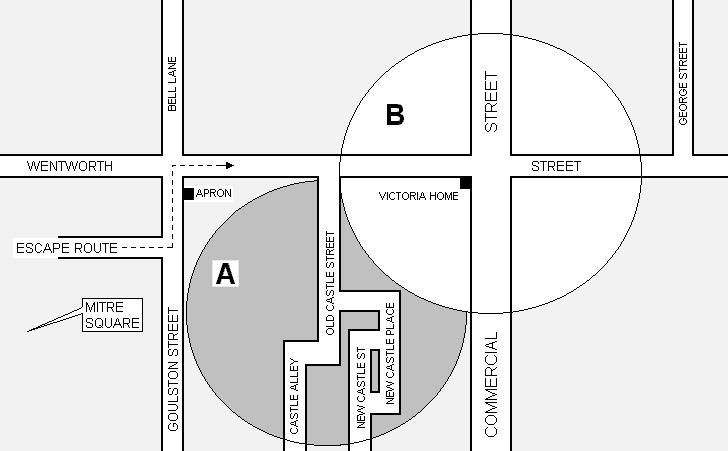
Having previously
addressed the residential question in Chapter Six, it must be considered doubtful
that the Ripper lived anywhere other than a low lodging house. This being the
case, it was surely a venue with which he enjoyed an intimate association, somewhere
so familiar that he could come and go with a reasonable degree of confidence.
The connotation here is that such confidence could only have developed over
a relatively protracted period of time, introducing the probability that he
remained at one particular lodging house rather than drift from premises to
premises. This, in turn, implies that the object of his retreat from Mitre Square
was the hideaway used after all of
the murders.
Of special
significance in this context is the reality that, according to the 1881 and
1891 census returns, there were no lodging houses situated in either Old Castle
Street or Castle Alley, nor in the adjacent New Castle Street or New Castle
Place. Since these four thoroughfares represent the only possible destinations
in the westerly of our two circles, it follows that the circle itself becomes
redundant.
Based upon
these conclusions, then, it would appear highly likely that the killer escaped
to a lodging house directly after butchering Kate Eddowes, and that this destination
was probably the bolt-hole he used throughout the series. Furthermore, its location
almost certainly fell within a fifty yard radius of the Commercial/Wentworth
streets intersection.
The Victoria
Home, as if one needed reminding, could not have lain closer to the centre of
this target area. Situated on the south-west corner of the Commercial/Wentworth
streets intersection, and providing bed-space for almost five hundred patrons,
it was the sole low lodging house on Commercial Street. And while the 1891 census
returns record Wentworth Street as incorporating three such establishments,
these were located in a cluster close to Brick Lane, more than a hundred yards
east of the circle’s origin. So the Victoria Home – “the place,”
according to Hutchinson, “where I usually sleep” – must now
be considered the property most likely to have served as the Ripper’s
lair during the course of these murders.
Earlier
in this chapter we set out to explore what might initially have seemed an absurd
proposition – that the most notorious killer in the annals of crime was
Spitalfields nondescript George Hutchinson. Yet the deeper one delves, the less
unlikely this proposition becomes. Here was a man who claimed to have known
Mary Kelly very well, a man who sometimes gave her a few shillings and occasionally
spent time in her company. How strange, then, that for three days he withheld
vital information regarding her death. While his fellow East Enders took to
the streets, venting their anger on Dr William Holt and anyone else they suspected
of being the murderer, Hutchinson sat back and did nothing.
When finally
he did come forward, it was certainly not through a sense of compassion. Nor
was his motive rooted in moral obligation or even a desire to get his hands
on the reward money. Hutchinson presented himself at Commercial Street Police
Station for one reason and one reason only. He knew that he had been seen behaving suspiciously
in close proximity to Mary Jane’s room. Such is the weight of evidence
supporting this contention that any other possibility may be effectively excluded.
Under police
interview Hutchinson dictated a statement that Abberline believed to be true.
Quite how the Inspector arrived at this conclusion is difficult to understand.
But the fact remains that, irrespective of Abberline’s conviction or the
acquiescence of theorists ever since, Hutchinson’s official version of
events simply does not bear scrutiny. Apart from anything else, several crucial
areas were invalidated within hours when he detailed a largely contradictory
story to reporters. Given these discrepancies, one or the other version must
have been unreliable. Once evaluated in context of all the known factors, however,
it becomes apparent that neither account
could have been accurate. In order to believe otherwise, one must accept that
Hutchinson, after trudging from Romford to Spitalfields in the early hours of
a cold and inclement morning, deliberately bypassed his lodgings, resisting
the lure of his bed for the pleasure of roaming the northern end of Commercial
Street; that by some physiological miracle Mary Kelly succeeded in drinking
herself sober between her midnight encounter with Mary
Ann Cox and meeting Hutchinson two hours later; that Hutchinson followed Kelly
and companion to Dorset Street and then mounted an hour-long vigil on Miller’s
Court for no reason other than idle curiosity; and that, after aborting this
vigil (making for Kelly’s room and the Victoria Home simultaneously),
he was forced to spend what remained of the night wandering aimlessly about
the locality, despite the availability of over two hundred lodging houses within
convenient walking distance.
One could
continue to enumerate these inconsistencies but the exercise would become repetative.
As such, it is sufficient to say that Hutchinson’s narrative was almost
entirely spurious. There was no meeting with Kelly and no client, Jewish or
otherwise. Each was an invention, a necessary component in a story that sought
to provide an innocent explanation for his presence on Dorset Street. Naturally,
this beggars the question: why, if Hutchinson had nothing to hide, did he resort
to duplicity to vindicate his interest in Miller’s Court?
The analytical
profile constructed in Chapter Six provides further food for thought. Again,
it must be stressed that this is an evaluation developed on empirical methodology
and restricted solely to the murderer’s characteristics. Once compared
with the facts relating to George Hutchinson, however, the level of congruity
is such that one could be forgiven for thinking that it was educed with Hutchinson
in mind. Besides this, there is the prospective Hutchinson link with Mary Kelly’s
missing key, as well as the certainty that he resided in the only common lodging
house circumscribed by our Commercial/Wentworth Streets target area. It may,
of course, be argued that many men could have conformed to these criteria. Yet, of all those
who might have met most of our profile specifications, whose relationship with
Kelly was sufficiently intimate that it facilitated the theft of her room key,
who in addition lodged at the heart of our residential target zone, only one was seen loitering close to Miller’s
Court at a time critical to Kelly’s death.
Viewed from
one perspective, the traditional perspective, Hutchinson conveys the impression
of honest reliability, a man eager to help police bring to justice the individual
who butchered his friend. When approached from another perspective, however,
an altogether different picture emerges. Now can be discerned a man who for
three days treated his friend’s demise with utter indifference; a man
who lied repeatedly to Inspector Abberline; a man who, within twenty-four hours
of making his police statement, detailed a largely conflicting version of events
to the press; a man who would almost certainly have never come forward at all
but for the revelations of Sarah Lewis.
Some facts
are so blindingly obvious that one can only look on in bewilderment when they
are disregarded. Yet one self-evident reality does seem to have eluded many
theorists. Jack the Ripper, whatever his identity, must have been at or near
the crime scenes at the times relevant to his killings. He did not materialize
out of nowhere, commit a murder, then evaporate into thin air. He walked to
the crime scene venue and away again having fulfilled his agenda. Nowadays all
competent murder investigations are at pains to determine who entered the crime
scene demesne within a prescribed timeframe. Virtually everyone is regarded
as a suspect until evidence indicates otherwise. Once eliminated, the subject
is coaxed into relating his or her account in the finest detail, irrespective
of the apparent insignificance of those details. Employing an identical procedure
during the Yorkshire Ripper inquiry, police located a man who had been walking
his dog at about the time of Josephine Whitaker’s murder. He had observed
a man and woman strolling together close to the crime scene. Such were his recollections
of the young female that investigators became convinced he had sighted Josephine.
In detailing her companion, this witness provided an accurate description of
Peter Sutcliffe.
Similarly,
Sarah Lewis observed a man in close proximity to a crime scene at a time crucial
to a killing. The man she sighted was George Hutchinson. But the significance
of Sarah’s testimony went unrecognized as the Kelly investigation degenerated
into farce. Absent bloodhounds, an illusory Commissioner and a suspiciously
truncated inquest hearing, each symptomatic of a slipshod inquiry concerned
less with catching a multiple murderer than presenting a favourable public image.
Even when an immense stroke of good fortune delivered Hutchinson into police
hands they bungled it. His inherently absurd story involving the Jewish-looking
dandy was accepted unreservedly. So too was his nonexplanation for the three-day
period of inertia. Yet by far the most serious investigative blunder was the
failure to act upon Hutchinson’s press disclosures. Not only did these
compromise his official police statement, they also contained the admission
regarding his three o’clock presence directly outside Mary Jane’s
room. Given the nature of Hutchinson’s narrative, moreover, the fact that
Joseph Lawende was never summoned to look him over was an omission of breathtaking
incompetence.
All things
considered, some might now subscribe to the view that the Whitechapel Murderer
escaped justice in consequence rather than in spite of police efforts.
Chapter Nine
PERSON
OR PERSONS UNKNOWN?
 In
many respects the search for Jack the Ripper is only just beginning. Finally,
after more than a century of chasing shadows, the way is open for future researchers
to determine whether this most infamous and elusive of killers really was local
nonentity George Hutchinson. But it won’t be easy. Several years invested
in the checking of parish and newspaper archives has yielded little information.
Still there is no explicit reference point, no place or date of birth from which
the fragments of Hutchinson’s existence might be pieced together. In the
absence of such data we are left with only conjecture. Authorities on the case
have variously suggested that he was a former groom or nightwatchman, though
at present there is no evidence to substantiate either proposition. A newspaper
description of him as ‘a man of military bearing’ introduces the
prospect of him having been a former soldier. And since Romford incorporated
an army barracks at the time of the murders, here exists another potential connection
between Hutchinson and the town. All the same, it is a connection that, for
the time being, remains entirely speculative.
In
many respects the search for Jack the Ripper is only just beginning. Finally,
after more than a century of chasing shadows, the way is open for future researchers
to determine whether this most infamous and elusive of killers really was local
nonentity George Hutchinson. But it won’t be easy. Several years invested
in the checking of parish and newspaper archives has yielded little information.
Still there is no explicit reference point, no place or date of birth from which
the fragments of Hutchinson’s existence might be pieced together. In the
absence of such data we are left with only conjecture. Authorities on the case
have variously suggested that he was a former groom or nightwatchman, though
at present there is no evidence to substantiate either proposition. A newspaper
description of him as ‘a man of military bearing’ introduces the
prospect of him having been a former soldier. And since Romford incorporated
an army barracks at the time of the murders, here exists another potential connection
between Hutchinson and the town. All the same, it is a connection that, for
the time being, remains entirely speculative.
Demonstrably,
there is a great deal of work to be done if the truth about Hutchinson and the
full extent of his involvement in the Ripper affair is ever to be established.
Future research may even uncover evidence indicating his innocence. Yet the
exclusion of Hutchinson’s name from the already expansive list of Ripper
suspects would be a welcome development if, as a consequence, the overall picture
were to be accorded greater clarity. For if it has achieved nothing else, the
present volume has at least illustrated the extent to which many aspects of
the Ripper case have been consistently misinterpreted, emphasizing the absolute
necessity of checking, double-checking and cross-checking even those ‘facts’
that are apparently written in stone.
Doubtless
there are those who will dismiss Hutchinson as a plausible suspect should research
demonstrate his failure to conform to the incapacitation, incarceration or death
scenario touched upon earlier. Serialists do not, the theory goes, give up killing
of their own volition. But whilst superficially cogent, this is a maxim that
need not necessarily hold true in a small minority of cases. Certainly there
have been instances when a series has ended for no apparent reason. It is assumed
that most of these perpetrators have committed suicide, the majority
to evade imminent capture. Because of the addictive element involved, runs the
prevailing school of thought, the offender is compelled to continue killing,
unable to give up even if he wants to. Yet the flaw in this line of logic is
that it is based on the experiences of those offenders who have been identified.
Nothing, or next to nothing, is known about those who have not.
Of special
interest in this context, particularly given the clear parallels between aberrant
and nonaberrant behaviour, are the similarities between serial murder and heroin
dependence. Being highly addictive activities, both are prone to the influence
of diminishing returns. In the fullness of time, moreover, each tends to be
self-destructive. Yet heroin addicts can and do break the habit. Against all
odds, a small minority go on to lead happy, productive, drug-free lives. Consequently,
it seems reasonable to suppose that a small proportion of serialists, too, are
able to break free of the addictive cycle. But since these individuals are never
identified, they remain an unknown quantity, a subdivision whose details elude
the statistical database. Hence the incapacitation, incarceration or death scenario,
whilst invaluable as a general principle, is not perhaps as all-encompassing
as is presently believed. As such, it is not beyond the bounds of possibility
that certain offenders are jolted free of the murder cycle by virtue of some
extreme personal trauma – a near-capture experience, for example.
Given the
passage of time, a number of Ripper luminaries are convinced that this is a
case destined to remain unsolved. Even if the killer were to come under the
investigative spotlight, their argument runs, it would prove impossible to establish
his guilt beyond any reasonable doubt. But this is a pessimistic, unimaginative
viewpoint that fails to consider an alternative strategy. For even now, more
than a century after his crimes stunned the world, there remains the potentiality
to unmask the Whitechapel Murderer by first identifying the ‘From hell’
author. Everything about the Lusk communication insinuates authenticity, from
its unique shunning of the hoaxer’s Ripper epithet through to the forensic
implications of the concomitant kidney portion. At the moment, however, the
only known examples of Hutchinson’s handwriting are the three signatures
appended to his police statement. This underlines the importance of placing
his antecedents on a firm historical footing, since only then can there be any
hope of uncovering the kind of handwriting sample that would allow for a definitive
graphological comparison with the From hell letter. Even so, on the basis of
current evidence, we may conclude on a note of some optimism.
Jack the
Ripper ... person or persons unknown?
Perhaps
not.
